Featuring market attractiveness scoring, total addressable market sizing, company benchmarking matrices, interactive Excel dashboards, deeper supply chain intelligence, emerging startup tracking, and granular product-level insights, The Business Research Company’s 2026 market reports are built to deliver research that is both more actionable and more strategically valuable.
Hybrid Robots Market Expansion Outlook: What Revenue Opportunities Are Ahead?
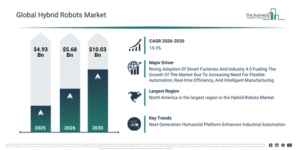
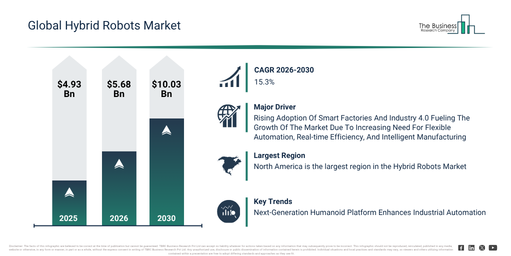
The hybrid robots market has experienced rapid expansion in recent years. It is projected to increase from $4.93 billion in 2025 to $5.68 billion in 2026, exhibiting a compound annual growth rate (CAGR) of 15.1%. Historically, this growth can be attributed to the early adoption of industrial automation, the rising demand for operational efficiency, the development of basic robotic systems, the growing utilization of manufacturing robotics, and increasing investments in defense automation.
The hybrid robots market is projected to experience substantial expansion over the upcoming years. This market is anticipated to reach $10.03 billion by 2030, exhibiting a compound annual growth rate (CAGR) of 15.3%. This expansion during the projected timeframe is linked to factors such as the proliferation of AI-powered robotics intelligence, increasing call for autonomous field tasks, greater uptake of human-robot cooperative setups, development within smart manufacturing frameworks, and a heightened requirement for operations in distant and dangerous environments. Significant developments expected during this forecast period encompass multi-modal autonomous control technologies, improved human-robot interaction in changing settings, real-time robotic decisions driven by edge AI, the incorporation of sensor fusion alongside advanced perception systems, and customizable mission-specific hybrid robot designs.
Get A Free Sample Report With In-Depth Market Insights:
Hybrid Robots Market Growth Catalysts And Demand Drivers
The expanding implementation of smart factories and Industry 4.0 is anticipated to fuel the expansion of the hybrid robots market in the future. These concepts, smart factories and Industry 4.0, describe manufacturing environments that are digitally integrated, utilizing cyber-physical systems, artificial intelligence, Internet of Things (IoT), cloud computing, and automation technologies to establish production systems that are self-optimizing, data-driven, and highly interconnected. The growing adoption within smart factories and Industry 4.0 is intensifying, propelled by the swift rollout of government-supported digital manufacturing initiatives and industrial automation programs. These programs aim to boost productivity, minimize operational downtime, and improve supply chain responsiveness through the integration of real-time data. Within smart factories and Industry 4.0 settings, hybrid robots are deployed to merge the speed, precision, and power of automation with flexible mobility and intelligent teamwork, thereby facilitating efficient production, material handling, inspection, and adaptable manufacturing processes. For example, in September 2024, the International Federation of Robotics, a Germany-based robotics industry association, reported that global industrial robot installations hit 541,302 units in 2023, and the worldwide operational stock of industrial robots surpassed 4,281,585 units, representing an approximate 10 percent rise from the prior year. Consequently, the increasing embrace of smart factories and Industry 4.0 is propelling the growth of the hybrid robots market moving forward.
Hybrid Robots Market Segment Analysis Spotlighting Growth Areas
The hybrid robots market covered in this report is segmented –
1) By Component: Hardware, Software, Services
2) By Robot Type: Articulated Hybrid Robots, Mobile Hybrid Robots, Collaborative Hybrid Robots Cobots, Mobile Manipulator Hybrid Robots
3) By Operational Mode: Autonomous Control, Remote Operation, Human Assisted Intelligence
4) By Application: Industrial Automation, Logistics And Warehousing, Healthcare And Medical Assistance, Defense And Security, Inspection And Maintenance, Agriculture And Field Operations
5) By End User: Manufacturing, Healthcare, Defense And Military, Logistics And Transportation, Agriculture, Energy And Utilities
Subsegments:
1) By Hardware: Sensors And Actuators, Control Units, Power Supply Systems, Drive Systems, End Effectors, Human Machine Interfaces, Communication Devices, Safety Systems, Robotic Arms, Mobility Platforms
2) By Software: Robot Operating Systems, Simulation And Modeling Software, Artificial Intelligence And Machine Learning Software, Vision And Image Processing Software, Navigation And Mapping Software, Data Analytics And Monitoring Software, Programming And Development Software, Fleet Management Software, Predictive Maintenance Software, Cybersecurity Software
3) By Services: Consulting Services, System Integration Services, Installation And Deployment Services, Maintenance And Support Services, Training And Education Services, Software Upgrade Services, Remote Monitoring Services, Customization Services, Technical Support Services, Managed Services
Hybrid Robots Market Trends Shaping Long-Term Demand
Leading companies within the hybrid robots market are concentrating on innovations in humanoid robotic platforms, particularly fully electric humanoid robots, to improve mobility, dexterity, and autonomous task execution within industrial, logistics, and smart manufacturing environments. Fully electric humanoid robots are defined as sophisticated robotic systems powered entirely by electric actuators and batteries, designed to mimic human-like movement while integrating artificial intelligence, sensing, and manipulation capabilities for diverse operations. For instance, in January 2026, Boston Dynamics, Inc., a US-based robotics company, showcased the product iteration of its new Atlas robot at the Consumer Electronics Show in Las Vegas. This advanced humanoid robot boasts fully electric actuation, dynamic bipedal mobility, cutting-edge perception systems, and autonomous movement abilities, facilitating its efficient deployment across industrial automation, warehouse operations, and future collaborative robotic applications.
Hybrid Robots Market Top Companies Driving Competitive Growth
Major companies operating in the hybrid robots market are Tesla Inc.; Geekplus Technology Co. Ltd.; Exotec SAS; UBTECH Robotics Corp Ltd; Figure AI Inc.; Locus Robotics Corporation; NEURA Robotics GmbH; Hangzhou Unitree Robotics Co. Ltd.; Agility Robotics Inc.; PAL Robotics S.L.; Bright Machines Inc.; Sanctuary Cognitive Systems Corporation; ANYbotics AG; 1X Technologies AS; Apptronik Inc.; LimX Dynamics Technology Co. Ltd.; Robotiq Inc.; Roboteam Ltd.; Revolute Robotics Inc.; Elistair SAS; Ghost Robotics Corporation; Vertiq Inc.
View The Full Hybrid Robots Market Report:
Hybrid Robots Market Global Footprint: Which Region Leads The Industry?
North America was the largest region in the hybrid robots market in 2025. Asia-Pacific is expected to be the fastest-growing region in the forecast period. The regions covered in the hybrid robots market report are Asia-Pacific, South East Asia, Western Europe, Eastern Europe, North America, South America, Middle East, Africa.
Reach Out To Our Team:
The Business Research Company: https://www.thebusinessresearchcompany.com/
Americas: +1 310-496-7795
Asia: +44 7882 955267 & +91 8897263534
Europe: +44 7882 955267
Email us at: marketing@tbrc.info
Follow us on:
LinkedIn: https://in.linkedin.com/company/the-business-research-company
YouTube: https://www.youtube.com/channel/UC24_fI0rV8cR5DxlCpgmyFQ
Global Market Model: https://www.thebusinessresearchcompany.com/global-market-model

Wasay has over a decade of experience in market research, data modelling, and analytics, with prior experience at GlobalData and Decision Tree Consulting Services. At The Business Research Company , he leads research operations across syndicated studies, customized consulting engagements, and the Global Market Model platform. His professional experience includes supporting organizations such as Boston Consulting Group, KPMG, and Ernst & Young. Wasay holds a degree in Electronics and Communications Engineering, postgraduate management qualifications from International Management Institute Belgium and Indian School of Business and Entrepreneurship, and completed the Integrated Program in Business Analytics from Indian Institute of Management Indore.