Built to provide research that’s more actionable and strategically valuable, The Business Research Company’s 2026 market reports include market attractiveness analysis, total addressable market sizing, company benchmarking matrices, interactive Excel dashboards, broader supply chain intelligence, emerging startup tracking, and in-depth product insights.
Laser Cladding Market Forecast: Value Set To Climb From $0.87 Billion To $1.31 Billion
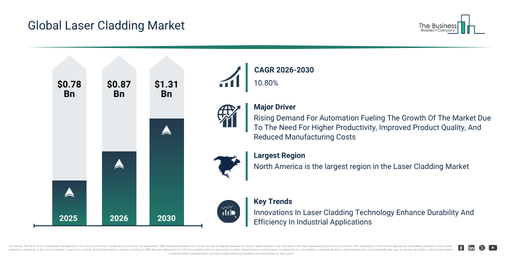
The laser cladding market has seen substantial growth in recent years. It is anticipated to expand from $0.78 billion in 2025 to $0.87 billion by 2026, achieving a compound annual growth rate (CAGR) of 10.6%. This historical expansion can be attributed to several key factors, including the increasing demand for surface hardening applications in industrial machinery, the escalating need for repair and refurbishment of high-value components, the development within the aerospace and automotive manufacturing sectors, the broadening requirements for maintaining oil and gas equipment, and the growing adoption of advanced welding and coating technologies.
The laser cladding market size is anticipated to undergo significant expansion over the coming years. It is projected to achieve a valuation of $1.31 billion by 2030, demonstrating a compound annual growth rate (CAGR) of 10.8%. This projected increase can be attributed to several factors including the escalating demand for lightweight yet robust industrial parts, the growing integration of automation in manufacturing workflows, the rising necessity for refurbishment of renewable energy equipment, the broadening scope of precision engineering uses, and the increased implementation of sustainable and low-waste surface engineering solutions. Noteworthy trends expected during this forecast period involve AI-enhanced laser parameter control for precise coating, the implementation of robotic laser cladding systems for automated surface mending, an uptick in the utilization of digital twin-based process simulation for cladding, the diversification of eco-efficient material deposition methods, and the growing need for laser repair systems that enable predictive maintenance.
Get A Free Sample Report With In-Depth Market Insights:
Laser Cladding Market Growth Drivers: What’s Behind The Acceleration?
The burgeoning need for automation is projected to fuel the expansion of the laser cladding market in the coming period. Automation signifies the deployment of control systems and software to run industrial processes without significant human involvement, replacing manual efforts with automated systems to enhance production speed and efficiency. The growth of automation is attributed to the public’s desire for greater productivity, superior product quality, and reduced production costs. Laser cladding supports automation by allowing for the precise and repeatable deposition of materials onto various surfaces, which in turn improves manufacturing efficiency and lessens manual labor requirements. For instance, in September 2023, according to the World Robotics report published by the International Federation of Robotics, a Germany-based professional non-profit organization, there were 553,052 industrial robot installations in factories worldwide, demonstrating a 5% year-on-year growth rate in 2022. Therefore, the increasing demand for automation is a key driver for the growth of the laser cladding market.
Laser Cladding Market Segment Trends And Revenue Contributors
The laser cladding market covered in this report is segmented –
1) By Technology: Laser Beam Cladding, Powder Cladding, Wire Cladding, Hybrid Cladding
2) By Laser Type: Diode Lasers, Fiber Lasers, Yttrium Aluminum Garnet Laser
3) By Material: Iron Based Alloys, Nickel Based Alloys, Cobalt Based Alloys, Carbides And Carbide Blends, Other Materials
4) By Application: Wear Or Corrosion Resistance, Hardfacing, Surface Restoration, Additive Manufacturing
5) By End-Use: Aerospace, Automotive, Energy, Oil And Gas, Mining, Manufacturing
Subsegments:
1) By Laser Beam Cladding: Continuous Laser Beam Cladding, Pulsed Laser Beam Cladding, Fiber Laser Beam Cladding, Diode Laser Beam Cladding
2) By Powder Cladding: Direct Metal Deposition Powder Cladding, Laser Engineered Net Shaping Powder Cladding, Plasma Transferred Arc Powder Cladding, Blown Powder Laser Cladding
3) By Wire Cladding: Direct Laser Deposition Wire Cladding, Arc Assisted Wire Cladding, Cold Wire Laser Cladding, Wire Feed Laser Cladding
4) By Hybrid Cladding: Laser Arc Hybrid Cladding, Laser Induction Hybrid Cladding, Laser Plasma Hybrid Cladding, Combined Powder Wire Hybrid Cladding
Laser Cladding Market Trends: What’s Defining The Industry’s Next Phase?
Leading enterprises and research institutions within the laser cladding market are prioritizing collaborative innovation to create sophisticated coating systems, particularly for metal matrix composite (MMC) applications. This focus aims to elevate wear resistance, durability, and overall performance in challenging industrial environments. Such collaborative developments refer to initiatives or breakthroughs achieved through the joint efforts of multiple organizations or stakeholders pursuing shared objectives. For example, in December 2024, a new project was unveiled by the Australian Composites Manufacturing Cooperative Research Centre, an Australia-based research institute, in partnership with LaserBond, an Australia-based engineering services company, and the University of Sydney, an Australia-based public university. This endeavor is dedicated to developing a high-efficiency, fully automated laser cladding system capable of producing multifunctional metal matrix composite (MMC) coatings. The project intends to optimize crucial process parameters like laser power and scanning speed, thereby improving coating microstructure, hardness, and its resistance to wear and corrosion. Tailored for industries including marine, mining, and defense, this system promises to enable cost-effective repair and fabrication of components, decrease reliance on imported parts, and foster sustainable, environmentally friendly manufacturing by eliminating detrimental chemicals and reducing waste generation.
Laser Cladding Market Competitive Landscape: Who Leads The Industry?
Major companies operating in the laser cladding market are IPG Photonics Corporation, Swanson Industries Inc., Setco Services LLC, Wall Colmonoy Corporation, Preco LLC, Apollo Machine and Welding Ltd., Sentes-BIR Inc., APEX Engineering Technology Group LLC, Metalock Engineering Group Services Ltd., IBC Coatings Technologies Ltd., Hayden Corporation, Whitfield Welding Inc., Laser Automation Pvt. Ltd., Alabama Laser LLC, American Cladding Technologies LLC, Synergy Additive Manufacturing LLC, KV Enterprises Inc., TopClad B. V., Hardchrome Engineering Pty Ltd, PMMT LLC
View The Full Laser Cladding Market Report:
Laser Cladding Market Geographic Landscape: Which Region Leads Industry Growth?
North America was the largest region in the laser cladding market in 2025. Asia-Pacific is expected to be the fastest-growing region in the forecast period. The regions covered in the laser cladding market report are Asia-Pacific, South East Asia, Western Europe, Eastern Europe, North America, South America, Middle East and Africa.
Reach Out To Our Team:
The Business Research Company: https://www.thebusinessresearchcompany.com/
Americas: +1 310-496-7795
Asia: +44 7882 955267 & +91 8897263534
Europe: +44 7882 955267
Email us at: marketing@tbrc.info
Follow us on:
LinkedIn: https://in.linkedin.com/company/the-business-research-company
YouTube: https://www.youtube.com/channel/UC24_fI0rV8cR5DxlCpgmyFQ
Global Market Model: https://www.thebusinessresearchcompany.com/global-market-model

Wasay has over a decade of experience in market research, data modelling, and analytics, with prior experience at GlobalData and Decision Tree Consulting Services. At The Business Research Company , he leads research operations across syndicated studies, customized consulting engagements, and the Global Market Model platform. His professional experience includes supporting organizations such as Boston Consulting Group, KPMG, and Ernst & Young. Wasay holds a degree in Electronics and Communications Engineering, postgraduate management qualifications from International Management Institute Belgium and Indian School of Business and Entrepreneurship, and completed the Integrated Program in Business Analytics from Indian Institute of Management Indore.