Built to provide research that’s more actionable and strategically valuable, The Business Research Company’s 2026 market reports include market attractiveness analysis, total addressable market sizing, company benchmarking matrices, interactive Excel dashboards, broader supply chain intelligence, emerging startup tracking, and in-depth product insights.
Political Risk Insurance Market Value Growth And Long-Term Outlook
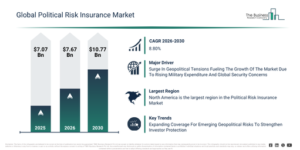
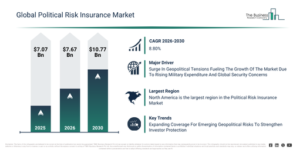
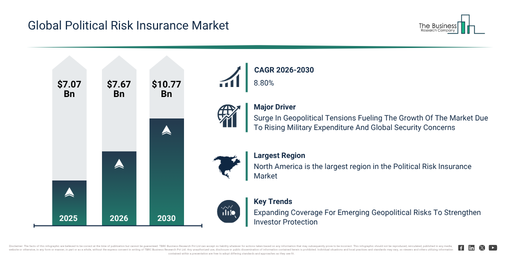
The political risk insurance market has shown substantial growth recently. Its value is expected to rise from $7.07 billion in 2025 to $7.67 billion in 2026, at a compound annual growth rate (CAGR) of 8.6%. This historical expansion can be attributed to factors like a surge in global foreign direct investment flows, heightened geopolitical instability across emerging economies, the broadening of multinational corporate operations, past currency volatility in developing markets, and an increase in cross-border trade liberalization agreements.
Significant expansion is projected for the political risk insurance market in the coming years. It is anticipated to reach $10.77 billion by 2030, driven by a compound annual growth rate (CAGR) of 8.8%. This forecasted growth is primarily fueled by escalating geopolitical division and trade disputes, alongside a rise in international infrastructure spending. Furthermore, a heightened need for emerging market diversification approaches, broader global risk mitigation and insurance reach, and a greater dependence on predictive analytics for assessing political risks are contributing factors. Key developments anticipated during this period encompass a surging requirement for cross-border investment safeguards in developing economies, a greater uptake of tailored political risk coverage for infrastructure ventures, and an increased call for policies protecting against currency transfer restrictions. Additionally, the expansion of insurance provisions for disruptions linked to geopolitical conflicts and a growing reliance on data-powered risk evaluation models for underwriting political risk are significant trends.
Get A Free Sample Report With In-Depth Market Insights:
Political Risk Insurance Market Development Factors: What’s Supporting Demand?
The expansion of the political risk insurance market is projected to be propelled by increasing geopolitical tensions. These tensions involve strained or hostile relationships among nations or regions, often arising from conflicting interests, security concerns, territorial disagreements, or competition in political and economic spheres. The escalation of global power rivalries drives the rise in geopolitical tensions, as competing national interests and security considerations lead to greater military build-up and strategic confrontations between countries. Political risk insurance serves to mitigate the financial and operational impacts of such tensions, offering protection to businesses and investors against losses stemming from political instability, expropriation, war, civil unrest, and disruptions in government policy. For instance, in September 2024, the Stockholm International Peace Research Institute (SIPRI), a Sweden-based international institute, indicated that the global estimate of deaths linked to conflicts rose from approximately 153,100 in 2022 to about 170,700 in 2023. Thus, the escalating geopolitical tensions are a key factor driving the growth of the political risk insurance market.
Political Risk Insurance Market Breakdown By Product Type And Application
The political risk insurance market covered in this report is segmented –
1) By Type: Political Risk, Credit Risk, Investment Risk, Other Types
2) By Coverage Type: Expropriation Insurance, Political Violence Insurance, Currency Inconvertibility And Transfer Restriction Insurance, Contract Frustration Insurance, Sovereign Non-payment Insurance, Confiscation And Nationalization Insurance, Other Coverage Types
3) By Provider Type: Public Providers, Private Insurers
4) By Application: Multinational Corporations, Investors, Exporters, Financial Institutions
5) By Industry Vertical: Energy And Power, Infrastructure And Construction, Manufacturing, Mining, Transportation And Logistics, Other Industry Verticals
Subsegments:
1) By Political Risk: Expropriation Insurance, Political Violence Insurance, Currency Inconvertibility And Transfer Restriction Insurance, Contract Frustration Insurance, Sovereign Default Insurance
2) By Credit Risk: Trade Credit Insurance, Export Credit Insurance, Receivables Non Payment Insurance, Payment Default Protection Insurance, Counterparty Credit Risk Coverage
3) By Investment Risk: Foreign Direct Investment Protection, Equity Investment Protection, Infrastructure Investment Protection, Capital Loss Protection, Cross Border Investment Coverage
4) By Other Types: Hybrid Political Financial Risk Coverage, Emerging Geopolitical Risk Coverage, Trade Disruption Risk Coverage, Regulatory Intervention Risk Coverage, Sanctions And Embargo Risk Coverage
Political Risk Insurance Market Transformation Trends: What Innovations Are Driving Change?
Major companies operating in the political risk insurance market are concentrating on creating sophisticated solutions, including expanded coverage offerings for emerging geopolitical challenges, to strengthen investor safeguarding, lessen vulnerability to sovereign and political unrest, and bolster assurance in international investments. Expanded coverage products represent improved offerings that extend the range of protection by incorporating additional risks, features, or advantages beyond standard provisions. For instance, in July 2024, Kita, a UK-based carbon insurance specialist, introduced a new political risk insurance product specifically designed to provide more extensive coverage for investors exposed to geopolitical and sovereign risks. This solution aims to foster international trade and investment by alleviating losses stemming from adverse political actions, thereby enhancing risk management for businesses operating in unstable environments.
Political Risk Insurance Market Competitive Landscape: Which Companies Lead The Industry?
Major companies operating in the political risk insurance market are Allianz SE, AXA S. A., Zurich Insurance Group Ltd., Liberty Mutual Insurance Company, Chubb Limited, Tokio Marine Holdings Inc., Munich Re Group, American International Group, Sompo Holdings Inc., QBE Insurance Group, Aon plc, Willis Towers Watson Public Limited Company, Markel Corporation, Swiss Re AG, Liberty Specialty Markets Ltd., Howden Group Holdings Ltd., Hiscox Ltd, Atradius N. V., Coface S. A., Marsh McLennan, Beazley plc, Lloyd’s of London
View The Full Political Risk Insurance Market Report:
Political Risk Insurance Market Regional Breakdown: Where Is Demand Concentrated?
North America was the largest region in the political risk insurance market in 2025. Asia-Pacific is expected to be the fastest-growing region in the forecast period. The regions covered in the political risk insurance market report are Asia-Pacific, South East Asia, Western Europe, Eastern Europe, North America, South America, Middle East and Africa.
Reach Out To Our Team:
The Business Research Company: https://www.thebusinessresearchcompany.com/
Americas: +1 310-496-7795
Asia: +44 7882 955267 & +91 8897263534
Europe: +44 7882 955267
Email us at: marketing@tbrc.info
Follow us on:
LinkedIn: https://in.linkedin.com/company/the-business-research-company
YouTube: https://www.youtube.com/channel/UC24_fI0rV8cR5DxlCpgmyFQ
Global Market Model: https://www.thebusinessresearchcompany.com/global-market-model

Wasay has over a decade of experience in market research, data modelling, and analytics, with prior experience at GlobalData and Decision Tree Consulting Services. At The Business Research Company , he leads research operations across syndicated studies, customized consulting engagements, and the Global Market Model platform. His professional experience includes supporting organizations such as Boston Consulting Group, KPMG, and Ernst & Young. Wasay holds a degree in Electronics and Communications Engineering, postgraduate management qualifications from International Management Institute Belgium and Indian School of Business and Entrepreneurship, and completed the Integrated Program in Business Analytics from Indian Institute of Management Indore.