Built to provide research that’s more actionable and strategically valuable, The Business Research Company’s 2026 market reports include market attractiveness analysis, total addressable market sizing, company benchmarking matrices, interactive Excel dashboards, broader supply chain intelligence, emerging startup tracking, and in-depth product insights.
Potable Water Bowser Truck Market Size Outlook: How Quickly Will Revenue Expand Through 2030?
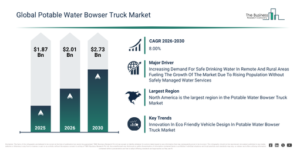
The potable water bowser truck market has observed significant expansion in recent years. This market is forecast to increase from $1.87 billion in 2025 to $2.01 billion in 2026, registering a compound annual growth rate (CAGR) of 7.7%. The growth witnessed in previous periods is attributable to the escalating demand for clean drinking water in remote areas, accelerating urbanization and existing infrastructure gaps, an upsurge in construction and mining activities, the broadening of municipal water distribution systems, and recurring drought and water scarcity occurrences.
The potable water bowser truck market is anticipated to experience substantial expansion over the upcoming years. This market is projected to reach $2.73 billion by 2030, exhibiting a compound annual growth rate (CAGR) of 8.0%. Factors driving this expansion during the forecast period include the increased adoption of smart fleet management systems, greater investment in sustainable water logistics, the development of disaster preparedness infrastructure, the proliferation of electric and hybrid utility vehicles, and governments’ heightened focus on water accessibility initiatives. Key trends anticipated during the forecast period encompass the incorporation of smart water monitoring and telematics into bowser trucks, a rise in the use of electric and low-emission vehicles for water delivery, the emergence of modular and lightweight tank designs, the broadening of automated water dispensing and flow control systems, and increasing requirements for emergency and disaster water supply logistics.
Get A Free Sample Report With In-Depth Market Insights:
Potable Water Bowser Truck Market Demand Drivers Opening New Revenue Streams
The escalating need for secure drinking water in distant and countryside regions is anticipated to propel the growth of the potable water bowser truck market. Secure drinking water in these locales refers to the provision and distribution of pure, drinkable water to populations situated away from urban facilities and centralized water supply systems. The increasing demand for secure drinking water in remote and rural areas is rising due to the scarcity of dependable water supply infrastructure and the growing necessity for uncontaminated and sanitary drinking water sources. Potable water bowser trucks support this increasing demand by conveying and delivering clean drinking water to locations that lack permanent water supply infrastructure. For instance, in August 2025, according to the United Nations Children’s Fund, a US-based child welfare organization, approximately 2.1 billion people globally still lacked access to safely managed drinking water, with rural communities facing the most significant service gaps and slower coverage growth than urban areas. Therefore, the increasing demand for safe drinking water in remote and rural areas is driving the expansion of the potable water bowser truck market.
Potable Water Bowser Truck Market Segment Breakdown: Which Categories Lead On Revenue?
The potable water bowser truck market covered in this report is segmented –
1) By Product Type: Small Capacity, Medium Capacity, Large Capacity
2) By Tank Material: Stainless Steel, Food Grade Aluminum, Polyethylene, Galvanized Steel
3) By Distribution Channel: Direct Sales, Distributors, Online Sales, Other Distribution Channels
4) By Application: Municipal Water Supply, Emergency Relief, Construction Sites, Remote Communities, Industrial Use
5) By End User: Government, Commercial, Residential, Other End Users
Subsegments:
1) By Small Capacity: Light Duty Potable Water Bowser Trucks, Compact Municipal Water Supply Trucks, Rural Water Distribution Trucks, Construction Site Water Supply Trucks, Emergency Drinking Water Delivery Trucks
2) By Medium Capacity: Municipal Service Water Bowser Trucks, Commercial Water Distribution Trucks, Industrial Facility Water Supply Trucks, Urban Drinking Water Delivery Trucks, Infrastructure Project Water Supply Trucks
3) By Large Capacity: Bulk Municipal Water Transport Trucks, Long Distance Drinking Water Supply Trucks, Disaster Relief Water Supply Trucks, Large Infrastructure Project Water Supply Trucks, Regional Bulk Water Distribution Trucks
Potable Water Bowser Truck Market Trends Powering Strategic Industry Growth
Leading companies in the potable water bowser truck sector are concentrating on developing eco-friendly vehicle designs, incorporating features like integrated intelligent water distribution and precision spraying systems to secure a competitive edge. These advancements enhance water usage efficiency, decrease operational waste, and support sustainable municipal and construction activities. Environmentally conscious designs also integrate optimized hydraulic pumping units, efficient tank structures, and programmable spraying mechanisms to minimize unnecessary discharge and energy consumption. Such innovations bolster operational sustainability while maintaining substantial water transport capacity for urban sanitation and emergency water supply uses. For instance, in January 2025, Jiyake Truck, a China-based special purpose vehicle manufacturing company, unveiled the shacman sinotruk howo 20m3 water tank truck. This vehicle features a 20 cubic meter high-capacity water tank, an intelligent in-cabin control system for operating spray functions, and multi-directional adjustable nozzles that facilitate targeted irrigation, dust suppression, and controlled water distribution for municipal and environmental management operations.
Potable Water Bowser Truck Market Leading Companies And Competitive Benchmarking
Major companies operating in the potable water bowser truck market are Mercedes-Benz (Daimler AG), Hyundai Motor Company, FAW Group, Volvo Group, Tata Motors, Isuzu Motors, Scania AB, Mahindra & Mahindra, XCMG Group, Oshkosh Corporation, JAC Motors, Ford Trucks, Chengli Automobile Group, Knapheide Manufacturing Company, Tremcar Inc., Sinotruk (China National Heavy Duty Truck Group), Curry Supply Company, Ledwell & Son Enterprises, Katmerciler, Amthor International, Hubei Hongyu Special Automobile Co. Ltd., Zoomlion Heavy Industry Science & Technology, Hubei Shenghui Special Automobile Co. Ltd.
View The Full Potable Water Bowser Truck Market Report:
Potable Water Bowser Truck Market Top Region By Revenue And Market Share
North America was the largest region in the potable water bowser truck market in 2025. Asia-Pacific is expected to be the fastest-growing region in the forecast period. The regions covered in the potable water bowser truck market report are Asia-Pacific, South East Asia, Western Europe, Eastern Europe, North America, South America, Middle East and Africa.
Reach Out To Our Team:
The Business Research Company: https://www.thebusinessresearchcompany.com/
Americas: +1 310-496-7795
Asia: +44 7882 955267 & +91 8897263534
Europe: +44 7882 955267
Email us at: marketing@tbrc.info
Follow us on:
LinkedIn: https://in.linkedin.com/company/the-business-research-company
YouTube: https://www.youtube.com/channel/UC24_fI0rV8cR5DxlCpgmyFQ
Global Market Model: https://www.thebusinessresearchcompany.com/global-market-model

Wasay has over a decade of experience in market research, data modelling, and analytics, with prior experience at GlobalData and Decision Tree Consulting Services. At The Business Research Company , he leads research operations across syndicated studies, customized consulting engagements, and the Global Market Model platform. His professional experience includes supporting organizations such as Boston Consulting Group, KPMG, and Ernst & Young. Wasay holds a degree in Electronics and Communications Engineering, postgraduate management qualifications from International Management Institute Belgium and Indian School of Business and Entrepreneurship, and completed the Integrated Program in Business Analytics from Indian Institute of Management Indore.