Backed by market attractiveness analysis, total addressable market sizing, company benchmarking matrices, interactive Excel dashboards, wider supply chain intelligence, emerging startup coverage, and detailed product-level insights, The Business Research Company’s 2026 market reports are designed to offer research that is more actionable and strategically valuable than ever.
Radio Frequency Identification (RFID) And Barcode Printer Market Revenue Outlook: What CAGR Lies Ahead Through 2030?
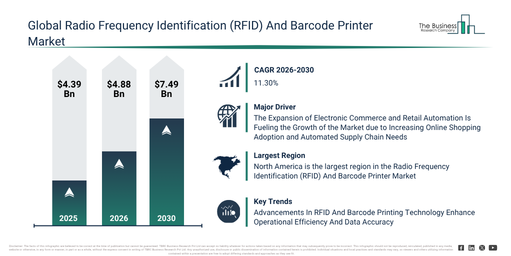
The radio frequency identification (RFID) and barcode printer market size has seen rapid expansion in recent years. This market is set to increase from $4.39 billion in 2025 to $4.88 billion in 2026, achieving a compound annual growth rate (CAGR) of 11.1%. Historically, this growth can be ascribed to the increasing adoption of automated inventory management systems, a heightened demand for precise product identification and tracking, the expanding use of barcode technology in retail and logistics, the growth of e-commerce and warehouse operations, and the rising implementation of RFID technology in supply chain management.
The radio frequency identification (RFID) and barcode printer market is projected to experience substantial expansion over the coming years, anticipated to reach $7.49 billion by 2030, at a compound annual growth rate (CAGR) of 11.3%. This growth during the forecast period is attributable to several factors, including the increasing implementation of smart manufacturing and connected factories, the rising demand for high-speed and high-resolution label printing, the growing adoption of mobile and wireless printing devices, the expansion of healthcare solutions for asset tracking and patient identification, and increased investment in sustainable and recyclable labeling technologies. Additionally, prominent trends for this period involve the rising uptake of cloud-connected RFID and barcode printing systems, enhanced integration of RFID printers with industrial automation and smart factories, greater deployment of wireless and mobile barcode printing solutions, the proliferation of eco-friendly and linerless label printing technologies, and the increased utilization of real-time inventory visibility and asset tracking solutions.
Get A Free Sample Report With In-Depth Market Insights:
Radio Frequency Identification (RFID) And Barcode Printer Market Growth Momentum: What Factors Are Shaping Demand?
The growth of the radio frequency identification (RFID) and barcode printer market going forward is projected to be invigorated by the expanding presence of electronic commerce and retail automation. These terms encompass the utilization of digital platforms, technologies, and automated systems to facilitate online buying and selling, streamline operations in stores and warehouses, and boost efficiency across the entire retail value chain. The increasing adoption of online shopping by consumers, who increasingly favor the convenience, speed, and accessibility of digital retail channels, is fueling this rising expansion of electronic commerce and retail automation. This heightened demand for electronic commerce and retail automation subsequently necessitates RFID and barcode printers to enable effective inventory management, precise product tracking, and seamless order fulfillment within increasingly digital and automated supply chains. For example, according to the U. S. Census Bureau, a U. S. -based government agency, in February 2024, total e-commerce sales in 2023 were estimated at $1,118.7 billion, showing a 7.6% increase compared to 2022. Thus, the expansion of electronic commerce and retail automation is a significant driver for the growth of the radio frequency identification (RFID) and barcode printer market.
Radio Frequency Identification (RFID) And Barcode Printer Market Breakdown By Product Type And Application
The radio frequency identification (rfid) and barcode printer market covered in this report is segmented –
1) By Type: Barcode, Radio Frequency Identification (RFID) Printers
2) By Printing Technology: Thermal Transfer, Direct Thermal, Inkjet
3) By Printing Resolution: Below 300 Dots Per Inch (Dpi), Between 301 And 600 Dots Per Inch (Dpi), Above 601 Dots Per Inch (Dpi)
4) By Connectivity Type: Ethernet, Bluetooth, Serial And Parallel, Universal Serial Bus
5) By Application: Manufacturing, Retail, Transportation And Logistics, Healthcare, Government, Entertainment, Other Applications
Subsegments:
1) By Barcode: Desktop Barcode Printers, Industrial Barcode Printers, Mobile Barcode Printers, Card Barcode Printers, Label Barcode Printers
2) By Radio Frequency Identification Printers: Desktop Radio Frequency Identification Printers, Industrial Radio Frequency Identification Printers, Mobile Radio Frequency Identification Printers, Card Radio Frequency Identification Printers, On-Demand Radio Frequency Identification Printers
Radio Frequency Identification (RFID) And Barcode Printer Market Trends Redefining Industry Growth
Leading companies in the radio frequency identification (RFID) and barcode printer market are prioritizing the development of advanced printing solutions that boast enhanced speed, precision, and connectivity to boost tracking efficiency and streamline supply chain operations. These innovations in printing solutions, featuring improved speed, precision, and connectivity, are intended to support high-performance labeling, real-time data capture, and seamless integration across diverse industrial applications. For example, in November 2023, Chainway, a China-based manufacturer and supplier of Internet of Things (IoT) products and solutions, unveiled the CP30 RFID Printer. This high-speed and high-precision device is specifically designed for printing and encoding RFID tags and barcodes. The printer accommodates ultra-small 10 mm wide tags, offers various connectivity options including USB, Ethernet, Bluetooth, and wireless, and features an offline operating mode with a touchscreen interface, making it ideal for logistics, warehousing, and inventory management applications.
Radio Frequency Identification (RFID) And Barcode Printer Market Key Participants And Competitive Landscape
Major companies operating in the radio frequency identification (rfid) and barcode printer market are TE Connectivity Ltd., Avery Dennison Corporation, Omron Corporation, Brother International Corporation, Zebra Technologies Corporation, Toshiba Tec Corporation, Brady Corporation, SATO Holdings Corporation, Balluff Inc., Impinj Inc., TSC Auto ID Technology Co. Ltd., General Data Company Inc., Primera Technology Inc., Citizen Systems Japan Co. Ltd., CAB Produkttechnik GmbH & Co. KG, GoDEX International Co. Ltd., FEIG ELECTRONIC GmbH, Postek Electronics Co. Ltd., Dascom Holdings Ltd., Xiamen Hanin Electronic Technology Co. Ltd., CYBRA Corporation, Chainway India Pvt. Ltd.
View The Full Radio Frequency Identification (RFID) And Barcode Printer Market Report:
Radio Frequency Identification (RFID) And Barcode Printer Market Geographic Analysis: Where Is Demand Rising Fastest?
North America was the largest region in the radio frequency identification (RFID) and barcode printer market in 2025. Asia-Pacific is expected to be the fastest-growing region in the forecast period. The regions covered in the radio frequency identification (RFID) and barcode printer market report are Asia-Pacific, South East Asia, Western Europe, Eastern Europe, North America, South America, Middle East and Africa.
Reach Out To Our Team:
The Business Research Company: https://www.thebusinessresearchcompany.com/
Americas: +1 310-496-7795
Asia: +44 7882 955267 & +91 8897263534
Europe: +44 7882 955267
Email us at: marketing@tbrc.info
Follow us on:
LinkedIn: https://in.linkedin.com/company/the-business-research-company
YouTube: https://www.youtube.com/channel/UC24_fI0rV8cR5DxlCpgmyFQ
Global Market Model: https://www.thebusinessresearchcompany.com/global-market-model

Wasay has over a decade of experience in market research, data modelling, and analytics, with prior experience at GlobalData and Decision Tree Consulting Services. At The Business Research Company , he leads research operations across syndicated studies, customized consulting engagements, and the Global Market Model platform. His professional experience includes supporting organizations such as Boston Consulting Group, KPMG, and Ernst & Young. Wasay holds a degree in Electronics and Communications Engineering, postgraduate management qualifications from International Management Institute Belgium and Indian School of Business and Entrepreneurship, and completed the Integrated Program in Business Analytics from Indian Institute of Management Indore.