Built to provide research that’s more actionable and strategically valuable, The Business Research Company’s 2026 market reports include market attractiveness analysis, total addressable market sizing, company benchmarking matrices, interactive Excel dashboards, broader supply chain intelligence, emerging startup tracking, and in-depth product insights.
Refrigeration Coolers Market Forecast: Value Set To Climb From $4.83 Billion To $7.93 Billion
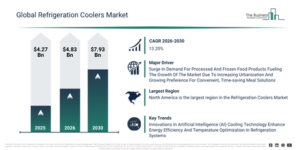
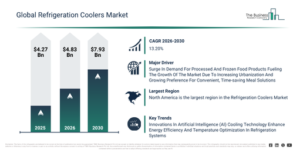
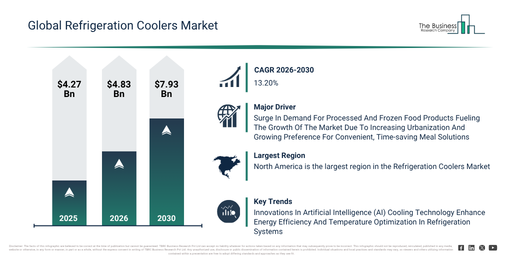
The refrigeration coolers market size has experienced significant expansion recently. It is projected to increase from $4. 27 billion in 2025 to $4. 83 billion in 2026, achieving a compound annual growth rate (CAGR) of 13.0%. The historical growth of this market can be linked to factors such as the increasing demand for cold-chain logistics infrastructure, the expansion of food and beverage processing industries, the rising deployment of refrigeration systems in supermarkets and hypermarkets, the growing needs for pharmaceutical cold-storage, and ongoing advancements in compressor and condenser technologies.
The refrigeration coolers market is projected to experience substantial expansion over the coming years. This market is anticipated to reach $7. 93 billion by 2030, exhibiting a compound annual growth rate (CAGR) of 13. 2%. This anticipated growth stems from several factors, including the rising uptake of smart refrigeration monitoring systems, heightened investments in sustainable refrigerant technologies, a growing need for energy-efficient industrial cooling systems, the broadening of data centre cooling applications, and the greater integration of automated temperature control solutions. Key trends emerging during this forecast period involve the increased use of natural and low-global-warming-potential refrigerants within refrigeration coolers, a surging demand for efficient cooling systems in cold-storage and food processing facilities, the expanding deployment of modular and compact refrigeration coolers for limited-space scenarios, the wider implementation of transcritical CO2 refrigeration systems across commercial and industrial areas, and a heightened emphasis on high-performance cooling systems for storing temperature-sensitive products.
Get A Free Sample Report With In-Depth Market Insights:
Refrigeration Coolers Market Development Factors: What’s Supporting Demand?
The increasing need for processed and frozen food items is anticipated to fuel the expansion of the refrigeration coolers market in the future. These food products are defined as items that have been altered, packed, or preserved to enhance their longevity and ease of use. This growing demand for processed and frozen foods stems from increasing urbanization and hectic modern lifestyles, prompting consumers to seek convenient, quick meal solutions. Refrigeration coolers are vital in preserving the quality and safety of these foods by ensuring stable low-temperature conditions for storage and transit, thereby extending their shelf life and accommodating consumer demand. For example, in October 2023, the Food Industry Association reported that US retail frozen food sales increased from USD 72.2 billion in 2022 to USD 74.2 billion in 2023. Consequently, the escalating demand for processed and frozen food products is a key factor boosting the refrigeration coolers market.
Refrigeration Coolers Market Segment Outlook: Which Categories Are Growing Fastest?
The refrigeration coolers market covered in this report is segmented –
1) By Product Type: Evaporators And Air Coolers, Condensers, Compressors, Magnetic Cooling Modules, Controls And Accessories, Other Product Types
2) By Refrigerant: Ammonia (NH3), Carbon Dioxide (CO2), HFC And HFO Blends, Hydrocarbons (R-290, R-600a), Other Refrigerants
3) By System Type: Self-contained (Plug-in), Remote Condensing Units, Centralized Rack Systems, Hybrid Or Transcritical CO2 Systems, Other System Types
4) By Distribution: Direct Sales, Distributors And Wholesalers, Retail Sales, Online Sales
5) By End-User: Food And Beverage Processing, Cold-storage And Logistics, Supermarkets And Hypermarkets, Pharmaceuticals And Life-sciences, Data Centers And Electronics Cooling, Other End-user Applications
Subsegments:
1) By Evaporators And Air Coolers: Plate Evaporators, Finned Tube Evaporators, Unit Coolers, Forced Air Coolers, Shell And Tube Evaporators
2) By Condensers: Air Cooled Condensers, Water Cooled Condensers, Evaporative Condensers, Microchannel Condensers
3) By Compressors: Reciprocating Compressors, Screw Compressors, Scroll Compressors, Centrifugal Compressors, Rotary Compressors
4) By Magnetic Cooling Modules: Active Magnetic Regenerator Modules, Magnetic Refrigeration Plates, Magnetic Heat Exchange Modules, Solid State Cooling Modules
5) By Controls And Accessories: Temperature Controllers, Pressure Controllers, Expansion Valves, Sensors And Transmitters, Control Panels
6) By Other Product Types: Thermal Storage Units, Refrigerant Distribution Systems, Cooling Fans And Blowers, Insulation Components
Refrigeration Coolers Market Transformation Trends: What Innovations Are Driving Change?
Leading companies within the refrigeration coolers market are concentrating on developing sophisticated cooling solutions, such as artificial intelligence-driven hybrid cooling systems, to bolster temperature stability, enhance energy efficiency, and prolong the freshness of stored food products. Artificial intelligence-driven hybrid cooling systems denote advanced refrigeration technologies that employ artificial intelligence to intelligently manage and optimize various cooling mechanisms for improved efficiency, consistent temperature, and energy savings. As an illustration, in December 2024, Samsung Electronics, a South Korea-based technology company, showcased its newest refrigerators at CES 2025, highlighting an advanced AI Hybrid Cooling technology. This system is engineered to elevate user convenience by fine-tuning cooling performance and energy consumption. It smartly regulates compressor activity and cooling cycles to guarantee stable and uniform internal temperatures. This approach contributes to lowering overall energy usage while ensuring superior freshness and preservation for stored food. Collectively, this innovation underscores Samsung’s dedication to intelligent, efficient, and energy-saving refrigeration solutions.
Refrigeration Coolers Market Top Companies Driving Competitive Growth
Major companies operating in the refrigeration coolers market are Panasonic Holdings Corporation, Haier Smart Home Co. Ltd., Johnson Controls International plc, Carrier Global Corporation, Emerson Electric Co., Danfoss A S, Dover Corporation, Kelvion Holding GmbH, True Manufacturing Company Inc., EVAPCO Inc., Güntner GmbH and Co KG, Roen Est Srl, Koller Refrigeration and Equipment Ltd., Everest Refrigeration Co Inc., Daikin Industries Ltd., Epta SpA, Western Refrigeration Private Limited, Skycon Equipments LLP, Arctic Refrigeration Pvt Ltd, Thermokey SpA
View The Full Refrigeration Coolers Market Report:
Refrigeration Coolers Market Global Footprint: Which Region Leads The Industry?
North America was the largest region in the refrigeration coolers market in 2025. Asia-Pacific is expected to be the fastest-growing region in the forecast period. The regions covered in the refrigeration coolers market report are Asia-Pacific, South East Asia, Western Europe, Eastern Europe, North America, South America, Middle East and Africa.
Reach Out To Our Team:
The Business Research Company: https://www.thebusinessresearchcompany.com/
Americas: +1 310-496-7795
Asia: +44 7882 955267 & +91 8897263534
Europe: +44 7882 955267
Email us at: marketing@tbrc.info
Follow us on:
LinkedIn: https://in.linkedin.com/company/the-business-research-company
YouTube: https://www.youtube.com/channel/UC24_fI0rV8cR5DxlCpgmyFQ
Global Market Model: https://www.thebusinessresearchcompany.com/global-market-model

Wasay has over a decade of experience in market research, data modelling, and analytics, with prior experience at GlobalData and Decision Tree Consulting Services. At The Business Research Company , he leads research operations across syndicated studies, customized consulting engagements, and the Global Market Model platform. His professional experience includes supporting organizations such as Boston Consulting Group, KPMG, and Ernst & Young. Wasay holds a degree in Electronics and Communications Engineering, postgraduate management qualifications from International Management Institute Belgium and Indian School of Business and Entrepreneurship, and completed the Integrated Program in Business Analytics from Indian Institute of Management Indore.