Backed by market attractiveness analysis, total addressable market sizing, company benchmarking matrices, interactive Excel dashboards, wider supply chain intelligence, emerging startup coverage, and detailed product-level insights, The Business Research Company’s 2026 market reports are designed to offer research that is more actionable and strategically valuable than ever.
Remote Debris Skimmer Market CAGR Outlook And Future Development
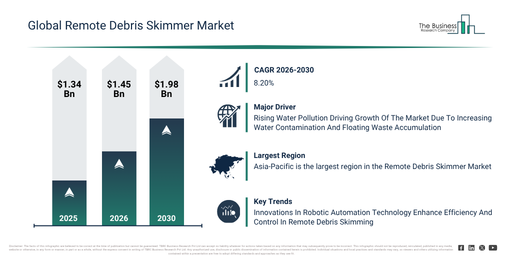
The remote debris skimmer market has shown significant expansion in recent years. Its size is projected to increase from $1.34 billion in 2025 to $1.45 billion in 2026, achieving a compound annual growth rate (CAGR) of 8.0%. Historically, this growth stemmed from elements such as manual water cleanup operations, limited marine monitoring technologies, a considerable reliance on labor-intensive spill response methods, the absence of real-time water quality tracking systems, and an uncoordinated environmental waste management infrastructure.
The remote debris skimmer market is projected to experience substantial expansion in the coming years. Its valuation is anticipated to reach $1.98 billion by 2030, demonstrating a compound annual growth rate (CAGR) of 8.2%. This projected growth during the forecast period is driven by factors such as the increasing use of autonomous marine robotics, heightened investment in ocean cleanup efforts, the proliferation of intelligent environmental monitoring systems, the incorporation of AI-powered navigation and detection capabilities, and an escalating need for sustainable water purification methods. Key developments expected in this period encompass AI-driven autonomous systems for debris identification and navigation, real-time water surface monitoring solutions powered by IoT, cloud-integrated platforms for coordinating marine cleanup fleets, sophisticated battery-electric propulsion systems for skimmers, and digital twin technology for modeling and simulating waterbody pollution.
Get A Free Sample Report With In-Depth Market Insights:
Remote Debris Skimmer Market Growth Momentum: What Factors Are Shaping Demand?
The escalating water pollution is anticipated to propel the growth of the remote debris skimmer market going forward. Water pollution refers to the contamination of water bodies by detrimental substances, rendering the water unsuitable for use and causing damage to aquatic ecosystems. A significant driver of increasing water pollution is rapid industrialization, which often results in untreated chemical waste being discharged into water bodies. Remote debris skimmers help alleviate water pollution by removing floating waste such as plastics, leaves, and oil residues from water surfaces, thereby preventing contamination and safeguarding aquatic ecosystems. For instance, in August 2025, the Environment Agency, a UK-based government department, reported that in 2024, the total number of pollution incidents from sewerage and water supply assets surged by 29% compared with 2023, an increase deemed unacceptable. Consequently, the rising water pollution is a key factor driving the remote debris skimmer market’s expansion. The advancement of industrialization is expected to fuel the growth of the remote debris skimmer market in the coming years. Industrialization signifies an economic transition from agriculture-based activities towards large-scale manufacturing and mechanized production. This increase in industrialization is primarily due to rising demand for goods, as expanding populations and urbanization necessitate higher production of consumer and industrial products, prompting countries to broaden manufacturing capabilities and adopt advanced technologies. Remote debris skimmers support industrialization by efficiently removing floating waste, ensuring cleaner water for operations while simultaneously reducing manual labor and maintenance costs. For example, in July 2025, according to Eurostat, a Luxembourg-based statistical office of the European Union, in May 2025, industrial production increased by 3.7% in the euro area and by 3.4% across the European Union (EU) compared with May 2024. Therefore, growing industrialization is a driving force behind the remote debris skimmer market.
Remote Debris Skimmer Market Segment Analysis And Revenue Potential
The remote debris skimmer market covered in this report is segmented –
1) By Product Type: Autonomous Remote Debris Skimmers, Semi-Autonomous Remote Debris Skimmers
2) By Propulsion Type: Solar Powered Systems, Battery Electric Propulsion, Hybrid Power Systems
3) By Distribution Channel: Direct Sales, Distributors And Dealers, Online Sales, Other Distribution Channels
4) By Application: Waterways Cleaning, Harbor And Port Maintenance, Industrial Waste Removal, Municipal Water Bodies, Other Applications
5) By End-User: Government And Municipalities, Industrial Users, Commercial Users, Other End-Users
Subsegments:
1) By Autonomous Remote Debris Skimmers: Surface Water Skimmers, Submersible Skimmers, Solar Powered Skimmers, Battery Operated Skimmers
2) By Semi-Autonomous Remote Debris Skimmers: Remote Controlled Skimmers, Partially Automated Surface Skimmers, Hybrid Power Skimmers, Tethered Skimmers
Remote Debris Skimmer Market Trends Redefining Industry Growth
Major companies within the remote debris skimmer market are concentrating on developing innovative solutions, such as intelligent robotic pool skimmers, aimed at enhancing autonomous debris detection, improving cleaning efficiency, and reducing manual intervention through advanced sensors and AI-driven navigation. An intelligent robotic pool skimmer is an automated device that utilizes sensors, AI, and navigation technology to detect, collect, and remove floating debris from water surfaces with minimal human involvement. For instance, in August 2024, Beatbot Technology Co. Ltd., a US-based technology company, launched the Beatbot iSkim Ultra, presented as the world’s first intelligent robotic pool skimmer, designed to automate surface debris removal while significantly improving cleaning coverage and user control. This device employs AI-driven path planning, multiple sensors, and a seven-motor system for precise navigation, alongside offering remote control and scheduling via a smartphone app over Wi-Fi and Bluetooth. It further incorporates a large filter basket, dual side brushes, and solar plus battery charging to extend cleaning coverage and runtime, thereby establishing itself as a smart, remote-controlled debris skimming solution for modern pool maintenance.
Remote Debris Skimmer Market Industry Leaders And Competitive Landscape
Major companies operating in the remote debris skimmer market are DESMI A/S, Lamor Corporation, Elastec Inc., Vikoma International Ltd., Aqua-Guard Spill Response Inc., Poralu Marine SAS, Markleen A/S, Mavi Deniz Çevre Hizmetleri A. S., Aquarius Systems, Clear Blue Sea Ltd., ClearBot Pte. Ltd., Ecosubsea AS, Koseq B. V., Potential Engineering Ltd., RanMarine Technology B. V., SkimOIL Inc., Urban Rivers, Water Witch Inc., Clean Sea Solutions GmbH, KECO Pump & Equipment
View The Full Remote Debris Skimmer Market Report:
Remote Debris Skimmer Market Regional Analysis And Leading Geography
Asia-Pacific was the largest region in the remote debris skimmer market in 2025. North America is expected to be the fastest-growing region in the forecast period. The regions covered in the remote debris skimmer market report are Asia-Pacific, South East Asia, Western Europe, Eastern Europe, North America, South America, Middle East and Africa.
Reach Out To Our Team:
The Business Research Company: https://www.thebusinessresearchcompany.com/
Americas: +1 310-496-7795
Asia: +44 7882 955267 & +91 8897263534
Europe: +44 7882 955267
Email us at: marketing@tbrc.info
Follow us on:
LinkedIn: https://in.linkedin.com/company/the-business-research-company
YouTube: https://www.youtube.com/channel/UC24_fI0rV8cR5DxlCpgmyFQ
Global Market Model: https://www.thebusinessresearchcompany.com/global-market-model

Wasay has over a decade of experience in market research, data modelling, and analytics, with prior experience at GlobalData and Decision Tree Consulting Services. At The Business Research Company , he leads research operations across syndicated studies, customized consulting engagements, and the Global Market Model platform. His professional experience includes supporting organizations such as Boston Consulting Group, KPMG, and Ernst & Young. Wasay holds a degree in Electronics and Communications Engineering, postgraduate management qualifications from International Management Institute Belgium and Indian School of Business and Entrepreneurship, and completed the Integrated Program in Business Analytics from Indian Institute of Management Indore.