Backed by market attractiveness analysis, total addressable market sizing, company benchmarking matrices, interactive Excel dashboards, wider supply chain intelligence, emerging startup coverage, and detailed product-level insights, The Business Research Company’s 2026 market reports are designed to offer research that is more actionable and strategically valuable than ever.
Satellite Surveillance Services Market Revenue Growth On Track For A 11% CAGR Through 2030
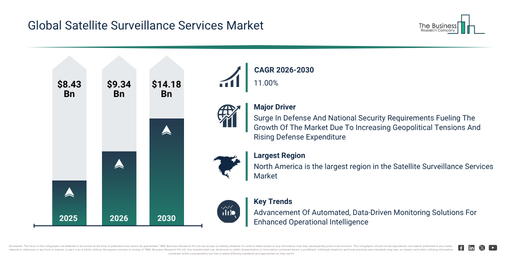
The satellite surveillance services market has experienced significant expansion in recent years. Its value is projected to climb from $8. 43 billion in 2025 to $9. 34 billion in 2026, achieving a compound annual growth rate (CAGR) of 10. 8%. This historical growth can be linked to factors such as increasing defense modernization programs, a rising demand for earth observation data in mapping, growing needs for weather and environmental monitoring, the expansion of commercial satellite launches, and the adoption of remote sensing in agriculture and urban planning.
The satellite surveillance services market size is anticipated to expand substantially in the upcoming years. Its valuation is projected to reach $14.18 billion by 2030, exhibiting a compound annual growth rate (CAGR) of 11.0%. This anticipated growth is driven by several factors, including the escalating demand for real-time intelligence and situational awareness, the increasing integration of AI-based satellite analytics platforms, the expansion of commercial space and private satellite operators, the wider application of satellite data in climate risk monitoring, and the growing incorporation of cloud-based geospatial data services. Prominent trends for this forecast period encompass the broadening of real-time earth observation intelligence, AI-driven interpretation of geospatial images, a heightened demand for high-resolution commercial satellite imaging, an increase in maritime and border surveillance monitoring services, and the integration of predictive analytics into satellite data processing.
Get A Free Sample Report With In-Depth Market Insights:
Satellite Surveillance Services Market Growth Catalysts And Demand Drivers
The future expansion of the satellite surveillance services market is anticipated to be fueled by growing defense and national security needs. These requirements encompass the policies, resources, and capabilities essential for safeguarding a nation’s sovereignty, territorial integrity, and citizens from both internal and external threats. The surge in these defense and national security demands is largely due to escalating geopolitical tensions, prompting countries to prioritize robust military capabilities and readiness against evolving external dangers. Satellite surveillance services play a crucial role in meeting these needs by delivering real-time intelligence, continuous oversight, and early warning of threats, thereby facilitating informed decisions and enhanced strategic responses. A relevant example is the United States’ allocation of approximately $919.2 billion to national defense in September 2025, according to USAFacts, which constituted 13% of the federal budget, making it the fifth-largest government expenditure and a 2% increase over FY 2024. Consequently, the increasing defense and national security requirements are significantly contributing to the expansion of the satellite surveillance services market.
Satellite Surveillance Services Market Breakdown By Product Type And Application
The satellite surveillance services market covered in this report is segmented –
1) By Service Type: Imaging, Monitoring, Data Analytics, Mapping, Other Service Types
2) By Platform: Low Earth Orbit, Medium Earth Orbit, Geostationary Earth Orbit
3) By Deployment Mode: Cloud-Based, On-Premises
4) By Application: Defense And Intelligence, Environmental Monitoring, Agriculture, Disaster Management, Urban Planning, Maritime, Other Applications
5) By End-User: Government, Commercial
Subsegments:
1) By Imaging: Optical Imaging, Infrared Imaging, Thermal Imaging, Hyperspectral Imaging, Multispectral Imaging, Radar Imaging
2) By Monitoring: Environmental Monitoring, Weather Monitoring, Border Monitoring, Infrastructure Monitoring, Maritime Monitoring, Wildlife Monitoring
3) By Data Analytics: Geospatial Data Analysis, Predictive Analytics, Image Processing And Interpretation, Change Detection Analysis, Pattern Recognition Analysis, Big Data Processing
4) By Mapping: Topographic Mapping, Thematic Mapping, Urban Mapping, Land Use Mapping, Geological Mapping, Hydrographic Mapping
5) By Other Service Types: Signal Intelligence Services, Communication Intelligence Services, Navigation Support Services, Disaster Response Services, Surveillance Integration Services, Consulting And Advisory Services
Satellite Surveillance Services Market Trends Shaping Long-Term Demand
Major companies operating in the satellite surveillance services market are focusing on developing advanced solutions, such as intelligent monitoring services, to reduce reliance on manual oversight by automating analysis, thereby lowering operational costs and minimizing human error. These intelligent monitoring services refer to technology-driven systems that continuously collect, analyze, and interpret data in real time to detect patterns, identify anomalies, and support timely decision-making. For instance, in June 2025, Maxar Intelligence, a US-based provider of high-resolution Earth observation imagery, launched Sentry for intelligent monitoring. This service delivers persistent, simultaneous monitoring across multiple global sites, positioning it within higher-value intelligence offerings as traditional imagery becomes commoditized. It integrates data from proprietary satellite assets and partner constellations, combining electro-optical and synthetic aperture radar inputs into a unified analytics platform. The system is designed to autonomously process large data volumes and highlight anomalies without continuous human intervention. Its application scope includes areas such as supply chain oversight and illicit activity detection, where it can monitor predefined locations and flag irregular patterns in movement or activity.
Satellite Surveillance Services Market Key Players Shaping Industry Direction
Major companies operating in the satellite surveillance services market are The Boeing Company, Airbus Defence and Space GmbH, RTX Corporation, Lockheed Martin Corporation, General Dynamics Mission Systems Inc., Northrop Grumman Corporation, BAE Systems plc, Thales Group, L3Harris Technologies Inc., Leonardo S. p. A., Israel Aerospace Industries Ltd., OHB SE, MDA Space Ltd., ICEYE Oy, Planet Labs PBC, Advent International Corporation, Capella Space Corp., Spire Global Inc., BlackSky Technology Inc., Satellogic Inc.
View The Full Satellite Surveillance Services Market Report:
Satellite Surveillance Services Market Regional Analysis: Which Geography Leads On Revenue?
North America was the largest region in the satellite surveillance services market in 2025. Asia-Pacific is expected to be the fastest-growing region in the forecast period. The regions covered in the satellite surveillance services market report are Asia-Pacific, South East Asia, Western Europe, Eastern Europe, North America, South America, Middle East and Africa.
Reach Out To Our Team:
The Business Research Company: https://www.thebusinessresearchcompany.com/
Americas: +1 310-496-7795
Asia: +44 7882 955267 & +91 8897263534
Europe: +44 7882 955267
Email us at: marketing@tbrc.info
Follow us on:
LinkedIn: https://in.linkedin.com/company/the-business-research-company
YouTube: https://www.youtube.com/channel/UC24_fI0rV8cR5DxlCpgmyFQ
Global Market Model: https://www.thebusinessresearchcompany.com/global-market-model

Wasay has over a decade of experience in market research, data modelling, and analytics, with prior experience at GlobalData and Decision Tree Consulting Services. At The Business Research Company , he leads research operations across syndicated studies, customized consulting engagements, and the Global Market Model platform. His professional experience includes supporting organizations such as Boston Consulting Group, KPMG, and Ernst & Young. Wasay holds a degree in Electronics and Communications Engineering, postgraduate management qualifications from International Management Institute Belgium and Indian School of Business and Entrepreneurship, and completed the Integrated Program in Business Analytics from Indian Institute of Management Indore.