Featuring market attractiveness scoring, total addressable market sizing, company benchmarking matrices, interactive Excel dashboards, deeper supply chain intelligence, emerging startup tracking, and granular product-level insights, The Business Research Company’s 2026 market reports are built to deliver research that is both more actionable and more strategically valuable.
Self Bag Drop Systems Market Revenue Outlook: What CAGR Lies Ahead Through 2030?
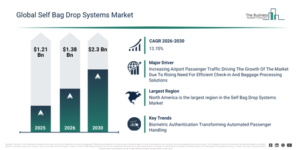
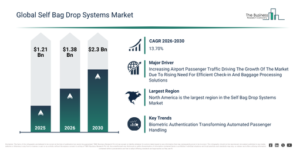
The size of the self bag drop systems market has expanded swiftly in recent years. It is projected to grow from $1.21 billion in 2025 to $1.38 billion in 2026, at a compound annual growth rate (CAGR) of 13.5%. The historical growth of this market stemmed from increasing global air passenger traffic, rising demand for airport automation solutions, the expansion of airport infrastructure and terminal modernization, a growing focus on reducing passenger waiting times, and the increasing adoption of self-service check-in technologies.
The self bag drop systems market is anticipated to experience significant expansion over the next few years, with expectations to reach $2.3 billion by 2030, showing a compound annual growth rate (CAGR) of 13.7%. This growth in the forecast period can be attributed to progress in biometric identification and facial recognition systems, increased investment in smart airport infrastructure, the expansion of AI-enabled passenger processing systems, a rising need for touchless travel experience solutions, and the increasing integration of cloud-based airport management platforms. Key trends in this period include the rise of biometric-enabled self-service passenger processing systems, a greater deployment of automated baggage handling kiosks, the growing integration of airport self-service ecosystems, the expansion of touchless travel and check-in solutions, and increasing adoption of cloud-connected baggage tracking and monitoring platforms.
Get A Free Sample Report With In-Depth Market Insights:
Self Bag Drop Systems Market Development Factors: What’s Supporting Demand?
The future expansion of the self bag drop systems market is anticipated to be propelled by the increasing airport passenger traffic. Airport passenger traffic is defined as the total count of travelers arriving, departing, or passing through airports within a specific timeframe, indicating the overall demand for air travel and airport services. The observed rise in airport passenger traffic is attributed to the robust recovery and expansion of global air travel demand, driven by both tourism and business mobility. Self-bag drop systems contribute to effective airport passenger traffic management by reducing check-in queues and the need for manual baggage handling, thereby facilitating faster passenger flow, enhancing operational efficiency, and minimizing congestion at airport terminals. For instance, in January 2025, according to the International Air Transport Association (IATA), a Canada-based aviation trade association, passenger traffic in 2024 rose 10.4% from 2023, exceeding pre-pandemic levels by 3.8%, with international traffic increasing 13.6%. Consequently, the increasing airport passenger traffic is a key factor driving the growth of the self bag drop systems market.
Self Bag Drop Systems Market Segments: Where Is Growth Concentrated?
The self bag drop systems market covered in this report is segmented –
1) By Component: Hardware, Software, Services
2) By Technology: Barcode, Radio-Frequency Identification, Biometric, Other Technologies
3) By Mode of Operation: Automatic, Semi-Automatic
4) By Deployment Type: On-Premise Solutions, Cloud-Based Solutions, Hybrid Solutions
5) By End-User: Airlines, Logistics Companies, Tour Operators, Travel Agencies
Subsegments:
1) By Hardware: Bag Drop Kiosks, Biometric Cameras, Passport And Document Readers, Boarding Pass Scanners, Baggage Tag Printers, Weighing Scales, Conveyor Interfaces, Radio-Frequency Identification Tag Readers, Touchscreen Displays, Barcode Scanners
2) By Software: Passenger Processing Software, Biometric Recognition Software, Baggage Tracking Software, Airline Departure Control Integration Software, Self Service User Interface Software, Baggage Reconciliation Software, Identity Verification Software, Queue Management Software, Data Analytics And Reporting Software, System Monitoring And Control Software
3) By Services: Installation And Deployment Services, Integration Services, Maintenance And Support Services, Managed Services, Consulting Services, Training Services, System Upgrade Services, Remote Monitoring Services, Technical Support Services, Software Update Services
Self Bag Drop Systems Market Transformation Trends: What Innovations Are Driving Change?
Leading companies within the self bag drop systems market are directing their efforts towards technological advancements in biometric-powered bag drop solutions, including facial recognition self-bag drop platforms, to facilitate touchless passenger identification and streamline baggage processing without requiring boarding pass scans. These platforms are automated baggage drop units that employ biometric cameras to capture and cross-reference a passenger’s facial data with airline information, subsequently automating the retrieval of booking particulars, completion of bag tagging, luggage weighing, and transfer to the baggage handling system. As an illustration, Incheon International Airport Corporation, an airport infrastructure firm based in South Korea, introduced a facial recognition self bag drop service in January 2026. This particular system permits passengers to confirm their identity via facial recognition rather than boarding pass scans, enabling travelers to check in their luggage autonomously through automated kiosks. Furthermore, the solution automatically accesses passenger details post-biometric authentication, thereby diminishing the need for manual document checks at the airport. Through the integration of biometric identification with automated baggage processing and self-service kiosk capabilities, this new service enhances departure processing efficiency and supports smooth, touchless bag drop procedures.
Self Bag Drop Systems Market Industry Leaders And Competitive Landscape
Major companies operating in the self bag drop systems market are Toyota Industries Corporation, Amadeus IT Group S. A., Air India Limited, Daifuku Co. Ltd., BEUMER Group GmbH & Co. KG, SITA N. V., Embross Systems Pvt. Ltd., Lyngsoe Systems A/S, Materna Information & Communications SE, Elenium Automation Pty Ltd, Glidepath Limited, Robson Handling Technology, Scarabee Aviation Group B. V., Marcus Pedersen ApS, Naitec S. r. l., IER SAS, Introba Inc., Leuze electronic GmbH + Co. KG, CITCOnveyors B. V., ICM Airport Technics B. V.
View The Full Self Bag Drop Systems Market Report:
Self Bag Drop Systems Market Regional Analysis And Leading Geography
North America was the largest region in the self bag drop systems market in 2025. Asia-Pacific is expected to be the fastest-growing region in the forecast period. The regions covered in the self bag drop systems market report are Asia-Pacific, South East Asia, Western Europe, Eastern Europe, North America, South America, Middle East and Africa.
Reach Out To Our Team:
The Business Research Company: https://www.thebusinessresearchcompany.com/
Americas: +1 310-496-7795
Asia: +44 7882 955267 & +91 8897263534
Europe: +44 7882 955267
Email us at: marketing@tbrc.info
Follow us on:
LinkedIn: https://in.linkedin.com/company/the-business-research-company
YouTube: https://www.youtube.com/channel/UC24_fI0rV8cR5DxlCpgmyFQ
Global Market Model: https://www.thebusinessresearchcompany.com/global-market-model

Wasay has over a decade of experience in market research, data modelling, and analytics, with prior experience at GlobalData and Decision Tree Consulting Services. At The Business Research Company , he leads research operations across syndicated studies, customized consulting engagements, and the Global Market Model platform. His professional experience includes supporting organizations such as Boston Consulting Group, KPMG, and Ernst & Young. Wasay holds a degree in Electronics and Communications Engineering, postgraduate management qualifications from International Management Institute Belgium and Indian School of Business and Entrepreneurship, and completed the Integrated Program in Business Analytics from Indian Institute of Management Indore.