Built to provide research that’s more actionable and strategically valuable, The Business Research Company’s 2026 market reports include market attractiveness analysis, total addressable market sizing, company benchmarking matrices, interactive Excel dashboards, broader supply chain intelligence, emerging startup tracking, and in-depth product insights.
Traction Transformer (Onboard) Market Value Analysis: What Growth Lies Ahead Over The Forecast Period?
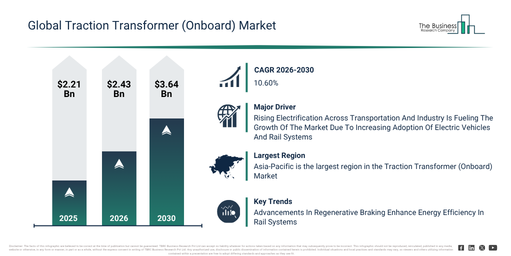
The traction transformer (onboard) market has experienced rapid growth in recent years. Its value is forecast to rise from $2.21 billion in 2025 to $2.43 billion in 2026, achieving a compound annual growth rate (CAGR) of 10.3%. This historical expansion can be attributed to several factors, including the increasing number of railway electrification projects in both developed and emerging economies, the expanding infrastructure for metro and high-speed rail, a growing need for efficient onboard power distribution systems, government spending on modernizing public transportation, and the rising adoption of electric locomotives and multiple units.
The traction transformer (onboard) market is projected to experience substantial growth over the coming years. This market is anticipated to reach a valuation of $3.64 billion by 2030, exhibiting a compound annual growth rate (CAGR) of 10.6%. This expansion during the forecast period is largely driven by increasing investments in sustainable and energy-efficient rail transport systems, the growing implementation of smart rail and interconnected transportation infrastructure, a rising global need for high-speed rail networks, the enlargement of urban metro and light rail transit systems, and a heightened emphasis on sophisticated transformer insulation and cooling technologies. Key trends expected within this period encompass the wider adoption of compact and lightweight onboard traction transformers for high-speed trains, an increasing requirement for energy-efficient traction transformers that minimize power losses, greater integration of advanced cooling systems into onboard traction transformers, the expanding application of dry-type traction transformers to boost operational safety, and the growing deployment of high-capacity traction transformers within metro and subway networks.
Get A Free Sample Report With In-Depth Market Insights:
Traction Transformer (Onboard) Market Growth Factors: What’s Supporting Expansion?
The expanding need for electrification is projected to drive the future growth of the traction transformer (onboard) market. Electrification describes the act of bringing electrical power to systems or technologies that previously lacked it, usually through the installation of infrastructure like power lines and electrical devices, allowing electricity to be used for diverse applications such as transportation and industrial activities. This surge in electrification stems from individuals pursuing increased convenience and a better quality of life, as it has rendered homes and industries more efficient, simplified daily routines, boosted safety, and contributed to the overall modernization of society. Traction transformers (onboard) support electrification by enabling electric trains or vehicles to transform the high-voltage supply from overhead lines or a third rail into the lower voltages required for their traction motors and onboard systems. For example, in January 2024, a report from Kelley Blue Book, a US-based Cox Automotive company, indicated that a record 1.2 million car buyers in the United States opted for electric vehicles in 2023, making up 7.6% of the entire U.S. vehicle market, an increase from 5.9% in 2022. Consequently, the growing demand for electrification is fueling the expansion of the traction transformer (onboard) market.
Traction Transformer (Onboard) Market Breakdown By Product Type And Application
The traction transformer (onboard) market covered in this report is segmented –
1) By Type: Oil-Immersed, Dry-Type (Cast Resin), Sulfur Hexafluoride (SF6) Gas-Insulated
2) By Insulation Type: Oil Insulation, Dry Insulation
3) By Cooling Method: Oil Natural Air Natural (ONAN), Oil Natural Air Forced (ONAF), Air Natural (AN), Air Forced (AF)
4) By Application: Railways, Metro And Subway, Trams, High-Speed Trains, Light Rail Transit (LRT)
5) By End-User: Rolling Stock Manufacturers, Railway Operators, Original Equipment Manufacturers (OEMs)
Subsegments:
1) By Oil-Immersed: Mineral Oil Filled, Natural Ester Fluid Filled, Synthetic Ester Fluid Filled, Hermetically Sealed Design, Conservator Type Design
2) By Dry-Type (Cast Resin): Vacuum Cast Resin, Open Winding Dry Type, Encapsulated Winding Type, Air Cooled Design, Forced Air Cooled Design
3) By Sulfur Hexafluoride (SF6) Gas-Insulated: Fully Gas Insulated Design, Hybrid Gas Insulated Design, Compact Enclosed Design, Modular Gas Insulated Unit, Sealed Pressure System
Traction Transformer (Onboard) Market Industry Trends: What’s Reshaping Demand?
Major companies operating in the traction transformer (onboard) market are concentrating on innovations such as regenerative braking to recover kinetic energy during a train’s deceleration and convert it back into electrical energy. Regenerative braking describes a system in electric or hybrid trains where the kinetic energy of the moving train is transformed back into electrical energy as it slows down, rather than being lost as heat. For instance, in January 2026, Bharat Heavy Electricals Limited (BHEL), an India-based state-owned engineering and manufacturing company, unveiled the semi-high-speed underslung onboard traction transformers for Vande Bharat Sleeper trains. This is a compact and highly efficient train propulsion solution featuring an underslung mounting for optimizing space, advanced cooling for continuous high-power functioning, bidirectional power flow enabling regenerative braking, and a fully indigenous design supporting national initiatives. Additionally, it provides enhanced operational reliability and simpler maintenance for semi-high-speed train operations.
Traction Transformer (Onboard) Market Company Landscape And Competitive Strategy
Major companies operating in the traction transformer (onboard) market are Hitachi Energy Ltd, Mitsubishi Electric Corporation, Siemens Energy AG, CRRC Corporation Limited, ABB Ltd, Toshiba Corporation, Alstom SA, Fuji Electric Co Ltd, Bharat Heavy Electricals Limited, Meidensha Corporation, Trench Group GmbH, CG Power and Industrial Solutions Limited, Wilson Transformer Company Pty Ltd, JST Transformateurs SA, Zetwerk Manufacturing Businesses Private Limited, Hind Rectifiers Limited, River Engineering Private Limited, International Electric Co Ltd, Medha Servo Drives Private Limited, Škoda Electric a. s.
View The Full Traction Transformer (Onboard) Market Report:
Traction Transformer (Onboard) Market Largest Region: Which Geography Holds The Highest Market Share?
Asia-Pacific was the largest region in the traction transformer (onboard) market in 2025. Asia-Pacific is expected to be the fastest-growing region in the forecast period. The regions covered in the traction transformer (onboard) market report are Asia-Pacific, South East Asia, Western Europe, Eastern Europe, North America, South America, Middle East and Africa.
Reach Out To Our Team:
The Business Research Company: https://www.thebusinessresearchcompany.com/
Americas: +1 310-496-7795
Asia: +44 7882 955267 & +91 8897263534
Europe: +44 7882 955267
Email us at: marketing@tbrc.info
Follow us on:
LinkedIn: https://in.linkedin.com/company/the-business-research-company
YouTube: https://www.youtube.com/channel/UC24_fI0rV8cR5DxlCpgmyFQ
Global Market Model: https://www.thebusinessresearchcompany.com/global-market-model

Wasay has over a decade of experience in market research, data modelling, and analytics, with prior experience at GlobalData and Decision Tree Consulting Services. At The Business Research Company , he leads research operations across syndicated studies, customized consulting engagements, and the Global Market Model platform. His professional experience includes supporting organizations such as Boston Consulting Group, KPMG, and Ernst & Young. Wasay holds a degree in Electronics and Communications Engineering, postgraduate management qualifications from International Management Institute Belgium and Indian School of Business and Entrepreneurship, and completed the Integrated Program in Business Analytics from Indian Institute of Management Indore.