Backed by market attractiveness analysis, total addressable market sizing, company benchmarking matrices, interactive Excel dashboards, wider supply chain intelligence, emerging startup coverage, and detailed product-level insights, The Business Research Company’s 2026 market reports are designed to offer research that is more actionable and strategically valuable than ever.
Triethylene Glycol (TEG) Dehydration Unit Market Poised To Hit $1.74 Billion By 2030 With A 5.9% CAGR
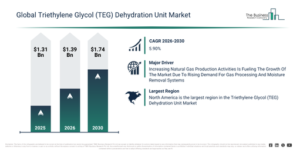
The market size for triethylene glycol (TEG) dehydration units has experienced robust growth recently. Projections indicate it will expand from $1.31 billion in 2025 to $1.39 billion in 2026, demonstrating a compound annual growth rate (CAGR) of 5.7%. Historically, this growth is primarily attributable to factors such as the expansion of global natural gas production, a growing demand for preventing pipeline corrosion, increased deployment of gas processing infrastructure, the proliferation of industrial-scale dehydration systems, and advancements in conventional glycol-based dehydration technology.
The triethylene glycol (TEG) dehydration unit market is projected to experience substantial expansion in the coming years. This market is anticipated to reach a valuation of $1.74 billion by 2030, exhibiting a compound annual growth rate (CAGR) of 5.9%. Several factors are contributing to this growth during the forecast period, including the escalating demand for cleaner natural gas distribution networks, heightened automation within oil and gas processing facilities, the proliferation of remote offshore gas production sites, wider implementation of energy infrastructure modernization initiatives, and a sharpened emphasis on reducing carbon emissions and enhancing process efficiency. Key trends anticipated over the forecast period encompass the growing integration of energy-efficient glycol regeneration systems, an uptick in demand for modular gas dehydration skid units, advancements in the automated monitoring of gas processing parameters, the broadening presence of remotely operated natural gas processing facilities, and a greater commitment to curbing emissions in gas dehydration activities.
Get A Free Sample Report With In-Depth Market Insights:
Triethylene Glycol (TEG) Dehydration Unit Market Opportunity Drivers: What’s Unlocking New Revenue Potential?
The market for triethylene glycol (TEG) dehydration units is projected to expand due to the escalating volume of natural gas production activities. These activities encompass the exploration, extraction, and processing of natural gas resources, which are increasingly adopted globally due to rising energy needs and a shift towards cleaner fuels. TEG dehydration units are crucial in this process, eliminating water vapor from gas streams to prevent pipeline degradation from corrosion and hydrate formation, thus ensuring compliance with gas quality standards. For instance, data from Enerdata in November 2025 revealed that global natural gas output saw a 2% recovery in 2024, following a 0.6% rise in 2023, indicating sustained annual growth since 2022. Consequently, the expansion of natural gas production activities is a primary catalyst for the growth of the triethylene glycol (TEG) dehydration unit market. The expanding adoption of corrosion-resistant materials is anticipated to bolster the triethylene glycol (TEG) dehydration unit market. These materials, defined as metals or alloys crafted to withstand deterioration from chemical reactions with elements like moisture, oxygen, and various contaminants, are seeing increased demand. This rise is attributed to the greater exposure of industrial infrastructure, particularly within oil and gas processing systems, to severe operational conditions. TEG dehydration units play a vital role here by extracting water vapor from natural gas, thereby mitigating moisture-related corrosion and working in conjunction with corrosion-resistant materials to prolong equipment lifespan and ensure dependable operations. As an illustration, the United States Geological Survey reported in April 2023 that worldwide stainless steel output climbed to approximately 54.2 million metric tons, marking a 6.1% increase from 2022, indicative of growing demand for these alloys across industries. Hence, the increasing application of corrosion-resistant materials is propelling the growth of the triethylene glycol (TEG) dehydration unit market.
Triethylene Glycol (TEG) Dehydration Unit Market Segmentation: How Does The Market Break Down By Category?
The triethylene glycol (teg) dehydration unit market covered in this report is segmented –
1) By Type: Skid-Mounted, Trailer-Mounted, Other Types
2) By Capacity: Small, Medium, Large
3) By Application: Onshore, Offshore
4) By End-User: Oil And Gas, Petrochemical, Natural Gas Processing, Other End-Users
Subsegments:
1) By Skid-Mounted: Single Tower Units, Dual Tower Units, High Capacity Units, Low Capacity Units, Modular Skid Systems
2) By Trailer-Mounted: Mobile Field Deployment Units, Rapid Deployment Units, Compact Capacity Units, Heavy Duty Mobile Units, Remote Location Service Units
3) By Other Types: Fixed Installation Units, Containerized Units, Offshore Platform Units, Custom Engineered Units, Hybrid Mobility Units
Triethylene Glycol (TEG) Dehydration Unit Market Top Companies Driving Competitive Growth
Major companies operating in the triethylene glycol (teg) dehydration unit market are Linde Engineering, Atlas Copco Gas & Process, Pall Corporation, Vanguard Process Solutions, Enerflex Ltd., Koch-Glitsch LP, Spitzer Industries Inc., Propak Systems Ltd., Cimarron Energy Services, Axens S. A., TransTech Energy LLC, Sichuan Rongteng Automation Equipment Co. Ltd., QB Johnson Manufacturing Inc, ERGIL, Mar-Quinn Industries Ltd., Petro Gasgen Private Limited, NiGen International LLC, Croft Productions Systems, PSB Industries Inc., Excalibur Fiberglass Inc., Brilex Energy Solutions LLC, Triofab Engineering
View The Full Triethylene Glycol (TEG) Dehydration Unit Market Report:
Triethylene Glycol (TEG) Dehydration Unit Market Global Footprint: Which Region Leads The Market?
North America was the largest region in the triethylene glycol (TEG) dehydration unit market in 2025. Asia Pacific is expected to be the fastest-growing region in the forecast period. The regions covered in the triethylene glycol (TEG) dehydration unit market report are Asia-Pacific, South East Asia, Western Europe, Eastern Europe, North America, South America, Middle East and Africa.
Reach Out To Our Team:
The Business Research Company: https://www.thebusinessresearchcompany.com/
Americas: +1 310-496-7795
Asia: +44 7882 955267 & +91 8897263534
Europe: +44 7882 955267
Email us at: marketing@tbrc.info
Follow us on:
LinkedIn: https://in.linkedin.com/company/the-business-research-company
YouTube: https://www.youtube.com/channel/UC24_fI0rV8cR5DxlCpgmyFQ
Global Market Model: https://www.thebusinessresearchcompany.com/global-market-model

Wasay has over a decade of experience in market research, data modelling, and analytics, with prior experience at GlobalData and Decision Tree Consulting Services. At The Business Research Company , he leads research operations across syndicated studies, customized consulting engagements, and the Global Market Model platform. His professional experience includes supporting organizations such as Boston Consulting Group, KPMG, and Ernst & Young. Wasay holds a degree in Electronics and Communications Engineering, postgraduate management qualifications from International Management Institute Belgium and Indian School of Business and Entrepreneurship, and completed the Integrated Program in Business Analytics from Indian Institute of Management Indore.