Featuring market attractiveness scoring, total addressable market sizing, company benchmarking matrices, interactive Excel dashboards, deeper supply chain intelligence, emerging startup tracking, and granular product-level insights, The Business Research Company’s 2026 market reports are built to deliver research that is both more actionable and more strategically valuable.
Vehicle Corrosion Inhibitor Market Revenue Outlook: What CAGR Lies Ahead Through 2030?
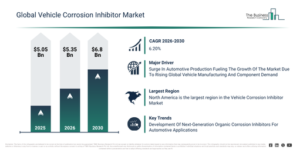
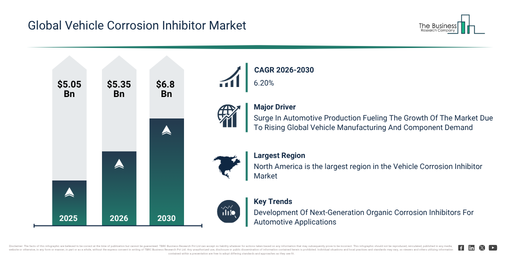
The vehicle corrosion inhibitor market has experienced significant expansion in recent years. It is anticipated to increase from $5.05 billion in 2025 to $5.35 billion in 2026, driven by a compound annual growth rate (CAGR) of 5.9%. This historical growth can be linked to factors such as increased vehicle exposure to severe environmental conditions, greater use of road salt in colder regions, an expansion in automotive manufacturing, the rising demand for improved vehicle durability, and the proliferation of aftermarket vehicle maintenance products.
The vehicle corrosion inhibitor market size is anticipated to experience substantial expansion over the coming years. This market is set to reach $6.8 billion by 2030, exhibiting a compound annual growth rate (CAGR) of 6.2%.
The expansion during the projected period is driven by several factors, including the advancement of intelligent self-healing corrosion coatings, the incorporation of IoT-based corrosion monitoring systems, the increasing use of lightweight materials in electric vehicles, a greater uptake of sustainable bio-based inhibitors, and the broadening application of predictive maintenance in fleet operations.
Significant developments expected in the forecast period encompass the adoption of eco-friendly water-based corrosion inhibitors, anti-corrosion coatings enhanced with nanotechnology, formulations offering extended-life multi-metal corrosion protection, smart monitoring-enabled systems for corrosion prevention, and a rise in the application of bio-based and non-toxic corrosion inhibitor chemicals.
Get A Free Sample Report With In-Depth Market Insights:
Vehicle Corrosion Inhibitor Market Expansion Drivers: What’s Shaping Future Growth?
The escalating volume of automotive manufacturing is anticipated to boost the growth of the vehicle corrosion inhibitor market moving forward. This expansion in automotive output is propelled by factors such as increasing urbanization, rising disposable incomes, and a growing necessity for both personal and commercial transport. Vehicle corrosion inhibitors play a crucial role in automotive production by safeguarding metal components from rust and deterioration, thereby extending vehicle longevity and ensuring adherence to established quality and safety benchmarks. For example, data released in March 2025 by the European Automobile Manufacturers’ Association, an automotive industry organization based in Belgium, indicated that car production hit 75.5 million units in 2024, a figure comparable to approximately 76 million units in 2023, signifying consistent high levels of automotive manufacturing and an ongoing requirement for vehicle parts. Thus, the increasing automotive production is a key driver for the expansion of the vehicle corrosion inhibitor market.
Vehicle Corrosion Inhibitor Market Segment Performance And Emerging Opportunities
The vehicle corrosion inhibitor market covered in this report is segmented –
1) By Product Type: Water-Based, Oil-Based, Solvent-Based, Other Product Types
2) By Form: Liquid, Aerosol, Gel, Other Forms
3) By Vehicle Type: Passenger Cars, Light Commercial Vehicles, Heavy Commercial Vehicles, Electric Vehicles
4) By Distribution Channel: Original Equipment Manufacturers, Aftermarket, Online Retail, Other Distribution Channels
5) By Application: Passenger Vehicles, Commercial Vehicles, Other Applications
Subsegments:
1) By Water-Based: Organic Water-Based Corrosion Inhibitor, Inorganic Water-Based Corrosion Inhibitor, Hybrid Water-Based Corrosion Inhibitor, Nitrite Based Water Corrosion Inhibitor
2) By Oil-Based: Rust Preventive Oil-Based Inhibitor, Oil Soluble Corrosion Inhibitor, Protective Film Forming Oil Inhibitor, Heavy Duty Oil-Based Corrosion Inhibitor
3) By Solvent-Based: Volatile Solvent-Based Corrosion Inhibitor, Film Forming Solvent-Based Inhibitor, Quick Drying Solvent-Based Inhibitor, Protective Coating Solvent-Based Inhibitor
4) By Other Product Types: Vapor Phase Corrosion Inhibitor, Powder Form Corrosion Inhibitor, Gel Based Corrosion Inhibitor, Multi Metal Corrosion Inhibitor
Vehicle Corrosion Inhibitor Market Strategic Trends: What Defines The Next Growth Phase?
Leading companies within the vehicle corrosion inhibitor market are prioritizing the development of innovative solutions, such as smart-release corrosion inhibitor technologies. This focus aims to meet the increasing demand for highly effective, robust, and efficient corrosion prevention in automotive applications. Smart-release corrosion inhibitors function as advanced materials that precisely dispense active inhibiting agents when activated by environmental stimuli like moisture or changes in pH levels. This mechanism allows for targeted safeguarding and extends the operational life of metallic components beyond what conventional inhibitors offer. As an illustration, in November 2024, ICL Group Ltd., an Israel-based specialty chemicals firm, unveiled HALOX 680, a smart-release corrosion inhibitor introduced during CHINACOAT 2024. This product utilizes a heterocyclic organic compound and is engineered to bolster corrosion protection by reacting to corrosive environments and deploying inhibitors specifically where needed. It effectively mitigates cathodic delamination, enhances the adherence of coatings on metal surfaces, and is suitable for use with both water-based and solvent-based coating systems. Furthermore, it provides enhanced durability, prolonged protection intervals, and lower material consumption, contributing to both operational efficiency and environmental responsibility.
Vehicle Corrosion Inhibitor Market Leading Players And Competitive Positioning
Major companies operating in the vehicle corrosion inhibitor market are The Sherwin-Williams Company, PPG Industries Inc., Evonik Industries AG, Sika AG, DuPont de Nemours Inc., Akzo Nobel N. V., RPM International Inc., LANXESS AG, The Lubrizol Corporation, The Chemours Company, Axalta Coating Systems Ltd., Kansai Paint Co. Ltd., FUCHS SE, Ashland Inc., Quaker Houghton, NOF Corporation, Afton Chemical Corporation, Valvoline Inc., Chemetall GmbH, Cortec Corporation, Daubert Chemical Company Inc., Northern Technologies International Corporation, Armor Protective Packaging, DINOL GmbH, Bilt-Hamber Laboratories, Corrosion Technologies LLC
View The Full Vehicle Corrosion Inhibitor Market Report:
Vehicle Corrosion Inhibitor Market Regional Distribution: Which Areas Power Market Growth?
North America was the largest region in the vehicle corrosion inhibitor market in 2025. Asia-Pacific is expected to be the fastest-growing region in the forecast period. The regions covered in the vehicle corrosion inhibitor market report are Asia-Pacific, South East Asia, Western Europe, Eastern Europe, North America, South America, Middle East and Africa.
Reach Out To Our Team:
The Business Research Company: https://www.thebusinessresearchcompany.com/
Americas: +1 310-496-7795
Asia: +44 7882 955267 & +91 8897263534
Europe: +44 7882 955267
Email us at: marketing@tbrc.info
Follow us on:
LinkedIn: https://in.linkedin.com/company/the-business-research-company
YouTube: https://www.youtube.com/channel/UC24_fI0rV8cR5DxlCpgmyFQ
Global Market Model: https://www.thebusinessresearchcompany.com/global-market-model

Wasay has over a decade of experience in market research, data modelling, and analytics, with prior experience at GlobalData and Decision Tree Consulting Services. At The Business Research Company , he leads research operations across syndicated studies, customized consulting engagements, and the Global Market Model platform. His professional experience includes supporting organizations such as Boston Consulting Group, KPMG, and Ernst & Young. Wasay holds a degree in Electronics and Communications Engineering, postgraduate management qualifications from International Management Institute Belgium and Indian School of Business and Entrepreneurship, and completed the Integrated Program in Business Analytics from Indian Institute of Management Indore.