Built to provide research that’s more actionable and strategically valuable, The Business Research Company’s 2026 market reports include market attractiveness analysis, total addressable market sizing, company benchmarking matrices, interactive Excel dashboards, broader supply chain intelligence, emerging startup tracking, and in-depth product insights.
Barium Fluoride Market Revenue Growth On Track For A 4.1% CAGR Through 2030
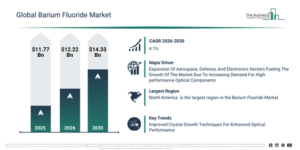
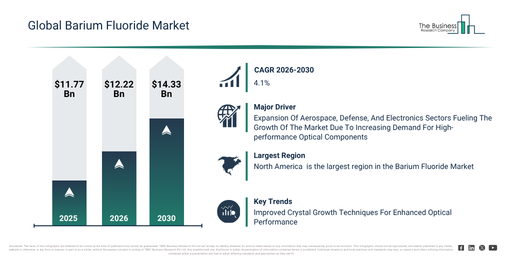
The barium fluoride market size has shown steady expansion over recent years. Projections indicate it will increase from $11.77 billion in 2025 to $12.22 billion in 2026, achieving a compound annual growth rate (CAGR) of 3.8%. The growth observed in the past can be attributed to various factors, including the rising demand for optical materials in scientific instrumentation, the broadening of metallurgy and glass manufacturing industries, the increased utilization of fluoride compounds in chemical processing, the growing adoption of infrared optical components in defense systems, and the progression of spectroscopy and laboratory research applications.
The market size for barium fluoride is projected to experience consistent expansion over the upcoming years. Its value is anticipated to reach $14.33 billion by 2030, demonstrating a compound annual growth rate (CAGR) of 4.1%. This growth during the projection period can be attributed to factors such as the expanding semiconductor and photonics sectors, a heightened need for sophisticated infrared and ultraviolet optical systems, an increase in nuclear and medical imaging uses, the growing embrace of high-purity crystal substances in electronic devices, and increased funding for optical technologies in aerospace and defense. Key trends anticipated within this forecast timeframe encompass the advancement of high-purity optical crystals for ultraviolet and infrared transmission, a greater uptake of barium fluoride in laser window and spectroscopy components, an increasing requirement for semiconductor-grade crystalline materials in cutting-edge electronics, the wider application of fluorides in radiation detection and scintillation systems, and the increased use of optical ceramics in defense and aerospace imaging setups.
Get A Free Sample Report With In-Depth Market Insights:
Barium Fluoride Market Development Factors: What’s Supporting Demand?
The expansion of aerospace, defense, and electronics sectors is projected to drive the growth of the barium fluoride market. These sectors encompass industries involved in the design, manufacturing, and maintenance of aircraft, spacecraft, military systems, electronic devices, and advanced communication technologies used for security, monitoring, and data processing. The growth in these sectors is propelled by increased government investments in defense modernization and the rapid advancements in semiconductor and telecommunications technologies. Barium fluoride finds application in aerospace, defense, and electronics to enable high-performance optical systems with excellent ultraviolet and infrared transmission, making it suitable for components such as lenses, windows, and scintillation detectors utilized in imaging, spectroscopy, and radiation detection systems. For instance, the House of Commons Library, a UK-based impartial research and information service, stated in October 2025 that the United Kingdom is anticipated to allocate approximately 2.4% of its GDP to defense expenditure in 2025. Additionally, in February 2025, the government announced a strategic commitment to elevate defense spending, as per NATO standards, to 2.5% of GDP by 2027, with total security and intelligence-related expenditure expected to reach around 2.6% of GDP when supplementary components are included. Therefore, the expansion of aerospace, defense, and electronics sectors is a significant factor contributing to the barium fluoride market’s growth. The rising demand for optical and photonics applications is also expected to propel the growth of the barium fluoride market. Optical and photonics applications refer to technologies that generate, manipulate, and detect light across ultraviolet, visible, and infrared spectra, used in systems like laser instruments, infrared optics, spectroscopy equipment, and imaging devices. This increasing demand in optical and photonics applications is due to the accelerating adoption of light-based technologies across high-growth end-use industries that require increasingly precise and high-performance optical components. Barium Fluoride supports these applications by offering exceptional broadband transparency across ultraviolet to infrared wavelengths, making it a critical material for optical windows, lenses, prisms, and scintillation detectors that demand low absorption and high optical clarity. For example, according to the Society of Photo-Optical Instrumentation Engineers (SPIE), a US-based international society dedicated to advancing light-based technologies in optics and photonics, global annual revenues from the production of optics and photonics core components reached $381 billion in 2024, up from $345 billion in 2023, representing a growth of approximately 10.4%, as reported in March 2026. Consequently, the increasing demand for optical and photonics applications is projected to drive the barium fluoride market forward.
Barium Fluoride Market Segmentation And Category Overview
The barium fluoride market covered in this report is segmented –
1) By Product Type: Optical Grade Barium Fluoride, Industrial Grade Barium Fluoride, High Purity Barium Fluoride
2) By Form: Powder, Single Crystal, Lumps, Other Forms
3) By Application: Chemical, Mining And Metallurgical, Military, Electronics, Construction, Pharmaceuticals, Other Applications
Subsegments:
1) By Optical Grade Barium Fluoride: Infrared Optical Components, Laser Window Materials, Spectroscopy Optical Elements, Ultraviolet Transmission Components
2) By Industrial Grade Barium Fluoride: Metallurgical Flux Materials, Ceramic Glazing Additives, Welding Flux Components, Glass Manufacturing Additives
3) By High Purity Barium Fluoride: Semiconductor Crystal Materials, Scintillation Detector Crystals, Electronic Grade Substrates, Advanced Research Grade Materials
Barium Fluoride Market Transformation Trends: What Innovations Are Driving Change?
Leading companies in the barium fluoride market are prioritizing the development of advanced solutions, such as the refined bridgman-stockbarger technique, to boost crystal purity, enhance optical performance, and enable the creation of large, flawless crystals for sophisticated optical and photonics applications. This modified bridgman–stockbarger technique is a crystal growth method where a molten material is gradually cooled under a controlled temperature gradient, incorporating process improvements that minimize defects and yield high-purity, uniform single crystals. For example, in August 2024, Fairfield Crystal, a US-based optical materials firm, launched enhanced large-diameter Barium Fluoride monocrystalline ingots. Their specialized growth process creates crystals with diameters up to 100mm, characterized by zero grain boundaries and strong resistance to ionizing radiation, suitable for aerospace surveillance systems. This development significantly improves thermal stability and optical throughput across the ultraviolet to infrared spectrum. While the substantial energy demands of vacuum-based growth elevate operational costs, the resulting material offers excellent durability for deep-space and high-energy physics applications.
Barium Fluoride Market Company Landscape And Competitive Strategy
Major companies operating in the barium fluoride market are Solvay Fluor GmbH, Thorlabs Inc., Edmund Optics Inc., Fujian Castech Crystals Inc., OptoSigma Corporation, Red Optronics Co. Ltd., Hellma Materials GmbH, UAB EKSMA Optics, Shanghai Optics Inc., American Elements Corporation, Laser Components GmbH, Foctek Photonics Inc., Alkor Technologies LLC, Wavelength Opto-Electronic (S) Pte. Ltd., Union Optic Inc., Crystran Limited, Knight Optical (UK) Ltd., Newlight Photonics Inc., Madras Fluorine Private Limited, Korth Kristalle GmbH.
View The Full Barium Fluoride Market Report:
Barium Fluoride Market Largest Region: Which Geography Holds The Highest Market Share?
North America was the largest region in the barium fluoride market in 2025. Asia-Pacific is expected to be the fastest-growing region in the forecast period. The regions covered in the barium fluoride market report are Asia-Pacific, South East Asia, Western Europe, Eastern Europe, North America, South America, Middle East, Africa.
Reach Out To Our Team:
The Business Research Company: https://www.thebusinessresearchcompany.com/
Americas: +1 310-496-7795
Asia: +44 7882 955267 & +91 8897263534
Europe: +44 7882 955267
Email us at: marketing@tbrc.info
Follow us on:
LinkedIn: https://in.linkedin.com/company/the-business-research-company
YouTube: https://www.youtube.com/channel/UC24_fI0rV8cR5DxlCpgmyFQ
Global Market Model: https://www.thebusinessresearchcompany.com/global-market-model

Wasay has over a decade of experience in market research, data modelling, and analytics, with prior experience at GlobalData and Decision Tree Consulting Services. At The Business Research Company , he leads research operations across syndicated studies, customized consulting engagements, and the Global Market Model platform. His professional experience includes supporting organizations such as Boston Consulting Group, KPMG, and Ernst & Young. Wasay holds a degree in Electronics and Communications Engineering, postgraduate management qualifications from International Management Institute Belgium and Indian School of Business and Entrepreneurship, and completed the Integrated Program in Business Analytics from Indian Institute of Management Indore.