Featuring market attractiveness scoring, total addressable market sizing, company benchmarking matrices, interactive Excel dashboards, deeper supply chain intelligence, emerging startup tracking, and granular product-level insights, The Business Research Company’s 2026 market reports are built to deliver research that is both more actionable and more strategically valuable.
Device Vulnerability Market Poised To Hit $4.85 Billion By 2030 With A 16.7% CAGR
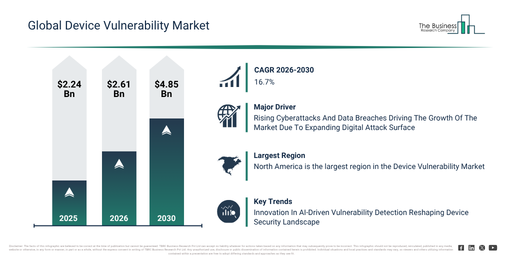
The market size for device vulnerabilities has experienced rapid expansion in recent years. It is projected to increase from $2.24 billion in 2025 to $2.61 billion in 2026, demonstrating a compound annual growth rate (CAGR) of 16.5%. The historical growth of this market is attributable to factors such as the exposure of vulnerabilities in legacy systems, limited adoption of endpoint security, prevalent reactive incident response practices, the expanding reach of device connectivity, and a lack of standardized firmware security protocols.
The device vulnerability market is projected for significant expansion in the coming years, reaching a valuation of $4.85 billion by 2030, exhibiting a compound annual growth rate (CAGR) of 16.7%. This anticipated growth is driven by several factors, including the increasing spread of IoT and connected devices, the wider implementation of zero-trust architectures, more stringent regulatory requirements for cybersecurity compliance, the wider deployment of automated tools for vulnerability scanning, and the escalating complexity of cyber threats and exploits. Key developments expected during this period encompass the uptake of zero-trust approaches for device security, the management of vulnerabilities in firmware and embedded systems, the integration of automated systems for patching and configuration management, the enhancement of endpoint security and threat detection capabilities, and the deployment of hardware root of trust and secure boot mechanisms.
Get A Free Sample Report With In-Depth Market Insights:
Device Vulnerability Market Industry Drivers: What’s Behind The Revenue Growth?
The increasing occurrence of cyberattacks and data breaches is anticipated to drive the expansion of the device vulnerability market in the future. These incidents involve unauthorized efforts to gain entry, interfere with, or pilfer information from digital platforms, leading to monetary, operational, and reputational harm. The surge in cyberattacks and data breaches stems from our increasing reliance on digital technologies, with more sensitive data residing online, which broadens potential targets and provides additional avenues for exploitation. Solutions for device vulnerability assist organizations by pinpointing susceptibilities across various devices and systems, thereby enhancing their capacity to avert, identify, and address cyber threats and data breaches. As an illustration, in October 2025, the Australian Signals Directorate, an Australia-based government agency, reported that during the financial year (FY) 2024–25, the Australian Cyber Security Centre (ACSC) alerted organizations over 1,700 times about potential malicious cyber activity, marking an 83% increase from the prior year. Consequently, the escalating occurrence of cyberattacks and data breaches is fueling the expansion of the device vulnerability market.
Device Vulnerability Market Segment Analysis Spotlighting Growth Areas
The device vulnerability market covered in this report is segmented –
1) By Component: Software, Services
2) By Device Type: Desktops And Laptops, Servers, Internet Of Things (IoT) Endpoints
3) By Deployment Mode: On-Premises, Cloud-Based
4) By Application: Risk And Compliance Management, Threat Intelligence And Monitoring, Patch And Configuration Management, Incident Response
5) By End-User: Banking, Financial Services, Insurance (BFSI), Information Technology (IT) And Telecom, Healthcare, Government And Defense, Retail And E-commerce, Manufacturing, Energy And Utilities
Subsegments:
1) By Software: Operating Systems, Application Software, Firmware, Database Management Systems, Web Applications, Mobile Applications, Cloud-based Software, Security Software
2) By Services: Consulting Services, Integration And Deployment, Support And Maintenance, Managed Security Services, Training And Education
#Device Vulnerability Market Growth Trends: What’s Shaping The Future Outlook?
Leading companies in the device vulnerability market are dedicated to developing innovative solutions, such as AI-driven vulnerability management platforms. This initiative aims to meet the increasing requirement for proactive threat detection, continuous oversight, and automated corrective actions, particularly as cyber threats and software vulnerabilities proliferate rapidly. These AI-powered vulnerability management platforms are sophisticated cybersecurity offerings that harness machine learning, threat intelligence, and automation to constantly scan devices, identify vulnerabilities, and determine the priority for their resolution. For example, in November 2025, Cybereason Inc., a US-based cybersecurity company, unveiled its integrated Vulnerability Management product, incorporated into the Cybereason Endpoint Protection Platform. This solution facilitates a transition from merely reacting to threats to actively mitigating risks. It accomplishes this by continuously analyzing endpoint applications, cross-referencing them with Common Vulnerabilities and Exposures (CVE) databases, and supplying prioritized remediation guidance through a consolidated interface. By integrating vulnerability assessment directly with endpoint protection, it removes the necessity for independent tools, presents a unified outlook on threats and vulnerabilities, and decreases operational intricacy.
Device Vulnerability Market Key Participants And Competitive Landscape
Major companies operating in the device vulnerability market are Microsoft Corporation; International Business Machines Corporation; Palo Alto Networks Inc.; Fortinet Inc.; CrowdStrike Holdings Inc.; Zoho Corporation; Check Point Software Technologies Ltd.; Rapid7 Inc.; Tenable Inc.; Qualys Inc.; Tanium Inc.; BreachLock Inc.; Claroty Ltd.; Dragos Inc.; CyCognito Ltd; Indusface Inc.; Greenbone Networks GmbH; Kratikal Tech Ltd.; NopSec Inc.; SecureLayer7 IT Solutions Pvt. Ltd.
View The Full Device Vulnerability Market Report:
Device Vulnerability Market Geographic Analysis: Where Is Demand Accelerating Fastest?
North America was the largest region in the device vulnerability market in 2025. Asia-Pacific is expected to be the fastest-growing region in the forecast period. The regions covered in the device vulnerability market report are Asia-Pacific, South East Asia, Western Europe, Eastern Europe, North America, South America, Middle East, Africa.
Reach Out To Our Team:
The Business Research Company: https://www.thebusinessresearchcompany.com/
Americas: +1 310-496-7795
Asia: +44 7882 955267 & +91 8897263534
Europe: +44 7882 955267
Email us at: marketing@tbrc.info
Follow us on:
LinkedIn: https://in.linkedin.com/company/the-business-research-company
YouTube: https://www.youtube.com/channel/UC24_fI0rV8cR5DxlCpgmyFQ
Global Market Model: https://www.thebusinessresearchcompany.com/global-market-model

Wasay has over a decade of experience in market research, data modelling, and analytics, with prior experience at GlobalData and Decision Tree Consulting Services. At The Business Research Company , he leads research operations across syndicated studies, customized consulting engagements, and the Global Market Model platform. His professional experience includes supporting organizations such as Boston Consulting Group, KPMG, and Ernst & Young. Wasay holds a degree in Electronics and Communications Engineering, postgraduate management qualifications from International Management Institute Belgium and Indian School of Business and Entrepreneurship, and completed the Integrated Program in Business Analytics from Indian Institute of Management Indore.