Backed by market attractiveness analysis, total addressable market sizing, company benchmarking matrices, interactive Excel dashboards, wider supply chain intelligence, emerging startup coverage, and detailed product-level insights, The Business Research Company’s 2026 market reports are designed to offer research that is more actionable and strategically valuable than ever.
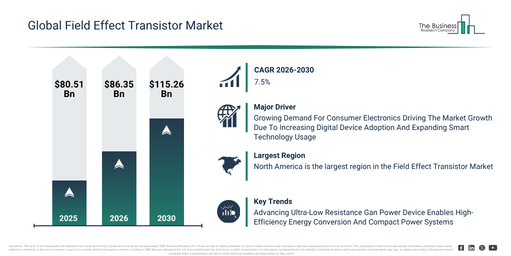
Field Effect Transistor Market Poised To Hit $115.26 Billion By 2030 With A 7.5% CAGR
The field effect transistor market has experienced strong expansion in recent years. It is projected to increase from $80.51 billion in 2025 to $86.35 billion in 2026, achieving a compound annual growth rate (CAGR) of 7.3%. The growth observed in the past can be attributed to an increasing demand for consumer electronics, the rise in digital switching applications, the expansion of industrial automation systems, the growing adoption of analog and power electronics, and improvements in semiconductor fabrication technologies.
The field effect transistor market is projected to experience substantial expansion in the coming years, reaching a valuation of $115.26 billion by 2030, driven by a compound annual growth rate (CAGR) of 7.5%. This growth during the forecast period is primarily fueled by an escalating demand for electric vehicles and power electronics, alongside the increasing uptake of GaN and SiC-based FET technologies. Further contributing factors include the expanding deployment within renewable energy infrastructure, the broadening of 5G and high-frequency communication systems, and a heightened emphasis on energy-efficient semiconductor parts. Key trends anticipated for this period encompass the accelerated embrace of wide bandgap semiconductor FETs, particularly GaN and SiC-based devices. Other significant developments involve a surging need for low-power, high-efficiency switching devices, the wider application of multi-gate and sophisticated nano-scale transistor designs, the broadened scope of high-frequency uses in RF and communication setups, and the increasing incorporation of FETs into power electronics designated for renewable energy frameworks.
Get A Free Sample Report With In-Depth Market Insights:
Field Effect Transistor Market Demand Drivers: What’s Powering Industry Growth?
The field effect transistor market is projected to expand due to the increasing demand for consumer electronics. This demand represents the rising adoption and usage of electronic devices, including smartphones, laptops, wearables, and smart home systems, by end users. The surge in consumer electronics demand is fueled by rapid digital transformation, leading to greater reliance on connected devices for communication, entertainment, and daily tasks in both personal and professional settings. Field effect transistors benefit consumer electronics by enabling efficient signal amplification and switching with low power consumption, high speed, and miniaturized integration. This capability enhances device performance, extends battery life, and supports the compact, high-functioning designs necessary for modern electronic devices such as smartphones, laptops, and wearable technologies. For instance, in May 2023, the Japan Electronics and Information Technology Industries Association, a Japan-based trade association, reported that Japan’s electronic equipment production reached 771,457 million yen (approximately USD 5.6 billion). Concurrently, consumer electronics output rose from 25,268 million yen (about USD 183 million) to 32,099 million yen (around USD 233 million) over the period, signifying a clear year-on-year increase in production activity. Therefore, the escalating demand for consumer electronics is a primary driver for the growth of the field effect transistor market.
Field Effect Transistor Market Segmentation And Category Overview
The field effect transistor market covered in this report is segmented –
1) By Type: Junction Field Effect Transistor (JFET), Metal Semiconductor Field Effect Transistor (MESFET), High Electron Mobility Transistor (HEMT), Metal Oxide Semiconductor Field Effect Transistor (MOSFET)
2) By Configuration: Single Gate, Double Gate, Multi-Gate
3) By Distribution Channel: Direct Sales, Distributors, Online Sales
4) By Application: Analog Switches, Amplifiers, Phase Shift Oscillator, Current Limiter, Digital Circuits, Other Applications
5) By End User: Consumer Electronics, Inverter And Uninterruptible Power Supply (UPS), Electric Vehicle, Industrial System, Other End Users
Subsegments:
1) By Junction Field Effect Transistor (JFET): N Channel Junction Field Effect Transistor (JFET), P Channel Junction Field Effect Transistor (JFET), Low Noise Junction Field Effect Transistor (JFET), High Voltage Junction Field Effect Transistor (JFET)
2) By Metal Semiconductor Field Effect Transistor (MESFET): Gallium Arsenide Metal Semiconductor Field Effect Transistor (MESFET), Silicon Carbide Metal Semiconductor Field Effect Transistor (MESFET), High Frequency Metal Semiconductor Field Effect Transistor (MESFET), Low Noise Metal Semiconductor Field Effect Transistor (MESFET)
3) By High Electron Mobility Transistor (HEMT): Gallium Nitride High Electron Mobility Transistor (HEMT), Gallium Arsenide High Electron Mobility Transistor (HEMT), Pseudomorphic High Electron Mobility Transistor (HEMT), Metamorphic High Electron Mobility Transistor (HEMT)
4) By Metal Oxide Semiconductor Field Effect Transistor (MOSFET): N Channel Metal Oxide Semiconductor Field Effect Transistor (MOSFET), P Channel Metal Oxide Semiconductor Field Effect Transistor (MOSFET), Enhancement Mode Metal Oxide Semiconductor Field Effect Transistor (MOSFET), Depletion Mode Metal Oxide Semiconductor Field Effect Transistor (MOSFET)
Field Effect Transistor Market Innovation Trends: What Developments Are Reshaping The Industry?
Leading companies in the field effect transistor (FET) market are increasingly focused on developing advanced devices, such as gallium nitride field effect transistors (GaN FETs), to enhance power efficiency, enable faster switching, and minimize energy losses in high-performance electronic systems. Gallium nitride field effect transistors (GaN FETs) are wide bandgap semiconductor switching devices that utilize gallium nitride instead of silicon, thereby achieving higher efficiency, quicker switching speeds, and reduced power losses, which collectively improve performance and lower heat generation in power electronic systems. For example, in Feb 2024, Efficient Power Conversion (EPC), a US-based semiconductor company, introduced the EPC2361, a 100 V, 1 mOhm ultra-low on-resistance gallium nitride (GaN) field effect transistor engineered to significantly boost power conversion efficiency in high-performance electronic systems. The EPC2361 is built upon enhancement-mode GaN technology, which substitutes traditional silicon channels with gallium nitride, leading to much higher electron mobility, faster switching speeds, and substantially lower switching and conduction losses. Unlike conventional silicon MOSFETs, which suffer from increased resistance and greater heat dissipation at elevated frequencies, this GaN FET provides dramatically reduced conduction losses due to its 1 milliohm on-resistance, facilitating more efficient current flow and improved thermal management. The device supports high-frequency operation, empowering designers to shrink the size of passive components like inductors and capacitors, ultimately yielding more compact and power-dense system designs.
Field Effect Transistor Market Industry Leaders And Competitive Landscape
Major companies operating in the field effect transistor market are Broadcom Inc.; Mitsubishi Electric Corporation; NEC Corporation; Texas Instruments Incorporated; Infineon Technologies AG; STMicroelectronics N.V.; NXP Semiconductors N.V.; Renesas Electronics Corporation; Microchip Technology Incorporated; ON Semiconductor Corporation; Fuji Electric Co. Ltd.; Mouser Electronics Inc.; Vishay Intertechnology Inc.; ROHM Co. Ltd.; Nexperia B.V.; Diodes Incorporated; MACOM Technology Solutions Holdings Inc.; Alpha and Omega Semiconductor Limited; Shindengen Electric Manufacturing Co. Ltd.; Navitas Semiconductor Corporation; Micro Commercial Components Corp.; Sensitron Semiconductor; Central Semiconductor Corp.; Solitron Devices Inc.
View The Full Field Effect Transistor Market Report:
Field Effect Transistor Market Regional Analysis And Top Geography
North America was the largest region in the field effect transistor market in 2025. Asia-Pacific is expected to be the fastest-growing region in the forecast period. The regions covered in the field effect transistor market report are Asia-Pacific, South East Asia, Western Europe, Eastern Europe, North America, South America, Middle East, Africa.
Reach Out To Our Team:
The Business Research Company: https://www.thebusinessresearchcompany.com/
Americas: +1 310-496-7795
Asia: +44 7882 955267 & +91 8897263534
Europe: +44 7882 955267
Email us at: marketing@tbrc.info
Follow us on:
LinkedIn: https://in.linkedin.com/company/the-business-research-company
YouTube: https://www.youtube.com/channel/UC24_fI0rV8cR5DxlCpgmyFQ
Global Market Model: https://www.thebusinessresearchcompany.com/global-market-model

Wasay has over a decade of experience in market research, data modelling, and analytics, with prior experience at GlobalData and Decision Tree Consulting Services. At The Business Research Company , he leads research operations across syndicated studies, customized consulting engagements, and the Global Market Model platform. His professional experience includes supporting organizations such as Boston Consulting Group, KPMG, and Ernst & Young. Wasay holds a degree in Electronics and Communications Engineering, postgraduate management qualifications from International Management Institute Belgium and Indian School of Business and Entrepreneurship, and completed the Integrated Program in Business Analytics from Indian Institute of Management Indore.