Built to provide research that’s more actionable and strategically valuable, The Business Research Company’s 2026 market reports include market attractiveness analysis, total addressable market sizing, company benchmarking matrices, interactive Excel dashboards, broader supply chain intelligence, emerging startup tracking, and in-depth product insights.
Smart Seed Planting Machine Market Growth Analysis: How Will Revenue Trend Over The Forecast Period?
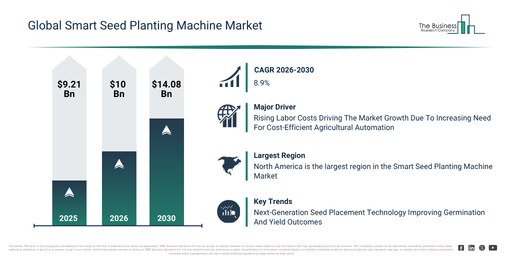
The smart seed planting machine market has demonstrated strong growth in recent years. It is forecast to expand from $9.21 billion in 2025 to $10 billion in 2026, achieving a compound annual growth rate (CAGR) of 8.7%. Historically, this growth can be attributed to the mechanization of traditional farming practices, the increasing demand for efficiency in food production, the adoption of basic seed drills in agriculture, rising labor shortages in rural farming, and the early introduction of mechanized planting equipment.
The smart seed planting machine market is set for considerable expansion in the coming years, with projections indicating a rise to $14.08 billion by 2030, demonstrating a compound annual growth rate (CAGR) of 8.9%. This upward trajectory during the forecast period is attributable to factors such as the increasing adoption of precision agriculture techniques, a growing demand for sustainable farming methods, the wider deployment of autonomous farm machinery, the integration of AI for crop yield optimization, and the escalating need for efficient large-scale agricultural production. Significant trends anticipated within this period include GPS-enabled precision seeding automation in large farms, variable rate seed placement aimed at yield improvement, sensor-based planting systems that adapt to soil conditions, IoT-connected smart seeder fleet management solutions, and seed planting systems integrated with autonomous tractors.
Get A Free Sample Report With In-Depth Market Insights:
Smart Seed Planting Machine Market Growth Momentum: What Factors Are Shaping Demand?
The future expansion of the smart seed planting machine market is expected to be propelled by increasing labor costs. Within farming operations, labor costs denote the financial outlays for employing and managing staff involved in agricultural tasks such as planting, harvesting, and farm upkeep. These costs are on the rise due to a scarcity of agricultural labor and growing wage demands, as fewer workers are available for physically demanding farm work. The expenditure on farm labor encourages the adoption of smart seed planting machines by motivating farmers to reduce their reliance on manual work through automated planting solutions that enhance efficiency, decrease operational expenses, and ensure precise and timely seeding. For instance, in September 2023, the U.S. Department of Agriculture’s Economic Research Service (ERS), a US-based Government agency, reported that total cash labor expenses in the U.S. agriculture sector reached $43.35 billion in 2023, an increase of $0.78 billion (1.8%) from the 2022 level of $42.57 billion. Thus, the escalating labor costs are driving the growth of the smart seed planting machine market.
Smart Seed Planting Machine Market Segment Outlook: Which Categories Are Growing Fastest?
The smart seed planting machine market covered in this report is segmented –
1) By Type: Vacuum Precision Planters, Pneumatic Precision Planters, Mechanical Seed Drills, Automatic Multi Crop Seed Cum Fertilizer Drills, Other Seed Planting Machine Types
2) By Technology: Global Positioning System Enabled Systems, Internet Of Things Integrated Systems, Artificial Intelligence And Machine Learning Based Systems, Sensor Based Variable Rate Technology Systems, Robotics And Autonomous Control Systems
3) By Crop Type: Row Crops, Grains And Cereals, Pulses And Oilseeds, Vegetables And Fruits, Forestry
4) By Distribution Channel: Direct Sales, Indirect Sales
5) By Farm Size: Small Farms Below 400 Hectares, Large Farms Above 400 Hectares
Subsegments:
1) By Vacuum Precision Planters: Single Row Vacuum Precision Planters, Multi Row Vacuum Precision Planters, High Accuracy Vacuum Precision Planters, Global Positioning System Enabled Vacuum Precision Planters
2) By Pneumatic Precision Planters: Single Row Pneumatic Precision Planters, Multi Row Pneumatic Precision Planters, High Speed Pneumatic Precision Planters, Variable Rate Pneumatic Precision Planters
3) By Mechanical Seed Drills: Conventional Mechanical Seed Drills, No Till Mechanical Seed Drills, Row Crop Mechanical Seed Drills, Towed Mechanical Seed Drills
4) By Automatic Multi Crop Seed Cum Fertilizer Drills: Fully Automatic Seed And Fertilizer Drills, Sensor Based Multi Crop Drills, Precision Controlled Seed Cum Fertilizer Drills, Computer Controlled Agricultural Drills
5) By Other Seed Planting Machine Types: Robotic Seed Planting Machines, Drone Assisted Seed Planting Systems, Handheld Smart Seeders, Hybrid Seed Planting Machines
Smart Seed Planting Machine Market Trends Redefining Industry Growth
Key companies in the smart seed planting machine market are concentrating on developing innovative products, such as electronic singulation-based smart seeders. These advancements aim to enhance seed placement accuracy, improve crop uniformity, and increase overall planting efficiency. Electronic singulation-based smart seeders are sophisticated planting systems that electronically separate and position individual seeds at consistent spacing and depth, thereby improving germination uniformity, reducing seed wastage, and boosting crop yield and planting efficiency compared to conventional seeding methods. For instance, in November 2025, Clean Seed Capital Group Ltd., a Canada-based agricultural technology company, introduced the SMART Seeder Mini-MAX, equipped with an advanced electronic singulation system designed to deliver seed-by-seed precision planting. The system is powered by a digital control platform that facilitates real-time adjustment of seed spacing and monitoring of seed delivery, ensuring even distribution for crops such as corn, maize, and soybean. Additionally, it supports retrofit capabilities, allowing existing seeding equipment to be upgraded with smart electronic modules, which improves scalability and adoption across diverse farming operations while enhancing sustainability and yield outcomes.
Smart Seed Planting Machine Market Industry Leaders And Competitive Landscape
Major companies operating in the smart seed planting machine market are Deere & Company, CNH Industrial N.V., Kubota Corporation, Mahindra & Mahindra Limited, AGCO Corporation, CLAAS KGaA mbH, Väderstad AB, Kinze Manufacturing Inc., Bourgault Industries Ltd., Jumil S.A., Amazonen-Werke H. Dreyer SE & Co. KG, Horsch Maschinen GmbH, Semeato S.A., Almaco Group Inc., Yetter Manufacturing Company Inc., Agrisem International SAS, Maschio Gaspardo S.p.A., Dharti Agro Engineering, Crucianelli S.A., Sfoggia Agriculture Division S.r.l.
View The Full Smart Seed Planting Machine Market Report:
Smart Seed Planting Machine Market Regional Analysis And Leading Geography
North America was the largest region in the smart seed planting machine market in 2025. Asia-Pacific is expected to be the fastest-growing region in the forecast period. The regions covered in the smart seed planting machine market report are Asia-Pacific, South East Asia, Western Europe, Eastern Europe, North America, South America, Middle East, Africa.
Reach Out To Our Team:
The Business Research Company: https://www.thebusinessresearchcompany.com/
Americas: +1 310-496-7795
Asia: +44 7882 955267 & +91 8897263534
Europe: +44 7882 955267
Email us at: marketing@tbrc.info
Follow us on:
LinkedIn: https://in.linkedin.com/company/the-business-research-company
YouTube: https://www.youtube.com/channel/UC24_fI0rV8cR5DxlCpgmyFQ
Global Market Model: https://www.thebusinessresearchcompany.com/global-market-model

Wasay has over a decade of experience in market research, data modelling, and analytics, with prior experience at GlobalData and Decision Tree Consulting Services. At The Business Research Company , he leads research operations across syndicated studies, customized consulting engagements, and the Global Market Model platform. His professional experience includes supporting organizations such as Boston Consulting Group, KPMG, and Ernst & Young. Wasay holds a degree in Electronics and Communications Engineering, postgraduate management qualifications from International Management Institute Belgium and Indian School of Business and Entrepreneurship, and completed the Integrated Program in Business Analytics from Indian Institute of Management Indore.