Built to provide research that’s more actionable and strategically valuable, The Business Research Company’s 2026 market reports include market attractiveness analysis, total addressable market sizing, company benchmarking matrices, interactive Excel dashboards, broader supply chain intelligence, emerging startup tracking, and in-depth product insights.
Spray-Induced Gene Silencing (SIGS) Carrier Adjuvant Market Growth From $1.09 Billion In 2026 To $1.54 Billion By 2030 At A CAGR Of 9%
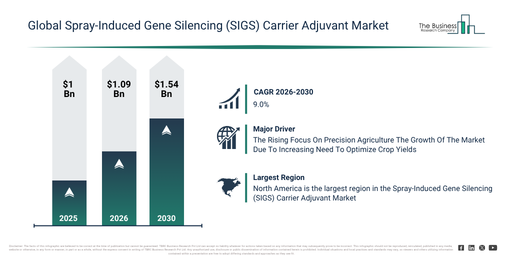
The market for spray-induced gene silencing (SIGS) carrier adjuvants has experienced robust expansion over recent years. This market is projected to expand from $1 billion in 2025 to $1.09 billion in 2026, demonstrating a compound annual growth rate (CAGR) of 8.7%. Historically, this growth can be ascribed to several factors, including a heightened dependence on chemical pesticides for safeguarding crops, augmented research into plant molecular biology and gene regulation, the initial advancements in RNA interference technologies within agriculture, the escalating resistance of pests to traditional agrochemicals, and the broader development of agrochemical formulation techniques.
The spray-induced gene silencing (SIGS) carrier adjuvant market is expected to experience robust expansion in the near future. Its valuation is predicted to reach $1.54 billion in 2030, growing at a compound annual growth rate (CAGR) of 9.0%. This projected increase is attributable to a growing demand for sustainable and residue-free crop protection, the rising embrace of precision agriculture technologies, the broadening scope of RNA-based biopesticide innovations, the spread of climate-resilient farming methods, and advancements in nano-delivery systems for agricultural applications. Significant trends for the forecast period include enhanced RNA stabilization and delivery systems for spray-induced gene silencing applications, bio-based carrier adjuvants improving the environmental compatibility of SIGS formulations, nano-encapsulation technologies designed to protect RNA molecules in field settings, the adoption of gene silencing-based crop protection solutions in precision agriculture, and the development of polymer-based adjuvants for improved foliar uptake efficiency.
Get A Free Sample Report With In-Depth Market Insights:
Spray-Induced Gene Silencing (SIGS) Carrier Adjuvant Market Growth Drivers: What’s Behind The Acceleration?
An increasing emphasis on precision agriculture is anticipated to drive the expansion of the spray-induced gene silencing (SIGS) carrier adjuvant market in the coming years. This approach to modern farm management leverages data, sensors, global positioning systems, and sophisticated analytics to enhance crop production at the field level, ensuring inputs are applied precisely—in the correct quantity, at the opportune moment, and in the exact spot. This heightened focus on precision agriculture primarily stems from the growing requirement to maximize crop yields, boost resource efficiency, and lower input expenses through the precise management of farming operations using data-driven technologies. Precision agriculture benefits spray-induced gene silencing (SIGS) carrier adjuvants by facilitating the highly targeted and effective delivery of RNA-based sprays to particular crops or field areas. This enhances the efficacy of gene silencing while simultaneously reducing the reliance on chemicals and mitigating environmental impact. For instance, in March 2025, according to the Department for Environment, Food and Rural Affairs (Defra), a UK-based government department, in 2022/23, 28% of farms adopted precision farming techniques, marking a rise of 3 percentage points compared to the previous year. Consequently, the increasing emphasis on precision agriculture is a key factor propelling the expansion of the Spray-Induced Gene Silencing (SIGS) carrier adjuvant market. A growing focus on sustainable farming practices is projected to stimulate the expansion of the spray-induced gene silencing (SIGS) carrier adjuvant market moving ahead. These practices encompass agricultural techniques that give precedence to safeguarding the environment, nurturing soil health, and conserving resources, all while ensuring sustained productivity over time. This heightened attention to sustainable farming arises from a growing consumer demand for food produced with minimal environmental harm, prompting farmers to embrace methods that cut down on chemical usage and lessen ecological footprints. Spray-induced gene silencing (SIGS) carrier adjuvants contribute to sustainable agriculture by improving the stability, precise delivery, and overall efficacy of RNA molecules designed to combat crop pests and pathogens, thus presenting a viable substitute for traditional chemical pesticides. For instance, in May 2025, according to the Department for Environment, Food and Rural Affairs (DEFRA), a UK-based government department, the UK had 503,000 hectares of land under organic farming in 2024, marking a 1.0% increase from 2023. Hence, the increased focus on sustainable farming methods is fueling the expansion of the spray-induced gene silencing (SIGS) carrier adjuvant market.
Spray-Induced Gene Silencing (SIGS) Carrier Adjuvant Market Segment Analysis Spotlighting Growth Areas
The spray-induced gene silencing (SIGS) carrier adjuvant market covered in this report is segmented –
1) By Product Type: Liquid Adjuvants, Solid Adjuvants, Other Product Types
2) By Crop Type: Cereals And Grains, Fruits And Vegetables, Oilseeds And Pulses, Other Crop Types
3) By Function: Penetration Enhancers, Surfactants, Stabilizers, Other Functions
4) By Application: Agriculture, Horticulture, Forestry, Other Applications
Subsegments:
1) By Liquid Adjuvants: Oil Based Adjuvants, Water Based Adjuvants, Emulsifiable Concentrates, Suspension Concentrates, Solution Concentrates
2) By Solid Adjuvants: Wettable Powders, Water Dispersible Granules, Soluble Powders, Dry Flowables, Granular Formulations
3) By Other Product Types: Silicone Based Adjuvants, Bio Based Adjuvants, Polymer Based Adjuvants, Organosilicon Adjuvants, Modified Vegetable Oil Adjuvants
Spray-Induced Gene Silencing (SIGS) Carrier Adjuvant Market Competitive Landscape: Which Companies Lead The Industry?
Major companies operating in the spray-induced gene silencing (sigs) carrier adjuvant market are BASF SE, Bayer AG, Corteva Inc., Evonik Industries AG, Solvay SA, Huntsman Corporation, Nouryon Industries BV, Stepan Company, Nufarm Limited, Croda International Plc, Ashland Global Holdings Inc., GreenLight Biosciences Inc., Brandt Consolidated Inc.
View The Full Spray-Induced Gene Silencing (SIGS) Carrier Adjuvant Market Report:
Spray-Induced Gene Silencing (SIGS) Carrier Adjuvant Market Regional Breakdown: Where Is Demand Concentrated?
North America was the largest region in the spray-induced gene silencing (SIGS) carrier adjuvant market in 2025. Asia-Pacific is expected to be the fastest-growing region in the forecast period. The regions covered in the spray-induced gene silencing (SIGS) carrier adjuvant market report are Asia-Pacific, South East Asia, Western Europe, Eastern Europe, North America, South America, Middle East, Africa.
Reach Out To Our Team:
The Business Research Company: https://www.thebusinessresearchcompany.com/
Americas: +1 310-496-7795
Asia: +44 7882 955267 & +91 8897263534
Europe: +44 7882 955267
Email us at: marketing@tbrc.info
Follow us on:
LinkedIn: https://in.linkedin.com/company/the-business-research-company
YouTube: https://www.youtube.com/channel/UC24_fI0rV8cR5DxlCpgmyFQ
Global Market Model: https://www.thebusinessresearchcompany.com/global-market-model

Wasay has over a decade of experience in market research, data modelling, and analytics, with prior experience at GlobalData and Decision Tree Consulting Services. At The Business Research Company , he leads research operations across syndicated studies, customized consulting engagements, and the Global Market Model platform. His professional experience includes supporting organizations such as Boston Consulting Group, KPMG, and Ernst & Young. Wasay holds a degree in Electronics and Communications Engineering, postgraduate management qualifications from International Management Institute Belgium and Indian School of Business and Entrepreneurship, and completed the Integrated Program in Business Analytics from Indian Institute of Management Indore.