Featuring market attractiveness scoring, total addressable market sizing, company benchmarking matrices, interactive Excel dashboards, deeper supply chain intelligence, emerging startup tracking, and granular product-level insights, The Business Research Company’s 2026 market reports are built to deliver research that is both more actionable and more strategically valuable.
Home Compostable Tray Market Growth Analysis: How Will Revenue Trend Over The Forecast Period?
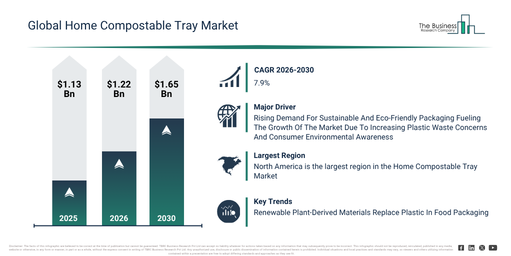
The home compostable tray market size has experienced robust growth in recent years. It is projected to increase from $1.13 billion in 2025 to $1.22 billion in 2026, at a compound annual growth rate (CAGR) of 7.6%. The expansion observed historically can be attributed to factors such as increasing awareness concerning the impact of plastic pollution, the growing adoption of sustainable packaging within the food industry, a rise in government bans on single-use plastics, the expansion of eco-friendly packaging startups, and evolving consumer preferences for biodegradable materials.
The home compostable tray market is set to experience significant expansion in the upcoming years, with its size expected to reach $1.65 billion by 2030, reflecting a compound annual growth rate (CAGR) of 7.9%. This projected growth is primarily fueled by strengthening circular economy regulations, a rising demand for compostable packaging in food delivery services, the expansion of sustainable retail packaging standards, ongoing innovation in plant fiber and bio-based materials, and increased corporate sustainability commitments across the foodservice industry. Prominent trends throughout this forecast period include the growing adoption of compostable food packaging solutions in quick service restaurants, an increasing need for plastic-free sustainable packaging materials, advancements in bio-based polymer and fiber molded packaging innovation, the spread of circular packaging systems within the retail and foodservice sectors, and a stronger regulatory impetus to replace single-use plastics with compostable alternatives.
Get A Free Sample Report With In-Depth Market Insights:
Home Compostable Tray Market Growth Drivers: What’s Behind The Acceleration?
The home compostable tray market is projected to grow as a result of the increasing requirement for sustainable and eco-friendly packaging moving forward. Sustainable and eco-friendly packaging refers to materials specifically designed to minimize environmental impact through biodegradability, renewability, and a reduced carbon footprint. The demand for such packaging is on the rise due to mounting environmental concerns, which are driven by escalating plastic pollution and enhanced consumer awareness regarding waste management. The home compostable tray supports sustainable and eco-friendly packaging by offering solutions that naturally decompose in household compost systems, thereby alleviating landfill burden and fostering circular waste practices. For instance, in January 2025, according to the Shorr Packaging Corp., a US-based distributor of packaging materials and equipment, a survey of 2,016 U.S. consumers indicated a strong inclination toward sustainability, with 54% reporting that they consciously chose products featuring sustainable packaging within the past six months. Moreover, 90% of respondents stated a higher likelihood of purchasing from brands or retailers that utilize environmentally friendly packaging. Therefore, the increasing demand for sustainable and eco-friendly packaging is fueling the expansion of the home compostable tray market.
Home Compostable Tray Market Segment Analysis And Revenue Potential
The home compostable tray market covered in this report is segmented –
1) By Product Type: Divided Trays, Single-Compartment Trays, Shallow Trays, Deep Trays
2) By Material Type: Bagasse, Polylactic Acid, Paper And Paperboard, Starch Blends, Other Material Types
3) By Distribution Channel: Online, Supermarkets Or Hypermarkets, Specialty Stores, Other Distribution Channels
4) By Application: Food Packaging, Fruits And Vegetables, Meat And Poultry, Ready-To-Eat Meals, Other Applications
5) By End-Use Industry: Food And Beverage, Retail, Foodservice, Household, Other End-Use Industries
Subsegments:
1) By Divided Trays: Small Divided Trays, Medium Divided Trays, Large Divided Trays
2) By Single-Compartment Trays: Shallow Single-Compartment Trays, Deep Single-Compartment Trays
3) By Shallow Trays: Rectangular Shallow Trays, Square Shallow Trays, Circular Shallow Trays
4) By Deep Trays: Rectangular Deep Trays, Square Deep Trays, Circular Deep Trays
Home Compostable Tray Market Trends: What’s Defining The Industry’s Next Phase?
Major companies operating in the home compostable tray market are concentrating on developing innovative products, such as biodegradable fiber-based packaging. This enables a shift from petroleum-based plastics to renewable, plant-derived materials that naturally decompose under home composting conditions while upholding packaging performance. Biodegradable fiber-based packaging refers to packaging solutions made from molded pulp or natural fibers, engineered to break down into organic matter quickly within home compost systems, thereby diminishing long-term environmental impact and landfill accumulation. For instance, in April 2025, Bubbies Homemade Ice Cream & Desserts Inc., a US-based frozen dessert manufacturer, introduced certified home-compostable paper pulp trays to replace its internal plastic clamshell packaging for its mochi ice cream offerings. These trays are designed to biodegrade within six months in home composting environments, maintaining structural integrity similar to plastic alternatives, which resulted in a 94% reduction in plastic usage and the elimination of approximately 310 tons of plastic waste annually, thus supporting sustainable packaging adoption and environmental conservation.
Home Compostable Tray Market Leading Players And Competitive Positioning
Major companies operating in the home compostable tray market are Huhtamaki Oyj, Duni AB, Footprint Inc., CKF Inc., Detmold Packaging Pty Ltd., Ecovative Design LLC, Henry Molded Products Inc., PAPACKS Sales GmbH, TIPA Corp Ltd., Zhiben Environmental Protection Technology Group Co. Ltd., Papstar GmbH, World Centric Inc., Ningbo Homelink Eco-iTech Co. Ltd., BIOPAP S.r.l., Green Olive Environmental Technology Co. Ltd., YITO Eco Packaging Co. Ltd., Anhui Ecolates Environmental Protection Co. Ltd., BonitoPak Corp., GreenGood USA Inc., Bioleader Environmental Protection Technology Co. Ltd.
View The Full Home Compostable Tray Market Report:
Home Compostable Tray Market Regional Split: Which Areas Are Fueling Growth?
North America was the largest region in the home compostable tray market in 2025. Asia-Pacific is expected to be the fastest-growing region in the forecast period. The regions covered in the home compostable tray market report are Asia-Pacific, South East Asia, Western Europe, Eastern Europe, North America, South America, Middle East, Africa.
Reach Out To Our Team:
The Business Research Company: https://www.thebusinessresearchcompany.com/
Americas: +1 310-496-7795
Asia: +44 7882 955267 & +91 8897263534
Europe: +44 7882 955267
Email us at: marketing@tbrc.info
Follow us on:
LinkedIn: https://in.linkedin.com/company/the-business-research-company
YouTube: https://www.youtube.com/channel/UC24_fI0rV8cR5DxlCpgmyFQ
Global Market Model: https://www.thebusinessresearchcompany.com/global-market-model

Wasay has over a decade of experience in market research, data modelling, and analytics, with prior experience at GlobalData and Decision Tree Consulting Services. At The Business Research Company , he leads research operations across syndicated studies, customized consulting engagements, and the Global Market Model platform. His professional experience includes supporting organizations such as Boston Consulting Group, KPMG, and Ernst & Young. Wasay holds a degree in Electronics and Communications Engineering, postgraduate management qualifications from International Management Institute Belgium and Indian School of Business and Entrepreneurship, and completed the Integrated Program in Business Analytics from Indian Institute of Management Indore.