Featuring market attractiveness scoring, total addressable market sizing, company benchmarking matrices, interactive Excel dashboards, deeper supply chain intelligence, emerging startup tracking, and granular product-level insights, The Business Research Company’s 2026 market reports are built to deliver research that is both more actionable and more strategically valuable.
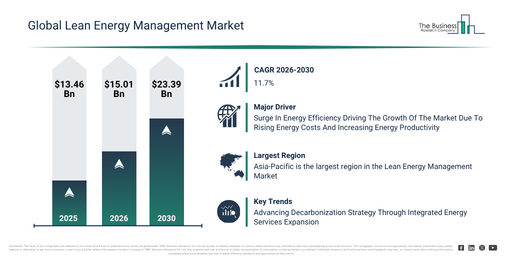
Lean Energy Management Market Growth From $15.01 Billion In 2026 To $23.39 Billion By 2030 At A CAGR Of 11.7%
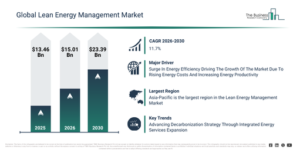
The lean energy management market size has seen rapid expansion in recent years. It is anticipated to increase from $13.46 billion in 2025 to $15.01 billion in 2026, exhibiting a compound annual growth rate (CAGR) of 11.5%. The historical growth of this market can be ascribed to several factors, including the rising industrial energy consumption across manufacturing sectors, increasing fuel and electricity costs that necessitate efficiency, regulatory pressure for energy conservation in various industries, the early adoption of basic energy monitoring systems within large enterprises, and a growing awareness of operational cost optimization.
The lean energy management market is anticipated to show significant expansion in the next few years, projected to attain a size of $23.39 billion by 2030, exhibiting a compound annual growth rate of 11.7%. This growth over the forecast period is primarily fueled by strict mandates for reducing carbon emissions, the increasing adoption of smart manufacturing and Industry 4.0 solutions, the expansion of IoT-enabled infrastructure for energy monitoring, the rising integration of AI-based tools for predictive optimization, and growing corporate commitments to sustainability and net-zero targets. Major trends expected during this period involve real-time energy consumption monitoring and optimization within industrial systems, the integration of AI-driven predictive energy analytics for demand forecasting, the deployment of IoT-enabled smart meters and sensors for energy tracking, the adoption of cloud-based energy management platforms for centralized control, and the implementation of carbon footprint tracking and reporting within enterprise energy systems.
Get A Free Sample Report With In-Depth Market Insights:
Lean Energy Management Market Growth Momentum: What Factors Are Shaping Demand?
The increasing need for energy efficiency is anticipated to spur the expansion of the lean energy management market in the future. Energy efficiency involves utilizing less power to achieve identical tasks or produce the same output, thereby minimizing energy wastage and enhancing overall operational effectiveness. The proliferation of energy efficiency is primarily fueled by cost advantages, as it decreases energy consumption and reduces operational expenditures, enabling both organizations and consumers to realize long-term financial gains. Lean energy management aids in improving energy efficiency by systematically pinpointing and eradicating energy waste, optimizing resource utilization, and ensuring constant oversight for sustained performance enhancements. For instance, in November 2025, according to the International Energy Agency, a France-based intergovernmental organization, global primary energy intensity improved by 1.8% in 2025, up from approximately 1% in the previous year. Consequently, the escalating demand for energy efficiency is propelling the growth of the lean energy management market. The rising adoption of cloud technology is augmenting lean energy management growth by creating a need for infrastructure that is both scalable and energy-efficient. The expanding requirement for cloud-based adoption is projected to drive forward the lean energy management market. Cloud-based adoption refers to the utilization of internet-based platforms for managing data and applications, facilitating scalable and remote access. The surge in cloud-based adoption is propelled by its inherent scalability, allowing organizations to readily expand resources as required without substantial initial infrastructure investments. Lean energy management supports cloud-based adoption through the optimization of energy consumption in data centers and cloud infrastructure, which not only lowers operational costs but also boosts efficiency and sustainability. For instance, in March 2025, according to the Office for National Statistics, a UK-based government agency, in 2023, artificial intelligence (AI) was adopted by 9% of firms, while cloud-based computing systems and applications were adopted by 69% of firms in the UK. Thus, the increasing demand for cloud-based adoption is a key factor in the expansion of the lean energy management market.
Lean Energy Management Market Segmentation: How Does The Market Break Down By Category?
The lean energy management market covered in this report is segmented –
1) By Component: Hardware, Software, Services
2) By Deployment Mode: Cloud-Based, On-Premises, Hybrid Models
3) By Application: Manufacturing, Power And Energy, Commercial Buildings, Information Technology And Telecom, Healthcare, Other Applications
4) By End-User: Industrial, Commercial Buildings, Utilities, Government, Healthcare, Other End-Users
Subsegments:
1) By Hardware: Sensors And Meters, Control Systems, Energy Measurement Devices, Industrial Equipment Monitoring Devices, Communication And Networking Devices
2) By Software: Energy Management Platforms, Data Analytics And Visualization Tools, Energy Optimization Software, Carbon Management Software, Reporting And Compliance Software
3) By Services: Energy Consulting Services, System Integration Services, Maintenance And Support Services, Energy Auditing Services, Training And Advisory Services
Lean Energy Management Market Trends Redefining Industry Growth
Leading companies within the lean energy management market are concentrating on integrating various aspects of the energy value chain. This effort is largely spurred by a significant focus on decarbonization, aiming to decrease carbon emissions, enhance energy efficiency, and contribute to long-term sustainability goals. A strong emphasis on decarbonization signifies a deliberate organizational or governmental commitment to substantially reduce carbon emissions through improved energy efficiency, increased adoption of renewables, and sustainable operational methods. For instance, in March 2025, ENGIE SA, an energy and services firm based in France, initiated its Supply and Energy Management operations in India. This involved establishing a specialized branch to link renewable energy assets with both customers and markets. The new framework provides customized solutions for sectors like manufacturing, commercial real estate, and industrial operations, thereby optimizing energy procurement, cutting costs, and promoting sustainability. Building on ENGIE’s 30-year history in India and its 2.3 GW solar and wind portfolio, this expansion intends to back the country’s move towards a carbon-neutral economy, while also investigating emerging technologies such as batteries, storage, and hybrid renewables. The initiative underscores asset optimization, risk management, and effective decarbonization solutions, promising businesses dependable, cost-efficient, and sustainable energy results by combining generation, supply, and energy management capabilities.
Lean Energy Management Market Key Players Shaping Industry Direction
Major companies operating in the lean energy management market are Siemens AG, IBM Corporation, General Electric Company, Schneider Electric SE, Honeywell International Inc., SAP SE, ABB Ltd., Johnson Controls International plc, Ameresco Inc., ista International GmbH, Willdan Group Inc., Enel X S.r.l., ENGIE Impact LLC, NORESCO LLC, Arcadia Inc., Emporia Energy Inc., Smart Joules Private Limited, GridBeyond Ltd., Econoler Inc., EcoFactor Inc., EnergyCAP LLC, Franklin Energy Services LLC, Edison Next S.p.A., Radix IoT LLC, Energy Elephant Ltd., Fabric IoT Inc., Sealed Inc.
View The Full Lean Energy Management Market Report:
Lean Energy Management Market Regional Analysis: Which Geography Leads On Revenue?
Asia-Pacific was the largest region in the lean energy management market in 2025. North America is expected to be the fastest-growing region in the forecast period. The regions covered in the lean energy management market report are Asia-Pacific, South East Asia, Western Europe, Eastern Europe, North America, South America, Middle East, Africa.
Reach Out To Our Team:
The Business Research Company: https://www.thebusinessresearchcompany.com/
Americas: +1 310-496-7795
Asia: +44 7882 955267 & +91 8897263534
Europe: +44 7882 955267
Email us at: marketing@tbrc.info
Follow us on:
LinkedIn: https://in.linkedin.com/company/the-business-research-company
YouTube: https://www.youtube.com/channel/UC24_fI0rV8cR5DxlCpgmyFQ
Global Market Model: https://www.thebusinessresearchcompany.com/global-market-model

Wasay has over a decade of experience in market research, data modelling, and analytics, with prior experience at GlobalData and Decision Tree Consulting Services. At The Business Research Company , he leads research operations across syndicated studies, customized consulting engagements, and the Global Market Model platform. His professional experience includes supporting organizations such as Boston Consulting Group, KPMG, and Ernst & Young. Wasay holds a degree in Electronics and Communications Engineering, postgraduate management qualifications from International Management Institute Belgium and Indian School of Business and Entrepreneurship, and completed the Integrated Program in Business Analytics from Indian Institute of Management Indore.