Backed by market attractiveness analysis, total addressable market sizing, company benchmarking matrices, interactive Excel dashboards, wider supply chain intelligence, emerging startup coverage, and detailed product-level insights, The Business Research Company’s 2026 market reports are designed to offer research that is more actionable and strategically valuable than ever.
Military Defense Semiconductor Market Expansion Outlook: What Revenue Opportunities Are Ahead?
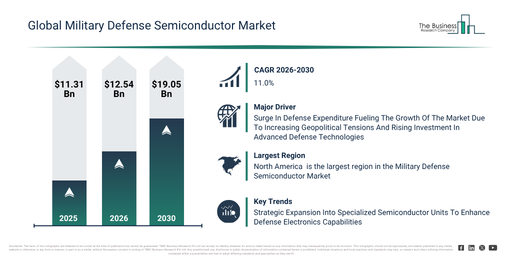
The military defense semiconductor market has experienced rapid expansion in recent years. It is anticipated to increase from $11.31 billion in 2025 to $12.54 billion in 2026, demonstrating a compound annual growth rate (CAGR) of 10.8%. Factors contributing to its historical growth include the expansion of defense electronics driven by the Cold War, a growing demand for secure military communication systems, the early adoption of embedded avionics computing systems, advancements in radar and surveillance modernization programs, and the increasing integration of semiconductor-based weapon guidance systems.
The military defense semiconductor market size is projected to experience substantial expansion in the coming years. Its value is forecast to reach $19.05 billion by 2030, demonstrating an 11.0% compound annual growth rate (CAGR). This anticipated growth during the projection period stems from factors such as the expansion of space-based defense and satellite communication networks, an increasing need for hypersonic and advanced missile guidance electronics, heightened investment in sovereign semiconductor fabrication facilities, a rising requirement for radiation-hardened and extreme environment electronics, and a surge in defense digital transformation and modernization initiatives. Key trends expected over the forecast period involve the advancement of radiation-hardened semiconductors for space and defense uses, the incorporation of gallium nitride (GaN) and silicon carbide (SiC) in high-frequency and high-temperature defense systems, the miniaturization of defense-grade chips for integrated military systems, the establishment of secure sovereign semiconductor supply chains for defense, and sophisticated thermal management solutions for highly reliable military electronics.
Get A Free Sample Report With In-Depth Market Insights:
Military Defense Semiconductor Market Demand Drivers Opening New Revenue Streams
The anticipated increase in defense expenditure is expected to fuel the expansion of the military defense semiconductor market in the future. This spending refers to governmental investment in military forces, equipment, operations, and activities related to national security. The surge in defense expenditure stems from escalating geopolitical tensions, as countries enhance military spending to bolster national security and readiness. Military defense semiconductors contribute to defense spending by enabling advanced, high-performance electronic systems like radar, communication, and weapons platforms, which in turn improve military capability and justify elevated defense budgets. For example, in April 2024, a report by the Stockholm International Peace Research Institute (SIPRI), an international research institute located in Sweden, indicated that global military spending reached $2.443 trillion in 2023, marking a 6.8% real-term increase compared to 2022. Thus, the growing global defense expenditure is driving the growth of the military defense semiconductor market.
Military Defense Semiconductor Market Segments: Where Is Growth Concentrated?
The military defense semiconductor market covered in this report is segmented –
1) By Component Type: Microprocessors And Microcontrollers, Field-Programmable Gate Arrays, Application-Specific Integrated Circuits, Memory Chips, Radio Frequency Semiconductors
2) By Packaging Technology: Surface Mount Technology, Through-Hole Technology
3) By Application Type: Radar And Surveillance Systems, Electronic Warfare And Jamming Systems, Military Communication Systems, Unmanned Systems, Space And Satellite Defense Systems, Cybersecurity And Secure Computing
4) By End-User Type: Defense Contractors And Original Equipment Manufacturers, Government Defense Agencies, Space Defense Organizations
Subsegments:
1) By Microprocessors And Microcontrollers: General Purpose Microprocessors, Embedded Microcontrollers, Digital Signal Processing Microcontrollers, Real Time Control Microcontrollers
2) By Field Programmable Gate Arrays: Low-Density Field Programmable Gate Arrays, Mid-Range Field Programmable Gate Arrays, High-Density Field Programmable Gate Arrays, Radiation-Hardened Field Programmable Gate Arrays
3) By Application Specific Integrated Circuits: Full Custom Application Specific Integrated Circuits, Semi Custom Application Specific Integrated Circuits, Standard Cell Based Application Specific Integrated Circuits, Structured Application Specific Integrated Circuits
4)By Memory Chips: Volatile Memory Chips, Non-Volatile Memory Chips, Dynamic Random Access Memory Chips, Static Random Access Memory Chips, Flash Memory Chips, Electrically Erasable Programmable Read-Only Memory Chips
5) By Radio Frequency Semiconductors: Power Amplifier Radio Frequency Semiconductors, Low Noise Amplifier Radio Frequency Semiconductors, Mixer Radio Frequency Semiconductors, Oscillator Radio Frequency Semiconductors, Transceiver Radio Frequency Semiconductors
Military Defense Semiconductor Market Trends Powering Strategic Industry Growth
Companies prominent in the military defense semiconductor market are increasingly concentrating on deliberate expansion into dedicated semiconductor verticals, establishing specialized subsidiaries and research and development units. This strategic move aims to bolster capabilities in cutting-edge chip design, secure processing systems, and vital electronic components utilized in radar, communication, surveillance, and electronic warfare applications. Such specialized entities are specifically designed to concentrate on developing, innovating, and advancing particular technologies or product lines. A notable instance occurred in February 2026, when Paras Defense and Space Technologies, an Indian defense engineering firm, announced the establishment of Paras Semiconductors Private Limited, a division dedicated to semiconductors. This initiative is designed to reinforce its footprint in advanced electronics and semiconductor technologies pertinent to defense, encompassing secure communication systems and high-performance electronic subsystems. This trend underscores the increasing emphasis within the defense sector on developing homegrown semiconductor capabilities, thereby supporting decreased reliance on imports, heightened technological sovereignty, and improved incorporation of sophisticated chips into military platforms such as radar systems, surveillance equipment, and electronic warfare solutions.
Military Defense Semiconductor Market Leading Players And Competitive Positioning
Major companies operating in the military defense semiconductor market are NVIDIA Corporation, Intel Corporation, Northrop Grumman Corporation, Advanced Micro Devices Inc., Texas Instruments Incorporated, Infineon Technologies AG, Analog Devices Inc., Microchip Technology Incorporated, ON Semiconductor Corporation, GlobalFoundries Inc., Amkor Technology Inc., Teledyne Technologies Incorporated, Marvell Technology Inc., Skyworks Solutions Inc., Qorvo Inc., Lattice Semiconductor Corporation, MACOM Technology Solutions Holdings Inc., Win Semiconductors Corp., GSI Technology Inc., QuickLogic Corporation
View The Full Military Defense Semiconductor Market Report:
Military Defense Semiconductor Market Regional Split: Which Areas Are Fueling Growth?
North America was the largest region in the military defence semiconductor market in 2025. Asia-Pacific is expected to be the fastest-growing region in the forecast period. The regions covered in the military defense semiconductor market report are Asia-Pacific, South East Asia, Western Europe, Eastern Europe, North America, South America, Middle East, Africa.
Reach Out To Our Team:
The Business Research Company: https://www.thebusinessresearchcompany.com/
Americas: +1 310-496-7795
Asia: +44 7882 955267 & +91 8897263534
Europe: +44 7882 955267
Email us at: marketing@tbrc.info
Follow us on:
LinkedIn: https://in.linkedin.com/company/the-business-research-company
YouTube: https://www.youtube.com/channel/UC24_fI0rV8cR5DxlCpgmyFQ
Global Market Model: https://www.thebusinessresearchcompany.com/global-market-model

Wasay has over a decade of experience in market research, data modelling, and analytics, with prior experience at GlobalData and Decision Tree Consulting Services. At The Business Research Company , he leads research operations across syndicated studies, customized consulting engagements, and the Global Market Model platform. His professional experience includes supporting organizations such as Boston Consulting Group, KPMG, and Ernst & Young. Wasay holds a degree in Electronics and Communications Engineering, postgraduate management qualifications from International Management Institute Belgium and Indian School of Business and Entrepreneurship, and completed the Integrated Program in Business Analytics from Indian Institute of Management Indore.