
Built to provide research that’s more actionable and strategically valuable, The Business Research Company’s 2026 market reports include market attractiveness analysis, total addressable market sizing, company benchmarking matrices, interactive Excel dashboards, broader supply chain intelligence, emerging startup tracking, and in-depth product insights.
Airborne Early Warning Aircraft Market CAGR Outlook And Future Development
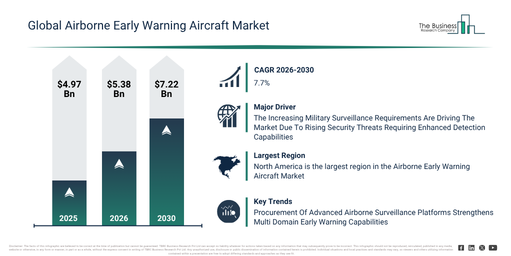
The airborne early warning aircraft market size has experienced robust growth in recent years. It is anticipated to increase from $4.97 billion in 2025 to $5.38 billion in 2026, achieving a compound annual growth rate (CAGR) of 8.1%. This historical growth can be ascribed to a surge in demand for enhanced airspace surveillance, augmented military expenditure on airborne defense systems, an expanding requirement for real-time battlefield situational awareness, the broader adoption of airborne command and control capabilities, and escalating threats from advanced aircraft and missiles.
The airborne early warning aircraft market size is projected to experience substantial growth over the upcoming years. It is anticipated to reach $7.22 billion by 2030, demonstrating a compound annual growth rate (CAGR) of 7.7%. This expansion during the forecast period is due to a heightened need for multi-domain command and control capabilities, an increasing requirement for the swift identification of hypersonic and low observable threats, expanding requirements for prolonged surveillance missions, the ongoing upgrade of older airborne early warning fleets, and a surging need for interoperable airborne defense networks. Key developments expected in this period encompass the wider deployment of sophisticated radar systems for detecting distant threats, a growing call for multi-domain surveillance features, an increasing embrace of network-centric airborne command and control, a greater desire for extended mission operational time, and the heightened incorporation of advanced electronic warfare functionalities.
Get A Free Sample Report With In-Depth Market Insights:
Airborne Early Warning Aircraft Market Opportunity Drivers: What’s Unlocking New Revenue Potential?
The escalating need for military surveillance is projected to fuel the expansion of the airborne early warning aircraft market moving forward. These military surveillance requirements involve the necessity for continuous monitoring, detection, tracking, and intelligence gathering across air, land, and maritime domains to bolster national security and defense operations. The increase in military surveillance demands is a result of rising geopolitical tensions, prompting defense forces to enhance continuous vigilance and early threat identification to improve national security. These growing surveillance requirements support airborne early warning aircraft by driving the demand for advanced airborne radar, real-time threat detection, and battlefield coordination capabilities, which ultimately strengthen situational awareness and mission effectiveness. For instance, in February 2026, Gov.UK, the official digital portal for the UK government, reported that uncrewed aerial vehicle (UAV) incidents near United Kingdom Ministry of Defence sites increased from 126 in 2024 to 266 in 2025, more than doubling within a year. This data highlights the intensifying need for improved military surveillance and early threat detection capabilities. Therefore, the expanding military surveillance requirements are propelling the growth of the airborne early warning aircraft market.
Airborne Early Warning Aircraft Market Segment Landscape And Growth Outlook
The airborne early warning aircraft market covered in this report is segmented –
1) By Component: Radar Systems, Identification Friend Or Foe, Communication Systems, Electronic Warfare Systems, Other Components
2) By Aircraft Type: Fixed Wing Airborne Early Warning Aircraft, Rotary Wing Airborne Early Warning Aircraft
3) By Application: Air Surveillance, Maritime Surveillance, Battle Management, Command And Control, Intelligence, Surveillance, And Reconnaissance, Border Security, Early Threat Detection
4) By End User: Air Force, Navy, Joint Defense Forces, Homeland Security Agencies
Subsegments:
1) By Radar Systems: Active Electronically Scanned Array Radar, Mechanically Scanned Radar, Radar Antenna, Radar Signal Processor
2) By Identification Friend Or Foe: Interrogator Unit, Transponder Unit, Cryptographic Module, Antenna Unit
3) By Communication Systems: Satellite Communication System, High Frequency Communication System, Very High Frequency Communication System, Ultra High Frequency Communication System
4) By Electronic Warfare Systems: Radar Warning Receiver, Electronic Support Measures, Electronic Countermeasure System, Self Protection Suite
5) By Other Components: Flight Management System, Navigation System, Display System, Integrated Modular Avionics
Airborne Early Warning Aircraft Market Innovation Trends Shaping Future Development
Leading companies in the airborne early warning aircraft market are concentrating on acquiring advanced airborne surveillance platforms to modernize defense capabilities, enhance multi-domain situational awareness, and counter evolving security threats. An airborne surveillance platform is defined as an aircraft equipped with integrated sensors and mission technologies, designed to provide persistent detection, tracking, monitoring, and situational awareness across air, land, and maritime environments. For example, in July 2026, the North Atlantic Treaty Organization (NATO), an intergovernmental military alliance based in Belgium, announced the joint procurement of Saab GlobalEye airborne surveillance platforms to serve as its new airborne warning and control system. This procurement aims to replace a portion of the alliance’s aging airborne early warning fleet with systems capable of delivering integrated surveillance across air, land, and sea, while also improving the detection and tracking of complex threats. The endeavor bolsters operational readiness, strengthens collective defense capabilities, and signifies increasing investment in next-generation airborne early warning systems.
Airborne Early Warning Aircraft Market Competitive Overview And Top Companies
Major companies operating in the airborne early warning aircraft market are The Boeing Company, Airbus SE, RTX Corporation, Lockheed Martin Corporation, Northrop Grumman Corporation, Leonardo S.p.A., BAE Systems plc, L3Harris Technologies Inc., Thales Group, Rostec State Corporation, Aviation Industry Corporation of China Ltd., Bombardier Inc., Embraer S.A., China Electronics Technology Group Corporation, Saab AB, Hindustan Aeronautics Limited, Israel Aerospace Industries Ltd., Indra Sistemas S.A., Bharat Electronics Limited, Aselsan Elektronik Sanayi ve Ticaret A.S., HENSOLDT AG, Hanwha Systems Co. Ltd., TTM Technologies Inc.
View The Full Airborne Early Warning Aircraft Market Report:
Airborne Early Warning Aircraft Market Top Region: Where Does Most Revenue Come From?
North America was the largest region in the airborne early warning aircraft market in 2025. Asia-Pacific is expected to be the fastest-growing region in the forecast period. The regions covered in the airborne early warning aircraft market report are Asia-Pacific, South East Asia, Western Europe, Eastern Europe, North America, South America, Middle East, Africa.
Reach Out To Our Team:
The Business Research Company: https://www.thebusinessresearchcompany.com/
Americas: +1 310-496-7795
Asia: +44 7882 955267 & +91 8897263534
Europe: +44 7882 955267
Email us at: marketing@tbrc.info
Follow us on:
LinkedIn: https://in.linkedin.com/company/the-business-research-company
YouTube: https://www.youtube.com/channel/UC24_fI0rV8cR5DxlCpgmyFQ
Global Market Model: https://www.thebusinessresearchcompany.com/global-market-model

Wasay has over a decade of experience in market research, data modelling, and analytics, with prior experience at GlobalData and Decision Tree Consulting Services. At The Business Research Company , he leads research operations across syndicated studies, customized consulting engagements, and the Global Market Model platform. His professional experience includes supporting organizations such as Boston Consulting Group, KPMG, and Ernst & Young. Wasay holds a degree in Electronics and Communications Engineering, postgraduate management qualifications from International Management Institute Belgium and Indian School of Business and Entrepreneurship, and completed the Integrated Program in Business Analytics from Indian Institute of Management Indore.