
Built to provide research that’s more actionable and strategically valuable, The Business Research Company’s 2026 market reports include market attractiveness analysis, total addressable market sizing, company benchmarking matrices, interactive Excel dashboards, broader supply chain intelligence, emerging startup tracking, and in-depth product insights.
Aircraft Electrical Systems Market Size Forecast: How Big Could The Market Get By 2030?
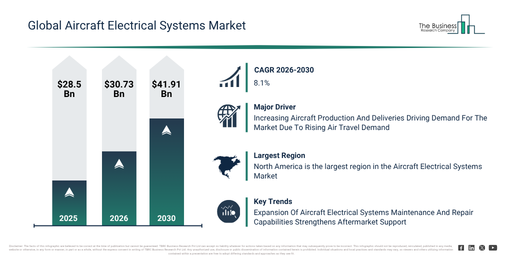
The aircraft electrical systems market has experienced robust expansion in recent years. Its valuation is projected to increase from $28.5 billion in 2025 to $30.73 billion in 2026, exhibiting a compound annual growth rate (CAGR) of 7.8%. The historical growth of this market can be attributed to several factors, including the increasing modernization of aircraft fleets, a growing need for dependable onboard electrical power, the wider adoption of electronic flight systems, rising aircraft production volumes, and the escalating demand for replacing aging electrical components.
The aircraft electrical systems market size is anticipated to experience significant growth over the next few years. It is forecast to grow to $41.91 billion in 2030 at a compound annual growth rate (CAGR) of 8.1%. This expansion during the forecast period is driven by factors such as the increasing adoption of more electric aircraft, a rising demand for enhanced onboard electrical power capacity, the progressive electrification of aircraft systems, a growing need for lightweight and energy-efficient electrical components, and the wider deployment of advanced aircraft power management systems. Prominent trends for this period include the expanding integration of more electric aircraft architectures, an escalating demand for higher power density electrical systems, the rising incorporation of lightweight electrical components, the increasing use of high-voltage aircraft electrical architectures, and a heightened emphasis on electrical system redundancy and fault tolerance.
Get A Free Sample Report With In-Depth Market Insights:
Aircraft Electrical Systems Market Demand Drivers: What’s Powering Industry Growth?
The future expansion of the aircraft electrical systems market is anticipated to be propelled by increasing aircraft production and deliveries. This refers to the manufacturing, assembly, certification, and transfer of completed aircraft from manufacturers to customers for commercial, military, or private operational use. The uptick in aircraft production and deliveries is attributed to the rising demand for air travel; as passenger traffic grows, airlines are encouraged to expand and modernize their fleets, prompting manufacturers to increase production and deliver more aircraft to satisfy customer requirements. This increase in aircraft production and deliveries supports aircraft electrical systems by driving demand for advanced electrical components, power distribution, and avionics systems necessary to enhance aircraft performance, safety, and operational efficiency. As an example, in January 2024, according to Airbus SE, a Netherlands-based manufacturer and developer of aerospace services, solutions, and products, the business delivered 735 commercial aircraft to 87 customers worldwide in 2023, which represented an 11% rise compared to 2022. Therefore, the increasing aircraft production and deliveries are driving the growth of the aircraft electrical systems market.
Aircraft Electrical Systems Market Segment Analysis: What Are The Core Market Categories?
The aircraft electrical systems market covered in this report is segmented –
1) By System: Power Generation, Power Distribution, Power Conversion, Energy Storage
2) By Component: Generators And Starter Generators, Power Distribution Units, Converters, Battery Packs And Battery Management Systems, Wiring And Cables, Connectors And Contactors, Power Distribution Software
3) By Technology: Conventional, Electric, Other Technologies
4) By Application: Power Generation Management, Flight Control And Operation, Cabin System, Configuration Management, Air Pressurization And Conditioning
5) By End User: Original Equipment Manufacturers, Aftermarket
Subsegments:
1) By Power Generation: Engine Driven Generators, Starter Generators, Auxiliary Power Unit Generators, Ram Air Turbine Generators, Integrated Drive Generators
2) By Power Distribution: Busbars, Circuit Breakers, Solid State Power Controllers, Electrical Contactors And Relays
3) By Power Conversion: Alternating Current To Direct Current Converters, Direct Current To Alternating Current Inverters, Direct Current To Direct Current Converters, Transformer Rectifier Units, Static Inverters
4) By Energy Storage: Lithium Ion Batteries, Nickel Cadmium Batteries, Lead Acid Batteries, Battery Management Systems, Supercapacitors
Aircraft Electrical Systems Market Innovation Trends: What Developments Are Reshaping The Industry?
Key companies within the aircraft electrical systems market are concentrating on developing advanced maintenance, repair, and overhaul (MRO) facilities. This effort aims to boost service capacity, shorten turnaround times, and address the increasing demand for dependable aircraft electrical systems. MRO facilities are specialized service centers responsible for inspecting, repairing, refurbishing, testing, and certifying aircraft electrical components, thereby ensuring their ongoing safety, reliability, and compliance with regulations. For instance, in March 2026, Safran Electrical & Power, a France-based aerospace and defense company, unveiled an enlarged 140,000-square-foot facility in Sarasota, Florida. This expanded facility is designed to offer maintenance, repair, and overhaul services for aircraft electrical systems and equipment. It provides benefits such as increased repair capacity, quicker turnaround times, and improved support for a wider variety of aircraft platforms. The expansion intends to help airlines and aircraft operators enhance fleet availability while simultaneously supporting the rising demand for efficient aftermarket services and the modernization of aviation infrastructure.
Aircraft Electrical Systems Market Competitive Analysis Of Leading Industry Participants
Major companies operating in the aircraft electrical systems market are RTX Corporation, General Electric Company, Honeywell International Inc., BAE Systems plc, Safran SA, Rolls-Royce Holdings plc, Parker-Hannifin Corporation, Amphenol Corporation, AMETEK Inc., Moog Inc., Nabtesco Corporation, Liebherr-International AG, Astronics Corporation, Ducommun Incorporated, Crane Co., Latécoère S.A., PBS Group a.s.
View The Full Aircraft Electrical Systems Market Report:
Aircraft Electrical Systems Market Geographic Spread And Regional Opportunities
North America was the largest region in the aircraft electrical systems market in 2025. Asia-Pacific is expected to be the fastest-growing region in the forecast period. The regions covered in the aircraft electrical systems market report are Asia-Pacific, South East Asia, Western Europe, Eastern Europe, North America, South America, Middle East, Africa.
Reach Out To Our Team:
The Business Research Company: https://www.thebusinessresearchcompany.com/
Americas: +1 310-496-7795
Asia: +44 7882 955267 & +91 8897263534
Europe: +44 7882 955267
Email us at: marketing@tbrc.info
Follow us on:
LinkedIn: https://in.linkedin.com/company/the-business-research-company
YouTube: https://www.youtube.com/channel/UC24_fI0rV8cR5DxlCpgmyFQ
Global Market Model: https://www.thebusinessresearchcompany.com/global-market-model

Wasay has over a decade of experience in market research, data modelling, and analytics, with prior experience at GlobalData and Decision Tree Consulting Services. At The Business Research Company , he leads research operations across syndicated studies, customized consulting engagements, and the Global Market Model platform. His professional experience includes supporting organizations such as Boston Consulting Group, KPMG, and Ernst & Young. Wasay holds a degree in Electronics and Communications Engineering, postgraduate management qualifications from International Management Institute Belgium and Indian School of Business and Entrepreneurship, and completed the Integrated Program in Business Analytics from Indian Institute of Management Indore.