
Built to provide research that’s more actionable and strategically valuable, The Business Research Company’s 2026 market reports include market attractiveness analysis, total addressable market sizing, company benchmarking matrices, interactive Excel dashboards, broader supply chain intelligence, emerging startup tracking, and in-depth product insights.
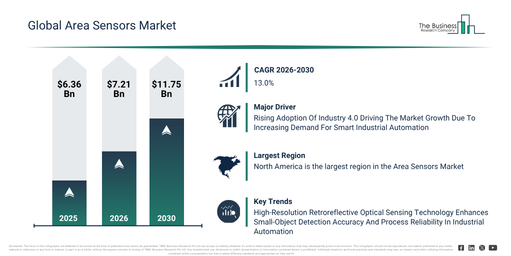
Area Sensors Market Growth From $7.21 Billion In 2026 To $11.75 Billion By 2030 At A CAGR Of 13%
The area sensors market has experienced significant expansion in recent years. It will grow from $6.36 billion in 2025 to $7.21 billion in 2026 at a compound annual growth rate (CAGR) of 13.4%. This past growth can be attributed to factors such as the increasing demand for automated object detection systems, rising industrial safety requirements, the growing adoption of photoelectric sensing technologies, an increasing need for accurate personnel detection, and rising demand for equipment protection systems.
The area sensors market is projected to experience substantial expansion in the coming years. It is anticipated to reach a valuation of $11.75 billion by 2030, exhibiting a compound annual growth rate (CAGR) of 13.0%. This growth during the forecast period is primarily driven by the escalating demand for high-resolution visual sensing, the increasing adoption of laser-based sensing technologies, a growing need for extended sensing ranges, the rising demand for multi-axis detection capabilities, and the expanded deployment of advanced area sensing solutions in logistics and warehousing. Significant trends expected in this period include the increasing embrace of high-resolution area sensing technologies, a surge in demand for wider sensing coverage and improved detection accuracy, the growing use of compact and adjustable detection area sensors, the greater integration of multi-beam and cross-beam sensing architectures, and an escalating need for long-range and precise object detection capabilities.
Get A Free Sample Report With In-Depth Market Insights:
Area Sensors Market Industry Drivers: What’s Behind The Revenue Growth?
The future expansion of the area sensors market is anticipated to be driven by the increasing integration of Industry 4.0. Industry 4.0 encompasses the incorporation of cutting-edge digital technologies like the internet of things (IoT), artificial intelligence (AI), robotics, cloud computing, and industrial automation into manufacturing and operational processes. The uptake of Industry 4.0 is expanding, spurred by the escalating demand for smart manufacturing systems that enhance productivity, operational efficiency, and facilitate real-time decision-making. This paradigm boosts the utility of area sensors by facilitating intelligent manufacturing, autonomous robotics, and interconnected production environments. Within these settings, sensors deliver accurate detection, monitor safety, and gather real-time data, thereby enhancing efficiency, minimizing downtime, streamlining workflows, and aiding smart factory integration. A notable example from March 2024, provided by Rockwell Automation Inc., a US-based automation company, indicates that manufacturers view AI as the foremost capability for achieving substantial business impact, with 83% expecting to integrate generative AI (GenAI) into their operations. Additionally, 95% of manufacturers are currently utilizing or exploring smart manufacturing technologies, a rise from 84% in 2023. Consequently, the expanding embrace of Industry 4.0 is fueling the growth of the area sensors market.
Area Sensors Market Segment Breakdown: Which Categories Lead On Revenue?
The area sensors market covered in this report is segmented –
1) By Product Type: General-Purpose Area Sensors, Cross-Beam Area Sensors
2) By Technology Type: Photoelectric Sensing, Infrared Sensing, Laser-Based Sensing, Vision-Based Sensing
3) By Sensing Range: Less Than 1 Meter, 1 Meter–3 Meters, 3 Meters–5 Meters, More Than 5 Meters
4) By Application Type: Object Detection, Picking Systems, Personnel Safety, Equipment Protection, Other Application Types
5) By End User: Automotive, Manufacturing, Electronics And Semiconductor, Food And Beverage, Pharmaceuticals, Logistics And Warehousing
Subsegments:
1) By General-Purpose Area Sensors: Single-Beam Area Sensors, Multi-Beam Area Sensors, Wide-Area Detection Sensors, Adjustable Detection Area Sensors, Compact Area Sensors
2) By Cross-Beam Area Sensors: Through-Beam Area Sensors, Opposed-Beam Area Sensors, Parallel-Beam Area Sensors, Multi-Axis Cross-Beam Area Sensors, Long-Range Cross-Beam Area Sensors
#Area Sensors Market Growth Trends: What’s Shaping The Future Outlook?
Leading companies in the area sensors market are concentrating on creating sophisticated products, such as high-resolution retroreflective area sensors, to boost the precision of small-object detection, elevate process reliability, and facilitate advanced quality surveillance within industrial automation settings. These high-resolution retroreflective area sensors are sophisticated optical sensing devices that employ a broad light band made up of several beams, rather than a single-point detection technique, allowing them to identify small, thin, or unusually shaped items with increased accuracy and fewer false alarms when contrasted with conventional photoelectric sensors. As an example, in September 2026, Pepperl+Fuchs SE, a sensor producer situated in Germany, introduced its R305 retroreflective area sensor, specifically engineered for the detection of thin and irregular items from a mere distance of 2 mm. The device incorporates a five-beam light band, where each beam can be switched independently, which permits versatile adjustment for tight spaces and the ability to disregard obstructive elements, while its high-resolution mode ensures dependable detection of exceptionally tiny targets. Moreover, the system facilitates IO-Link communication to convey object height information, offers integrated trend analysis for supervising processes like assessing packaging fill levels, and includes Auto-Teach functionality to simplify both initial setup and ongoing maintenance.
Area Sensors Market Competitive Overview And Top Companies
Major companies operating in the area sensors market are Siemens AG, Panasonic Industry Co. Ltd., Honeywell International Inc., Mitsubishi Electric Corporation, Eaton Corporation plc, Rockwell Automation Inc., KEYENCE Corporation, OMRON Corporation, SICK AG, ifm electronic GmbH, Banner Engineering Corp., Hans Turck GmbH & Co. KG, Pepperl+Fuchs SE, Baumer Holding AG, Balluff GmbH, IDEC Corporation, Pilz GmbH & Co. KG, Leuze electronic GmbH + Co. KG, wenglor sensoric GmbH, Autonics Corporation, Contrinex AG
View The Full Area Sensors Market Report:
Area Sensors Market Top Region: Where Does Most Revenue Come From?
North America was the largest region in the area sensors market in 2025. Asia-Pacific is expected to be the fastest-growing region in the forecast period. The regions covered in the area sensors market report are Asia-Pacific, South East Asia, Western Europe, Eastern Europe, North America, South America, Middle East, Africa.
Reach Out To Our Team:
The Business Research Company: https://www.thebusinessresearchcompany.com/
Americas: +1 310-496-7795
Asia: +44 7882 955267 & +91 8897263534
Europe: +44 7882 955267
Email us at: marketing@tbrc.info
Follow us on:
LinkedIn: https://in.linkedin.com/company/the-business-research-company
YouTube: https://www.youtube.com/channel/UC24_fI0rV8cR5DxlCpgmyFQ
Global Market Model: https://www.thebusinessresearchcompany.com/global-market-model

Wasay has over a decade of experience in market research, data modelling, and analytics, with prior experience at GlobalData and Decision Tree Consulting Services. At The Business Research Company , he leads research operations across syndicated studies, customized consulting engagements, and the Global Market Model platform. His professional experience includes supporting organizations such as Boston Consulting Group, KPMG, and Ernst & Young. Wasay holds a degree in Electronics and Communications Engineering, postgraduate management qualifications from International Management Institute Belgium and Indian School of Business and Entrepreneurship, and completed the Integrated Program in Business Analytics from Indian Institute of Management Indore.