
Backed by market attractiveness analysis, total addressable market sizing, company benchmarking matrices, interactive Excel dashboards, wider supply chain intelligence, emerging startup coverage, and detailed product-level insights, The Business Research Company’s 2026 market reports are designed to offer research that is more actionable and strategically valuable than ever.
Aromatics Market Poised To Hit $225.87 Billion By 2030 With A 7.7% CAGR
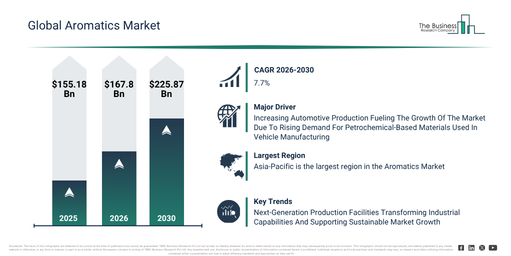
The aromatics market size has demonstrated significant expansion in recent years. It is anticipated to increase from $155.18 billion in 2025 to $167.8 billion in 2026, achieving a compound annual growth rate (CAGR) of 8.1%. The growth observed in prior periods can be attributed to factors such as the increasing requirement for petrochemical feedstocks, a rise in the consumption of benzene and toluene derivatives, expanding automotive production, an escalating demand for paints and coatings, and growing pharmaceutical manufacturing.
The aromatics market size is anticipated to demonstrate robust growth over the next few years. It is forecast to expand to $225.87 billion in 2030, driven by a compound annual growth rate (CAGR) of 7.7%. This projected growth during the forecast period can be largely attributed to the escalating demand for sustainable aromatic feedstocks, the increasing adoption of bio-based aromatics, the growing requirement for polymer-grade p-xylene, the rising consumption of aromatic chemical intermediates, and the expanding production of specialty aromatic derivatives. Significant trends expected during this forecast period include an increase in the production of high-purity aromatics, a rising demand for bio-based aromatics, the growing utilization of aromatics as chemical intermediates, an increasing adoption of solvent-grade aromatics, and a surge in the demand for specialized aromatic derivatives.
Get A Free Sample Report With In-Depth Market Insights:
Aromatics Market Expansion Drivers: What’s Shaping Future Growth?
The aromatics market is anticipated to experience growth in the future, driven by increasing automotive production. This production involves the large-scale manufacturing of passenger cars, commercial vehicles, and other motor vehicles through integrated industrial processes. The rise in automotive output is fueled by growing consumer demand for personal mobility and commercial transportation, prompting manufacturers to expand vehicle production. Automotive production stimulates demand for aromatics by utilizing key raw materials such as benzene, toluene, and xylenes in the creation of lightweight plastics, synthetic rubber, engineering resins, coatings, adhesives, and automotive textiles, all essential for various vehicle components. For instance, in March 2025, according to the European Automobile Manufacturers’ Association, a Belgium-based trade association, global car sales reached 74.6 million units in 2024, marking a 2.5% increase over 2023, with the EU car market expanding by 0.8% during the same period. Thus, the escalating automotive production is a primary catalyst for the growth of the aromatics market.
Aromatics Market Segments: Where Is Growth Concentrated?
The aromatics market covered in this report is segmented –
1) By Product Type: P-Xylene, O-Xylene, Toluene, Benzene, Other Product Types
2) By Source Type: Petroleum-Based Aromatics, Bio-Based Aromatics
3) By Application: Solvents, Chemical Intermediates, Detergents, Other Applications
4) By End-User Industry: Automotive, Paints And Coatings, Pharmaceuticals, Textiles, Other End-User Industries
Subsegments:
1) By P-Xylene: Polymer-Grade P-Xylene, Chemical-Grade P-Xylene
2) By O-Xylene: Solvent-Grade O-Xylene, Chemical-Grade O-Xylene
3) By Toluene: Industrial-Grade Toluene, Solvent-Grade Toluene, Chemical-Grade Toluene
4) By Benzene: Industrial-Grade Benzene, Chemical-Grade Benzene
5) By Other Product Types: Ethylbenzene, Mixed Xylenes, Styrene, Cumene
Aromatics Market Strategic Trends: What Defines The Next Growth Phase?
Major companies operating in the aromatics market are focusing on establishing advanced chemical facilities, such as toluene production units, to enhance domestic supply, reduce import dependency, and strengthen the availability of key aromatic hydrocarbons for industrial applications. Toluene production facilities are specialized petrochemical processing units that manufacture toluene, an aromatic hydrocarbon derived from refinery streams, which helps increase domestic supply, reduce import dependency, support industries like chemicals, paints, pharmaceuticals, and coatings, and fortify overall petrochemical supply chain security. For instance, in January 2025, Mangalore Refinery and Petrochemicals Limited, an India-based oil refining and petrochemicals company, launched its Toluene product to expand its aromatics portfolio and meet domestic demand. The newly inaugurated toluene facility has an annual production capacity of 40 thousand metric tonnes (TMT) and is designed to improve India’s self-reliance in aromatic hydrocarbon supply by reducing its reliance on imports. This product caters to multiple industries, including pharmaceuticals, chemicals, paints, and defense, due to its potent solvent properties and its function as a chemical intermediate. This initiative supports India’s petrochemical growth strategy by boosting domestic production capacity, enhancing supply chain security, and contributing to foreign exchange savings through decreased imports.
Aromatics Market Top Companies Driving Competitive Growth
Major companies operating in the aromatics market are PetroChina Company Limited, China Petroleum & Chemical Corporation, Exxon Mobil Corporation, Shell plc, TotalEnergies SE, Reliance Industries Limited, Indian Oil Corporation Limited, BASF SE, Idemitsu Kosan Co. Ltd., Dow Inc., Saudi Basic Industries Corporation, LG Chem Ltd., LyondellBasell Industries N.V., Mitsubishi Chemical Group Corporation, INEOS Group Limited, PTT Global Chemical Public Company Limited, ENEOS Corporation, Formosa Plastics Corporation, Chevron Phillips Chemical Company LLC, Haldia Petrochemicals Limited
View The Full Aromatics Market Report:
Aromatics Market Global Footprint: Which Region Leads The Market?
Asia-Pacific was the largest region in the aromatics market in 2025. Asia-Pacific is expected to be the fastest-growing region in the forecast period. The regions covered in the aromatics market report are Asia-Pacific, South East Asia, Western Europe, Eastern Europe, North America, South America, Middle East, Africa.
Reach Out To Our Team:
The Business Research Company: https://www.thebusinessresearchcompany.com/
Americas: +1 310-496-7795
Asia: +44 7882 955267 & +91 8897263534
Europe: +44 7882 955267
Email us at: marketing@tbrc.info
Follow us on:
LinkedIn: https://in.linkedin.com/company/the-business-research-company
YouTube: https://www.youtube.com/channel/UC24_fI0rV8cR5DxlCpgmyFQ
Global Market Model: https://www.thebusinessresearchcompany.com/global-market-model

Wasay has over a decade of experience in market research, data modelling, and analytics, with prior experience at GlobalData and Decision Tree Consulting Services. At The Business Research Company , he leads research operations across syndicated studies, customized consulting engagements, and the Global Market Model platform. His professional experience includes supporting organizations such as Boston Consulting Group, KPMG, and Ernst & Young. Wasay holds a degree in Electronics and Communications Engineering, postgraduate management qualifications from International Management Institute Belgium and Indian School of Business and Entrepreneurship, and completed the Integrated Program in Business Analytics from Indian Institute of Management Indore.