
Built to provide research that’s more actionable and strategically valuable, The Business Research Company’s 2026 market reports include market attractiveness analysis, total addressable market sizing, company benchmarking matrices, interactive Excel dashboards, broader supply chain intelligence, emerging startup tracking, and in-depth product insights.
Deep Space Optical Communication Market CAGR Outlook And Future Development
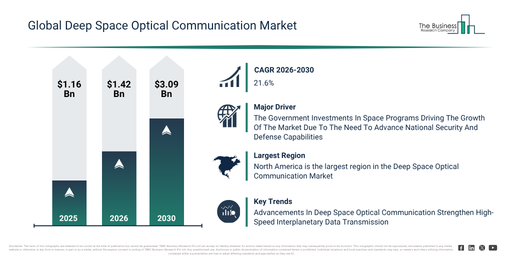
The deep space optical communication market has seen remarkable expansion in recent years. Its valuation is set to climb from $1.16 billion in 2025 to $1.42 billion in 2026, demonstrating a compound annual growth rate (CAGR) of 22.0%. The past growth in this sector is largely due to increased deep space exploration efforts, a rising demand for superior spacecraft data transmission capacity, the expanding volume of scientific data from space missions, the growing limitations inherent in traditional RF communication, and the increasing necessity for efficient deep space bandwidth utilization.
The deep space optical communication market size is projected to experience substantial growth in the coming years. It is expected to reach $3.09 billion by 2030, showing a compound annual growth rate (CAGR) of 21.6%. This expansion during the forecast period is influenced by a rising demand for ultra-high-speed space communications, the increasing launch of lunar and planetary missions, a growing necessity for transmitting high-resolution scientific data, the wider adoption of optical communication terminals, and the expanding need for interplanetary data connectivity. Prominent trends anticipated in this period involve an elevated demand for high-bandwidth deep space communication, the increasing use of laser-based spacecraft communication, a greater requirement for quicker scientific data transmission, a surging demand for precision optical pointing systems, and the expanding establishment of high-speed optical ground stations.
Get A Free Sample Report With In-Depth Market Insights:
Deep Space Optical Communication Market Growth Drivers: What’s Behind The Acceleration?
Government funding for space initiatives is projected to stimulate the expansion of the deep space optical communication market moving forward. These investments in space programs encompass the allocation of financial resources by governments, private entities, or international bodies to back the exploration, research, development, launch, operation, and advancement of space exploration, satellite systems, space infrastructure, and related technologies. Government expenditures in space programs are motivated by the necessity to enhance national security and defense capabilities by fortifying satellite communications, intelligence gathering, missile warning, surveillance, navigation, and secure military operations in space. Such investments accelerate the conceptualization and deployment of deep space missions, advanced satellites, and essential ground infrastructure, thereby driving the demand for high-speed, reliable deep space optical communication systems. For instance, The Space Foundation, a US-based nonprofit group, reported in July 2024 that international government spending on space programs witnessed an 11% year-over-year increase, reaching $125 billion in 2024. Therefore, governmental financial commitments to space programs are fueling the growth of the deep space optical communication market.
Deep Space Optical Communication Market Segment Landscape And Growth Outlook
The deep space optical communication market covered in this report is segmented –
1) By Component: Transceivers, Modulators, Detectors, Amplifiers, Other Components
2) By Communication Range: Near Deep Space, Mid Deep Space, Far Deep Space, Interplanetary Communication
3) By Platform: Spacecraft, Satellites, Space Probes, Rovers, Orbiters, Landers
4) By Deployment: Space-Based Systems, Ground-Based Systems, Hybrid Systems
5) By End User: Government Space Agencies, Commercial Space Companies, Defense Organizations, Research Institutions, Academic Organizations
Subsegments:
1) By Transceivers: Laser Communication Transceivers, Integrated Optical Transceivers, Spaceborne Optical Transceivers, Ground Station Optical Transceivers
2) By Modulators: Electro Optical Modulators, Acousto Optical Modulators, Phase Modulators, Intensity Modulators
3) By Detectors: Avalanche Photodiode Detectors, Single Photon Detectors, Charge Coupled Device Detectors, Complementary Metal Oxide Semiconductor Detectors
4) By Amplifiers: Fiber Optical Amplifiers, Semiconductor Optical Amplifiers, Raman Optical Amplifiers, Solid State Optical Amplifiers
5) By Other Components: Optical Antennas, Beam Steering Assemblies, Optical Filters, Wavelength Multiplexers
Deep Space Optical Communication Market Trends: What’s Defining The Industry’s Next Phase?
Leading companies within the deep space optical communication market are concentrating on enhancing laser-based communication technologies. Their goal is to enable higher data transmission rates, improve interoperability across international space networks, and support upcoming deep-space exploration missions. These laser-based communication technologies involve systems that use highly focused laser beams to transmit data over extensive distances, providing greater bandwidth, quicker data transfer, and more secure communications compared to radio frequency systems. As an illustration, in July 2025, the European Space Agency (ESA), a France-based intergovernmental organization, successfully established Europe’s initial deep-space optical communication link with NASA’s Deep Space Optical Communications (DSOC) experiment onboard the Psyche mission, which was approximately 265 million kilometers from Earth. This significant event showcased a two-way laser communication link, employing dedicated optical ground stations situated in Greece. It validated the effectiveness of high-speed, long-distance optical communications and set the groundwork for future solar system Internet infrastructure and next-generation deep-space missions.
Deep Space Optical Communication Market Leading Players And Competitive Positioning
Major companies operating in the deep space optical communication market are NASA Jet Propulsion Laboratory, Airbus Defence and Space SAS, Lockheed Martin Corporation, Northrop Grumman Corporation, Thales Alenia Space SAS, Space Exploration Technologies Corp., Tesat-Spacecom GmbH & Co. KG, L3Harris Technologies Inc., Honeywell International Inc., CACI International Inc., BAE Systems plc, BridgeComm Inc., Blue Origin LLC, General Atomics Electromagnetic Systems Inc., Rocket Lab Corporation, Sierra Space Corporation, Cailabs SAS, Gooch & Housego PLC, GomSpace Group AB, Astro Digital Inc., Xenesis Inc., Voyager Technologies Inc., Astrolight UAB, Transcelestial Technologies Pte. Ltd.
View The Full Deep Space Optical Communication Market Report:
Deep Space Optical Communication Market Regional Split: Which Areas Are Fueling Growth?
North America was the largest region in the deep space optical communication market in 2025. Asia-Pacific is expected to be the fastest-growing region in the forecast period. The regions covered in the deep space optical communication market report are Asia-Pacific, South East Asia, Western Europe, Eastern Europe, North America, South America, Middle East, Africa.
Reach Out To Our Team:
The Business Research Company: https://www.thebusinessresearchcompany.com/
Americas: +1 310-496-7795
Asia: +44 7882 955267 & +91 8897263534
Europe: +44 7882 955267
Email us at: marketing@tbrc.info
Follow us on:
LinkedIn: https://in.linkedin.com/company/the-business-research-company
YouTube: https://www.youtube.com/channel/UC24_fI0rV8cR5DxlCpgmyFQ
Global Market Model: https://www.thebusinessresearchcompany.com/global-market-model

Wasay has over a decade of experience in market research, data modelling, and analytics, with prior experience at GlobalData and Decision Tree Consulting Services. At The Business Research Company , he leads research operations across syndicated studies, customized consulting engagements, and the Global Market Model platform. His professional experience includes supporting organizations such as Boston Consulting Group, KPMG, and Ernst & Young. Wasay holds a degree in Electronics and Communications Engineering, postgraduate management qualifications from International Management Institute Belgium and Indian School of Business and Entrepreneurship, and completed the Integrated Program in Business Analytics from Indian Institute of Management Indore.