
Featuring market attractiveness scoring, total addressable market sizing, company benchmarking matrices, interactive Excel dashboards, deeper supply chain intelligence, emerging startup tracking, and granular product-level insights, The Business Research Company’s 2026 market reports are built to deliver research that is both more actionable and more strategically valuable.
Deep Ultraviolet (DUV) Lithography Systems Market Size, Value And Growth Trajectory Through 2030
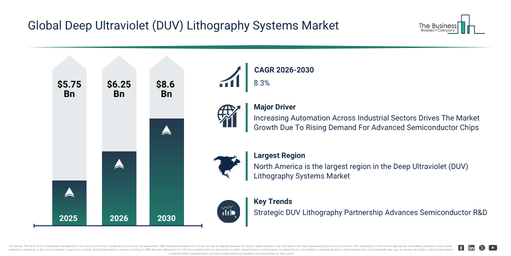
The deep ultraviolet (DUV) lithography systems market size has witnessed significant expansion in recent years. It will grow from $5.75 billion in 2025 to $6.25 billion in 2026 at a compound annual growth rate (CAGR) of 8.7%. This historic period’s growth is due to several factors, including increasing semiconductor fabrication capacity, rising demand for lithography equipment in mature-node chip production, growing semiconductor demand from consumer electronics, increasing adoption of 193 nm lithography systems, and expanding semiconductor manufacturing infrastructure.
The deep ultraviolet (DUV) lithography systems market is anticipated to show significant growth in the upcoming years, with its size projected to reach $8.6 billion in 2030, exhibiting a compound annual growth rate (CAGR) of 8.3%. This expansion during the forecast period is fueled by factors such as the increasing need for higher semiconductor production capacity, a rising demand for advanced DUV patterning in automotive and industrial chips, the growing requirement for high-throughput lithography equipment, the ongoing expansion of wafer fabrication facilities across emerging semiconductor regions, and the increasing demand for cost-efficient lithography solutions for mature and specialty nodes. Key trends for this period encompass an increasing demand for high-resolution DUV lithography systems, the rising adoption of 193 nm lithography for advanced semiconductor fabrication, a growing need for precision wafer patterning, an increasing demand for improved overlay accuracy in lithography processes, and the expanding deployment of high-throughput DUV lithography equipment.
Get A Free Sample Report With In-Depth Market Insights:
Deep Ultraviolet (DUV) Lithography Systems Market Demand Drivers: What’s Powering Industry Growth?
The increasing automation across industrial sectors is projected to drive the growth of the deep ultraviolet (DUV) lithography systems market in the future. Automation across industrial sectors refers to the integration of intelligent machines, software, and control systems to streamline operations, enhance productivity, and improve operational performance across diverse industries. The rise in industrial automation is attributed to growing labor shortages, prompting businesses to implement automated systems that boost productivity, reduce reliance on manual workers, and maintain consistent operational efficiency. This increasing automation across industrial sectors supports deep ultraviolet (DUV) lithography systems by elevating the demand for advanced semiconductor chips used in industrial robots, automated machinery, and smart manufacturing equipment, thereby necessitating precise and high-volume chip fabrication. For instance, in September 2024, the World Robotics 2024 report, released by the International Federation of Robotics, a Germany-based professional non-profit organization, stated that the global operational stock of industrial robots reached 4,281,585 units in factories worldwide, marking a 10% year-on-year increase, while annual installations surpassed 500,000 units for the third consecutive year. Asia accounted for 70% of newly deployed robots in 2023, followed by Europe at 17% and the Americas at 10%. This expanding automation across industrial sectors is stimulating the growth of the deep ultraviolet (DUV) lithography systems market.
Deep Ultraviolet (DUV) Lithography Systems Market Segment Performance And Emerging Opportunities
The deep ultraviolet (DUV) lithography systems market covered in this report is segmented –
1) By Product Type: Argon Fluoride Immersion Lithography Systems, Argon Fluoride Dry Lithography Systems, Krypton Fluoride Lithography Systems, I-Line Lithography Systems
2) By Technology: Laser Diode Lithography, Maskless Lithography, Exposure Tool Lithography
3) By Light Source: Excimer Laser, Mercury Lamp, Solid State Laser
4) By Application: Logic Devices, Memory Devices, Analog And Mixed-Signal Integrated Circuits, Power Semiconductors, Micro-Electro-Mechanical Systems Devices, Complementary Metal-Oxide-Semiconductor Image Sensors, Radio Frequency Devices
5) By End Use: Consumer Electronics, Automotive, Telecommunications
Subsegments:
1) By Argon Fluoride Immersion Lithography Systems: High Numerical Aperture Systems, Standard Numerical Aperture Systems
2) By Argon Fluoride Dry Lithography Systems: High Resolution Systems, Standard Resolution Systems
3) By Krypton Fluoride Lithography Systems: High Throughput Systems, Standard Throughput Systems
4) By I-Line Lithography Systems: Automatic Alignment Systems, Manual Alignment Systems
Deep Ultraviolet (DUV) Lithography Systems Market Innovation Trends: What Developments Are Reshaping The Industry?
Companies active in the deep ultraviolet (DUV) lithography systems market are increasingly focusing on forming strategic partnerships to expand access to advanced lithography equipment and bolster semiconductor research and development capabilities. DUV immersion lithography systems are crucial for advanced semiconductor patterning and work alongside other lithography technologies to facilitate the development of high-end semiconductor nodes. For instance, in March 2025, ASML, a Netherlands-based semiconductor equipment supplier, and imec, a Belgium-based research and innovation center, entered into a five-year strategic partnership agreement with the goal of propelling semiconductor research and sustainable innovation. This collaboration encompasses ASML’s entire product portfolio, including DUV immersion systems, along with 0.55 NA EUV, 0.33 NA EUV, YieldStar optical metrology, and HMI single- and multi-beam technologies. These systems are planned for installation in imec’s state-of-the-art pilot line and will be integrated into the EU- and Flemish-funded NanoIC pilot line, thereby providing essential infrastructure for sub-2nm semiconductor R&D.
Deep Ultraviolet (DUV) Lithography Systems Market Top Companies Driving Competitive Growth
Major companies operating in the deep ultraviolet (DUV) lithography systems market are ASML Holding N.V., Nikon Corporation, Canon Inc., Shanghai Micro Electronics Equipment (Group) Co. Ltd., SUSS MicroTec SE
View The Full Deep Ultraviolet (DUV) Lithography Systems Market Report:
Deep Ultraviolet (DUV) Lithography Systems Market Global Footprint: Which Region Leads The Market?
North America was the largest region in the deep ultraviolet (DUV) lithography systems market in 2025. Asia-Pacific is expected to be the fastest-growing region in the forecast period. The regions covered in the deep ultraviolet (DUV) lithography systems market report are Asia-Pacific, South East Asia, Western Europe, Eastern Europe, North America, South America, Middle East, Africa.
Reach Out To Our Team:
The Business Research Company: https://www.thebusinessresearchcompany.com/
Americas: +1 310-496-7795
Asia: +44 7882 955267 & +91 8897263534
Europe: +44 7882 955267
Email us at: marketing@tbrc.info
Follow us on:
LinkedIn: https://in.linkedin.com/company/the-business-research-company
YouTube: https://www.youtube.com/channel/UC24_fI0rV8cR5DxlCpgmyFQ
Global Market Model: https://www.thebusinessresearchcompany.com/global-market-model

Wasay has over a decade of experience in market research, data modelling, and analytics, with prior experience at GlobalData and Decision Tree Consulting Services. At The Business Research Company , he leads research operations across syndicated studies, customized consulting engagements, and the Global Market Model platform. His professional experience includes supporting organizations such as Boston Consulting Group, KPMG, and Ernst & Young. Wasay holds a degree in Electronics and Communications Engineering, postgraduate management qualifications from International Management Institute Belgium and Indian School of Business and Entrepreneurship, and completed the Integrated Program in Business Analytics from Indian Institute of Management Indore.