
Built to provide research that’s more actionable and strategically valuable, The Business Research Company’s 2026 market reports include market attractiveness analysis, total addressable market sizing, company benchmarking matrices, interactive Excel dashboards, broader supply chain intelligence, emerging startup tracking, and in-depth product insights.
Radiation-Hardened Field-Programmable Gate Array (FPGA) Market Forecast: What Value Will The Market Reach By 2030?
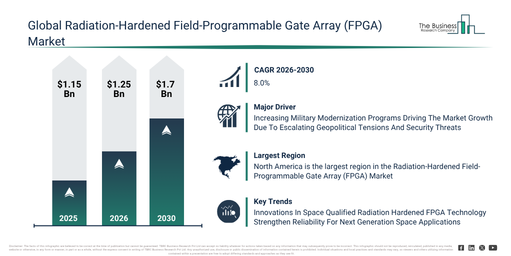
The radiation-hardened field-programmable gate array (fpga) market has witnessed substantial growth in recent times. It is anticipated to expand from $1.15 billion in 2025 to $1.25 billion in 2026, achieving a compound annual growth rate (CAGR) of 8.4%. This historical upward trend can be ascribed to several factors, including the increasing deployment of satellites and spacecraft, a heightened demand for radiation-resistant electronics, the progression of defense modernization programs, expanding space exploration initiatives, and the critical need for dependable mission-critical computing.
The market for radiation-hardened field-programmable gate arrays (FPGAs) is projected to experience substantial expansion in the coming years. Its valuation is anticipated to reach $1.7 billion in 2030, demonstrating a compound annual growth rate (CAGR) of 8.0%. This projected increase is fueled by factors such as the growing deployment of advanced satellite constellations, heightened demand for high-performance computing in space, the increasing uptake of autonomous aerospace systems, ongoing modernization efforts in defense electronics, and the critical requirement for long-duration radiation-tolerant electronic components. Key developments anticipated within this period involve the enhanced creation of FPGA architectures with greater radiation tolerance, significant progress in designs that mitigate single-event upsets and incorporate fault tolerance, the expanding incorporation of radiation-hardened FPGAs into vital mission systems, the emergence of more powerful reconfigurable space-grade processors, and the broader application of these FPGAs for extended missions.
Get A Free Sample Report With In-Depth Market Insights:
Radiation-Hardened Field-Programmable Gate Array (FPGA) Market Growth Factors Behind Sustained Expansion
The expansion of military modernization programs is projected to stimulate the growth of the radiation-hardened field-programmable gate array (FPGA) market moving forward. These programs represent comprehensive efforts by armed forces to upgrade and enhance their defense capabilities through advanced weapons systems and technologies. The rise in military modernization initiatives is attributed to escalating geopolitical tensions and security threats to national sovereignty and regional stability, as countries endeavor to strengthen their defense capacities, deter potential adversaries, and safeguard their strategic interests. Consequently, the increasing military modernization programs are boosting the adoption of radiation-hardened field-programmable gate arrays (FPGAs) by raising the demand for reliable, reconfigurable, and radiation-tolerant electronics in advanced defense, space, missile, and secure communication systems. For instance, in March 2023, according to the European Security and Defense College, a Belgium-based autonomous institution, by 2030, the ongoing US Army modernization program is slated to introduce 35 new future force systems, forming the core of more than 500 development, acquisition, or upgrade initiatives currently underway. Therefore, the growing military modernization programs are propelling the expansion of the radiation-hardened field-programmable gate array market.
Radiation-Hardened Field-Programmable Gate Array (FPGA) Market Segmentation And Category Overview
The radiation-hardened field-programmable gate array (fpga) market covered in this report is segmented –
1) By Type: Static Random-Access Memory-Based, Flash-Based, Antifuse-Based
2) By Node Size: Less Than Or Equal To 28 Nanometers, 28 To 90 Nanometers, Greater Than 90 Nanometers
3) By Material: Silicon Carbide, Gallium Nitride
4) By Operating Frequency: Up To 50 Megahertz, 51 To 100 Megahertz, Above 100 Megahertz
5) By Application: Aerospace And Defense, Space, Nuclear Power, Industrial, Other Applications
Subsegments:
1) By Static Random-Access Memory-Based: Spaceborne Computing Systems, Satellite Communication Systems, Software-Defined Radio Systems, Artificial Intelligence Processing, Image Processing Systems, High-Performance Computing, Reconfigurable Signal Processing, Secure Data Processing
2) By Flash-Based: Low-Power Space Electronics, Satellite Control Systems, Industrial Control Systems, Mission-Critical Embedded Systems, Radiation-Tolerant Data Acquisition, Sensor Interface Systems, Edge Computing Platforms, Avionics Control Systems
3) By Antifuse-Based: One-Time Programmable Logic Devices, Flight Control Systems, Missile Guidance Systems, Launch Vehicle Electronics, Spacecraft Command And Control, Secure Cryptographic Hardware, Safety-Critical Aerospace Systems, Defense Communication Systems
Radiation-Hardened Field-Programmable Gate Array (FPGA) Market Industry Trends Fueling Future Revenue Growth
Leading companies in the radiation-hardened field-programmable gate array (FPGA) market are prioritizing the expansion of advanced space-qualified FPGA portfolios. This effort aims to enhance reliability, radiation tolerance, and power efficiency for their use in satellite, avionics, and deep space missions. Space-qualified radiation-hardened FPGAs are defined as programmable semiconductor devices built to function dependably in environments with high radiation levels, while sustaining their performance under the extreme conditions of space. For example, in July 2025, Microchip Technology Inc., a US-based semiconductor company, broadened its space-qualified FPGA offerings. This was achieved by announcing MIL-STD-883 Class B and QML Class Q qualification for its RT PolarFire RTPF500ZT FPGA and by introducing engineering samples of the RT PolarFire System-on-Chip (SoC) FPGA. These new devices deliver improved radiation resilience, reduced power consumption, and integrated RISC-V processing capabilities, thereby facilitating reliable and efficient performance for next-generation satellite, avionics, and other critical space applications.
Radiation-Hardened Field-Programmable Gate Array (FPGA) Market Competitive Overview And Top Companies
Major companies operating in the radiation-hardened field-programmable gate array (fpga) market are BAE Systems plc, Honeywell International Inc., Advanced Micro Devices Inc., Thales S.A., QuickLogic Corporation, STMicroelectronics N.V., United Microelectronics Corporation, GlobalFoundries Inc., Microchip Technology Incorporated, Mercury Systems Inc., Frontgrade Technologies Inc., NanoXplore SAS, Rochester Electronics LLC, Achronix Semiconductor Corporation, Menta SAS
View The Full Radiation-Hardened Field-Programmable Gate Array (FPGA) Market Report:
Radiation-Hardened Field-Programmable Gate Array (FPGA) Market Top Region: Where Does Most Revenue Come From?
North America was the largest region in the radiation-hardened field-programmable gate array (FPGA) market in 2025. Asia-Pacific is expected to be the fastest-growing region in the forecast period. The regions covered in the radiation-hardened field-programmable gate array (fpga) market report are Asia-Pacific, South East Asia, Western Europe, Eastern Europe, North America, South America, Middle East, Africa.
Reach Out To Our Team:
The Business Research Company: https://www.thebusinessresearchcompany.com/
Americas: +1 310-496-7795
Asia: +44 7882 955267 & +91 8897263534
Europe: +44 7882 955267
Email us at: marketing@tbrc.info
Follow us on:
LinkedIn: https://in.linkedin.com/company/the-business-research-company
YouTube: https://www.youtube.com/channel/UC24_fI0rV8cR5DxlCpgmyFQ
Global Market Model: https://www.thebusinessresearchcompany.com/global-market-model

Wasay has over a decade of experience in market research, data modelling, and analytics, with prior experience at GlobalData and Decision Tree Consulting Services. At The Business Research Company , he leads research operations across syndicated studies, customized consulting engagements, and the Global Market Model platform. His professional experience includes supporting organizations such as Boston Consulting Group, KPMG, and Ernst & Young. Wasay holds a degree in Electronics and Communications Engineering, postgraduate management qualifications from International Management Institute Belgium and Indian School of Business and Entrepreneurship, and completed the Integrated Program in Business Analytics from Indian Institute of Management Indore.