
Featuring market attractiveness scoring, total addressable market sizing, company benchmarking matrices, interactive Excel dashboards, deeper supply chain intelligence, emerging startup tracking, and granular product-level insights, The Business Research Company’s 2026 market reports are built to deliver research that is both more actionable and more strategically valuable.
Large Satellite Market CAGR Outlook And Future Development
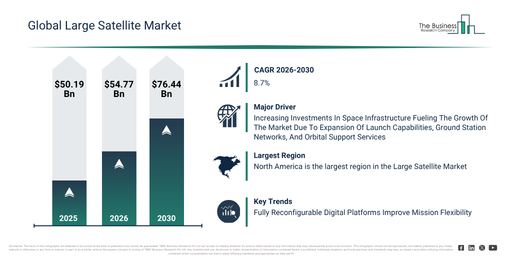
The large satellite market has experienced robust growth in recent years. It is projected to expand from $50.19 billion in 2025 to $54.77 billion in 2026, achieving a compound annual growth rate (CAGR) of 9.1%. This historical growth is primarily due to the expansion of satellite-based communications, increasing demand for earth observation data, growth in satellite navigation services, rising defense and security spending, and increasing demand for weather monitoring.
The large satellite market is poised for robust expansion over the next few years. It is anticipated to achieve a valuation of $76.44 billion by 2030, demonstrating a compound annual growth rate (CAGR) of 8.7%. This growth in the projection period can be attributed to factors such as the increasing demand for high-throughput satellite communications, greater government investment in space infrastructure, the expansion of commercial space activities, a rising need for advanced earth observation capabilities, and the growing deployment of next-generation satellite systems. Prominent trends throughout this forecast period include an escalating demand for high-capacity satellite payloads, the wider adoption of advanced satellite propulsion systems, an increasing requirement for longer satellite mission lifetimes, the greater deployment of large satellite constellations, and growing investment in high-performance satellite platforms.
Get A Free Sample Report With In-Depth Market Insights:
Large Satellite Market Development Factors: What’s Supporting Demand?
Future expansion of the large satellite market is anticipated to be driven by rising investments in space infrastructure. These investments encompass both public and private sector outlays on components such as satellites, launch systems, ground facilities, spaceports, and auxiliary technologies, all of which facilitate various space activities including communication, navigation, Earth monitoring, scientific studies, and defense initiatives. Both governmental bodies and commercial entities are escalating these expenditures to bolster national security and enhance commercial space functionalities. Such investments provide crucial support for large satellites by enhancing launch capacities, extending ground station networks, and improving orbital services essential for the deployment, operation, and upkeep of high-capacity satellites. For instance, as reported by the US-based nonprofit Space Foundation in July 2025, the worldwide space economy expanded from $570 billion in 2023 to $613 billion in 2024, reflecting an increase of $43 billion or 7.5% over 2023. During this same period, government space expenditures also rose, from $125 billion to $132 billion, an increment of $7 billion or 5.6%. Consequently, the escalating financial commitments to space infrastructure are fueling the expansion of the large satellite market.
Large Satellite Market Segment Analysis: What Are The Core Market Categories?
The large satellite market covered in this report is segmented –
1) By Satellite Orbit: Low Earth Orbit, Medium Earth Orbit, Geostationary Earth Orbit, Highly Elliptical Orbit
2) By Propulsion Type: Chemical Propulsion, Electric Propulsion, Hybrid Propulsion
3) By Application: Communications, Earth Observation, Navigation, Weather Monitoring, Scientific Research
4) By End User: Commercial, Government, Military And Defense, Civil Space Agencies
Subsegments:
1) By Low Earth Orbit: Polar Orbit, Sun Synchronous Orbit, Equatorial Orbit, Inclined Orbit, Circular Orbit
2) By Medium Earth Orbit: Navigation Orbit, Communications Orbit, Inclined Medium Earth Orbit, Circular Medium Earth Orbit, Elliptical Medium Earth Orbit
3) By Geostationary Earth Orbit: Communications Satellite, Weather Monitoring Satellite, Broadcasting Satellite, Data Relay Satellite, Multi Mission Satellite
4) By Highly Elliptical Orbit: Molniya Orbit, Tundra Orbit, Scientific Research Orbit, Communications Orbit, Earth Observation Orbit
Large Satellite Market Transformation Trends: What Innovations Are Driving Change?
Leading companies within the large satellite market are concentrating on technological innovations, such as fully reconfigurable digital satellite platforms, with the aim of enhancing mission adaptability, optimizing capacity usage, and lowering operational expenditures. These platforms represent sophisticated spacecraft designs that empower operators to adjust coverage zones, frequency assignments, bandwidth, and beam capacity even as the satellite orbits the Earth. This unique ability permits satellite operators to swiftly adapt to evolving customer requirements, support diverse applications using a solitary spacecraft, and prolong the economic worth of satellite assets across their entire operational lifespan. As an illustration, in April 2024, Airbus, an aerospace and defense firm situated in France, deployed EUTELSAT 36D. This was a substantial geostationary communications satellite built upon its Eurostar Neo platform. The satellite incorporates an all-electric propulsion system, which cuts down launch mass and boosts operational efficiency. It also includes 78 Ku-band transponders, providing superior communications capacity, alongside sophisticated power and thermal management systems that enhance payload performance and mission reliability for an anticipated service life exceeding 15 years.
Large Satellite Market Leading Companies And Competitive Benchmarking
Major companies operating in the large satellite market are Mitsubishi Electric Corporation, The Boeing Company, RTX Corporation, Airbus Defence and Space SAS, Lockheed Martin Corporation, Northrop Grumman Corporation, NEC Corporation, Leonardo S.p.A., L3Harris Technologies Inc., Israel Aerospace Industries Ltd., Thales Alenia Space, Turkish Aerospace Industries Inc., Indian Space Research Organisation, KARI, INVAP S.E., China Academy of Space Technology, China Great Wall Industry Corporation, Shanghai Academy of Spaceflight Technology, NewSpace India Limited, OHB SE, Sierra Space Corporation, ISS Reshetnev
View The Full Large Satellite Market Report:
Large Satellite Market Top Region By Revenue And Market Share
North America was the largest region in the large satellite market in 2025. Asia-Pacific is expected to be the fastest-growing region in the forecast period. The regions covered in the large satellite market report are Asia-Pacific, South East Asia, Western Europe, Eastern Europe, North America, South America, Middle East, Africa.
Reach Out To Our Team:
The Business Research Company: https://www.thebusinessresearchcompany.com/
Americas: +1 310-496-7795
Asia: +44 7882 955267 & +91 8897263534
Europe: +44 7882 955267
Email us at: marketing@tbrc.info
Follow us on:
LinkedIn: https://in.linkedin.com/company/the-business-research-company
YouTube: https://www.youtube.com/channel/UC24_fI0rV8cR5DxlCpgmyFQ
Global Market Model: https://www.thebusinessresearchcompany.com/global-market-model

Wasay has over a decade of experience in market research, data modelling, and analytics, with prior experience at GlobalData and Decision Tree Consulting Services. At The Business Research Company , he leads research operations across syndicated studies, customized consulting engagements, and the Global Market Model platform. His professional experience includes supporting organizations such as Boston Consulting Group, KPMG, and Ernst & Young. Wasay holds a degree in Electronics and Communications Engineering, postgraduate management qualifications from International Management Institute Belgium and Indian School of Business and Entrepreneurship, and completed the Integrated Program in Business Analytics from Indian Institute of Management Indore.