Delivering more actionable and strategically valuable research, The Business Research Company’s 2026 market reports feature market attractiveness analysis, total addressable market evaluation, company benchmarking matrices, interactive Excel dashboards, expanded supply chain intelligence, emerging startup coverage, and detailed product insights.
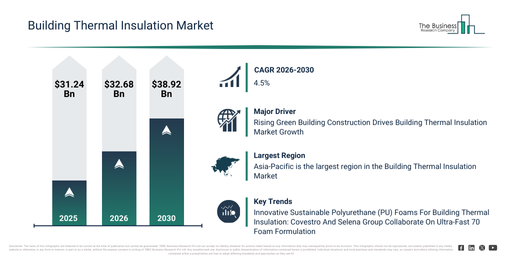
Building Thermal Insulation Market Expected To Reach $38.92 Billion By 2030 At 4.5% CAGR
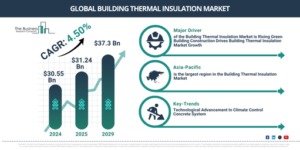
The building thermal insulation market size has experienced consistent expansion in recent years. It is anticipated to increase from $31.24 billion in 2025 to $32.68 billion in 2026, growing at a compound annual growth rate (CAGR) of 4.6%. This historical growth can be linked to factors such as the rising demand for energy-efficient buildings, the continued use of conventional insulation materials, the expansion of both residential and commercial construction projects, a stable availability of polymer feedstock, and the long-standing cost competitiveness of fiberglass and foam insulation.
The building thermal insulation market size is expected to demonstrate consistent growth in the coming years. It is projected to expand to $38.92 billion by 2030, achieving a compound annual growth rate (CAGR) of 4.5%. This growth during the forecast period can be attributed to several factors, including a shift towards sustainable insulation materials, increasing regulatory pressures for energy efficiency, a rise in retrofitting activities, the broader adoption of advanced insulation technologies, and the expanding utilization of low-conductivity materials. Major trends anticipated in this period include an increasing demand for high-performance insulation materials, a growing adoption of fire-resistant insulation solutions, an uptick in retrofitting and energy-efficiency upgrades, the expansion of lightweight and flexible insulation products, and advancements in manufacturing processes for foamed plastics.
Download A Free Sample Report For Comprehensive Market Insights:
Building Thermal Insulation Market Demand Drivers: What Is Fueling Industry Growth?
The future expansion of the building thermal insulation market is anticipated to be spurred by the growing number of green building constructions. These are environmentally responsible structures, conceived and built with sustainable methods to lower resource use, lessen ecological footprint, and enhance the well-being and comfort of occupants. The impetus behind this increase in green building projects largely stems from initiatives aimed at combating climate change and more stringent governmental mandates for improved energy efficiency. To meet their energy efficiency objectives, sustain ideal interior conditions, and reduce energy consumption for heating and cooling, green buildings necessitate advanced insulation systems. An example of this trend is seen in July 2024, when, as reported by the Green Building Council, a US-based non-profit organization, more than 46,000 residential projects received LEED green building certification, indicating nearly a 5% rise in new registrations compared to 2023. Consequently, the expanding construction of green buildings is a key driver for the growth of the building thermal insulation market.
#Building Thermal Insulation Market Segment Landscape And Growth Potential
The building thermal insulation market covered in this report is segmented –
1) By Material: Foamed Plastic, Mineral Wool, Aerogels, Cellulose, Other Materials
2) By Product: Glass Wool, Mineral Wool, Expanded polystyrene (EPS), Extruded polystyrene (XPS), Other Products
3) By Application: Roof Insulation, Wall Insulation, Floor Insulation
4) By End Use: Residential, Commercial, Industrial
Subsegments:
1) By Foamed Plastic: Expanded Polystyrene (EPS), Extruded Polystyrene (XPS), Polyurethane (PUR), Polyisocyanurate (PIR)
2) By Mineral Wool: Glass Wool, Rock Wool
3) By Aerogels: Silica Aerogel, Polymer Aerogel
4) By Cellulose: Loose-Fill Cellulose, Spray-Applied Cellulose
5) By Other Materials: Natural Fiber Insulation, Vermiculite, Perlite
Building Thermal Insulation Market Innovation Trends: Which Developments Are Transforming The Industry?
Leading companies within the building thermal insulation market are introducing an innovative and sustainable assortment of polyurethane (PU) foams. These include formulations like Ultra-Fast 70, which notably decreases the time required for door and window installation, thereby significantly increasing the volume of projects achievable within the same timeframe to gain a market advantage. The primary goal of these PU foams is to improve building thermal insulation through quicker installation, allowing for seamless integration into existing operations without compromising quality. For instance, in September 2023, Covestro, a Germany-based supplier of advanced solutions for vehicles and infrastructure, collaborated with Selena Group, a Poland-based manufacturer of PU foams and construction-related chemicals. Together, they launched the innovative Ultra-Fast 70 polyurethane (PU) foam formulation. This particular formulation significantly reduces the time needed for installing doors and windows, thereby considerably boosting the number of building thermal insulation projects that can be completed within the same timeframe. Moreover, the material has obtained ISSC Plus certification, affirming its composition from plant-based feedstocks via the mass balance method, which is claimed to result in a 60% decrease in carbon emissions compared to fossil-derived materials. Ultimately, the Ultra-Fast 70 foam formulation substantially minimizes the installation time required for doors and windows, consequently greatly enhancing the quantity of projects that can be accomplished within a given timeframe.
Building Thermal Insulation Market Competitive Landscape: Who Are The Leading Companies?
Major companies operating in the building thermal insulation market are Johns Manville, Saint-Gobain S.A., Kingspan Group PLC, Owens Corning, Rockwool International A/S, GAF Materials Corporation, Guardian Building Products Inc., CertainTeed Corporation, Knauf Insulation, Armacell International S.A., Dow Inc., Huntsman Corporation, Cabot Corporation, Recticel NV, Paroc Group, URSA Insulation S.A., Superglass Insulation Ltd., Kaimann GmbH, Thermaflex International Holding B.V., Lapinus Fibres, KCC Corporation, Beijing New Building Material (Group) Co. Ltd., Fletcher Insulation Pty Ltd., TechnoNICOL Corporation, Unifrax I LLC, Aspen Aerogels Inc., Evonik Industries AG
Access The Complete Building Thermal Insulation Market Report:
Building Thermal Insulation Market Global Footprint: Which Region Holds Market Leadership?
Asia-Pacific was the largest region in the building thermal insulation market in 2025. The regions covered in the building thermal insulation market report are Asia-Pacific, South East Asia, Western Europe, Eastern Europe, North America, South America, Middle East, Africa.
Get in touch with us:
The Business Research Company: https://www.thebusinessresearchcompany.com/
Americas: +1 310-496-7795
Asia: +44 7882 955267 & +91 8897263534
Europe: +44 7882 955267
Email us at: marketing@tbrc.info
Follow us on:
LinkedIn: https://in.linkedin.com/company/the-business-research-company
YouTube: https://www.youtube.com/channel/UC24_fI0rV8cR5DxlCpgmyFQ
Global Market Model: https://www.thebusinessresearchcompany.com/global-market-model

Wasay has over a decade of experience in market research, data modelling, and analytics, with prior experience at GlobalData and Decision Tree Consulting Services. At The Business Research Company , he leads research operations across syndicated studies, customized consulting engagements, and the Global Market Model platform. His professional experience includes supporting organizations such as Boston Consulting Group, KPMG, and Ernst & Young. Wasay holds a degree in Electronics and Communications Engineering, postgraduate management qualifications from International Management Institute Belgium and Indian School of Business and Entrepreneurship, and completed the Integrated Program in Business Analytics from Indian Institute of Management Indore.