
Built to provide research that’s more actionable and strategically valuable, The Business Research Company’s 2026 market reports include market attractiveness analysis, total addressable market sizing, company benchmarking matrices, interactive Excel dashboards, broader supply chain intelligence, emerging startup tracking, and in-depth product insights.
Memory Devices Market Size And Revenue Outlook Through 2030
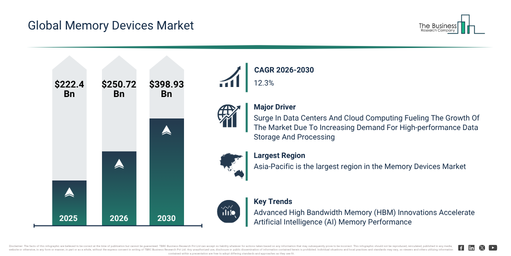
The memory devices market size has experienced rapid expansion in recent years. It is projected to grow from $222.4 billion in 2025 to $250.72 billion in 2026, demonstrating a compound annual growth rate (CAGR) of 12.7%. The historical growth of this market can be attributed to the rising demand for digital data storage, increasing semiconductor manufacturing capacity, the growing adoption of smartphones and personal computers, the expansion of consumer electronics applications, and an increasing demand for embedded memory in electronic devices.
The memory devices market size is anticipated to expand rapidly in the upcoming years. It is projected to reach $398.93 billion by 2030, demonstrating a compound annual growth rate (CAGR) of 12.3%. This expansion throughout the forecast period can be attributed to several factors: increasing demand for memory-intensive computing applications, the growing adoption of advanced memory technologies, a rising need for higher memory bandwidth, the expanding integration of memory in automotive electronics, and a heightened demand for energy-efficient memory solutions. Significant trends expected during this period include a greater embrace of high-density memory architectures, an increasing requirement for low-power memory solutions, the burgeoning development of high-speed memory interfaces, enhanced integration of non-volatile memory technologies, and a growing adoption of heterogeneous memory architectures.
Get A Free Sample Report With In-Depth Market Insights:
Memory Devices Market Growth Catalysts And Demand Drivers
The future expansion of the memory devices market is anticipated to be propelled by the increasing prevalence of data centers and cloud computing. These technologies offer a scalable framework for storing, processing, and handling digital information, simultaneously facilitating dependable computing, storage, and network functionalities. The expansion of data centers and cloud computing is escalating due to organizations’ swift embrace of artificial intelligence, digital services, big data analytics, and enterprise applications, all of which necessitate adaptable computing and storage capabilities. This growth in data centers and cloud computing bolsters memory devices through heightened demand for high-performance dynamic random-access memory, NAND flash memory, and other sophisticated memory technologies, which facilitate quicker data processing, dependable storage, and effective workload handling across servers and cloud infrastructure. A specific example illustrating this trend is that, in September 2024, the National Telecommunications and Information Administration, a US-based government agency, reported approximately 5,000 data centers in the United States, with domestic demand projected to increase by about nine percent each year through 2030. Consequently, the expansion of data centers and cloud computing serves as a primary driver for the growth of the memory devices market.
Memory Devices Market Segment Landscape: Which Areas Lead Development?
The memory devices market covered in this report is segmented –
1) By Type: Dynamic Random Access Memory (DRAM), Static Random Access Memory (SRAM), Not AND Flash Memory (NAND) Flash Memory, Not OR Flash Memory (NOR) Flash Memory, Electrically Erasable Programmable Read Only Memory (EEPROM), Other Types
2) By Memory Capacity: Less Than 1 Gigabyte (GB), 1 Gigabyte (GB) To 8 Gigabytes (GB), 8 Gigabyte (GB) To 64 Gigabyte (GB), 64 Gigabyte (GB) To 256 Gigabyte (GB), More Than 256 Gigabyte (GB)
3) By Form Factor: Integrated Circuits (ICs), Memory Cards, Memory Modules
4) By Application: Consumer Electronics, Enterprise Storage, Industrial, Automotive, Healthcare
Subsegments:
1) By Dynamic Random Access Memory: Synchronous Dynamic Random Access Memory, Double Data Rate Dynamic Random Access Memory, Graphics Dynamic Random Access Memory, Low Power Dynamic Random Access Memory, High Bandwidth Memory
2) By Static Random Access Memory: Asynchronous Static Random Access Memory, Synchronous Static Random Access Memory, Low Power Static Random Access Memory, Nonvolatile Static Random Access Memory
3) By Not AND Flash Memory (NAND) Flash Memory: Single Level Cell, Multi Level Cell, Triple Level Cell, Quad Level Cell, Penta Level Cell
4) By Not OR Flash Memory (NOR) Flash Memory: Parallel Interface NOR Flash, Serial Interface NOR Flash
5) By Electrically Erasable Programmable Read Only Memory: Serial Electrically Erasable Programmable Read Only Memory, Parallel Electrically Erasable Programmable Read Only Memory
6) By Other Types: Read Only Memory, Programmable Read Only Memory, Erasable Programmable Read Only Memory, Magnetoresistive Random Access Memory, Ferroelectric Random Access Memory, Phase Change Memory, Resistive Random Access Memory, Three Dimensional Crosspoint Memory
Memory Devices Market Trends Shaping Long-Term Demand
Leading firms in the memory devices market are concentrating on creating sophisticated high bandwidth memory (HBM) solutions to enhance data processing velocity, energy effectiveness, and thermal characteristics, particularly for artificial intelligence (AI) and high-performance computing applications. High Bandwidth Memory (HBM) represents a high-performance DRAM technology, characterized by the vertical stacking of numerous memory chips, which provides considerably greater bandwidth and reduced power usage compared to traditional memory. As an illustration, in March 2024, SK Hynix Inc., a semiconductor producer situated in South Korea, commenced mass production of HBM3E, which stands as the industry’s inaugural fifth-generation high-bandwidth memory offering. This product is engineered for use with AI accelerators and computation requiring extensive data. HBM3E provides data processing speeds reaching up to 1.18 terabytes per second and demonstrates roughly 10% superior heat dissipation compared to its predecessor, thanks to the company’s cutting-edge MR MUF packaging technology, thereby boosting AI memory capabilities and overall system dependability.
Memory Devices Market Competitive Overview And Top Companies
Major companies operating in the memory devices market are Samsung Electronics Co. Ltd., SK hynix Inc., Micron Technology Inc., Western Digital Corporation, Kioxia Holdings Corporation, Intel Corporation, Sony Group Corporation, Toshiba Electronic Devices & Storage Corporation, Infineon Technologies AG, STMicroelectronics N.V., Renesas Electronics Corporation, Microchip Technology Incorporated, Kingston Technology Corporation, Rohm Co. Ltd., Panasonic Holdings Corporation, Fujitsu Limited, Yangtze Memory Technologies Co. Ltd., ChangXin Memory Technologies Inc., Macronix International Co. Ltd., Winbond Electronics Corporation, Nanya Technology Corporation, GigaDevice Semiconductor Inc., Elite Semiconductor Microelectronics Technology Inc., Etron Technology Inc., Everspin Technologies Inc., Crossbar Inc.
View The Full Memory Devices Market Report:
Memory Devices Market Leading Geography: Which Region Contributes The Most Revenue?
Asia-Pacific was the largest region in the memory devices market in 2025. Asia-Pacific is expected to be the fastest-growing region in the forecast period. The regions covered in the memory devices market report are Asia-Pacific, South East Asia, Western Europe, Eastern Europe, North America, South America, Middle East, Africa.
Reach Out To Our Team:
The Business Research Company: https://www.thebusinessresearchcompany.com/
Americas: +1 310-496-7795
Asia: +44 7882 955267 & +91 8897263534
Europe: +44 7882 955267
Email us at: marketing@tbrc.info
Follow us on:
LinkedIn: https://in.linkedin.com/company/the-business-research-company
YouTube: https://www.youtube.com/channel/UC24_fI0rV8cR5DxlCpgmyFQ
Global Market Model: https://www.thebusinessresearchcompany.com/global-market-model

Wasay has over a decade of experience in market research, data modelling, and analytics, with prior experience at GlobalData and Decision Tree Consulting Services. At The Business Research Company , he leads research operations across syndicated studies, customized consulting engagements, and the Global Market Model platform. His professional experience includes supporting organizations such as Boston Consulting Group, KPMG, and Ernst & Young. Wasay holds a degree in Electronics and Communications Engineering, postgraduate management qualifications from International Management Institute Belgium and Indian School of Business and Entrepreneurship, and completed the Integrated Program in Business Analytics from Indian Institute of Management Indore.