
Backed by market attractiveness analysis, total addressable market sizing, company benchmarking matrices, interactive Excel dashboards, wider supply chain intelligence, emerging startup coverage, and detailed product-level insights, The Business Research Company’s 2026 market reports are designed to offer research that is more actionable and strategically valuable than ever.
Memory Intellectual Property (IP) Market Value Growth And Long-Term Outlook
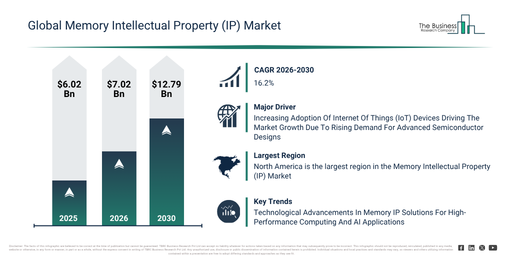
The memory intellectual property (IP) market size has experienced swift expansion in recent years. Its valuation is projected to increase from $6.02 billion in 2025 to $7.02 billion in 2026, achieving a compound annual growth rate (CAGR) of 16.6%. This historical progression can be attributed to factors such as the increasing demand for semiconductor design reuse, the growing adoption of system-on-chip architectures, the escalating complexity of integrated circuit designs, the rising need to reduce semiconductor development time, and the increasing demand for validated semiconductor IP solutions.
The memory intellectual property (IP) market is anticipated to undergo significant expansion in the next few years, with its size projected to reach $12.79 billion by 2030, reflecting a compound annual growth rate (CAGR) of 16.2%. This expected growth throughout the forecast period stems from the increasing need for advanced memory architectures, the wider adoption of chiplet-based semiconductor designs, a heightened demand for customized memory IP solutions, the expanding integration of high-bandwidth memory technologies, and a growing emphasis on power-efficient memory architectures. Noteworthy trends during this period include a rising preference for reusable memory IP designs, an escalating demand for advanced memory architecture IP, the ongoing development of low-power memory IP solutions, an increased requirement for high-performance memory IP, and the broader acceptance of validated memory IP for SoC designs.
Get A Free Sample Report With In-Depth Market Insights:
Memory Intellectual Property (IP) Market Demand Drivers Opening New Revenue Streams
The expanding integration of Internet of Things (IoT) devices is anticipated to drive the growth of the memory intellectual property (IP) market in the future. Internet of Things (IoT) devices are interconnected electronic devices that collect, process, and exchange data via communication networks, thereby enabling automation, monitoring, and intelligent decision-making. The prevalence of IoT devices is expanding due to the rising demand for connected technologies across various sectors, including consumer electronics, automotive, healthcare, industrial automation, and smart infrastructure, all of which require efficient and high-performance memory solutions. This growing adoption of Internet of Things (IoT) devices positively influences memory intellectual property (IP) by increasing the need for energy-efficient and compact memory designs, which are essential for reliable data storage and processing in resource-constrained connected devices. For instance, the European Commission, a Belgium-based governing body, reported in July 2025 that the number of installed IoT-connected devices was approximately 40 billion in 2023, and is projected to reach 49 billion by 2026, reflecting an annual growth rate of 7%. Therefore, the expanding integration of Internet of Things (IoT) devices is propelling the growth of the memory intellectual property (IP) market.
Memory Intellectual Property (IP) Market Segmentation And Category Overview
The memory intellectual property (IP) market covered in this report is segmented –
1)By Memory Type: Dynamic Random Access Memory (DRAM) Intellectual Property, Static Random Access Memory (SRAM) Intellectual Property, Read Only Memory (ROM) Intellectual Property, Flash Memory Intellectual Property, Embedded Memory Intellectual Property
2) By Fabrication Process Node: Advanced Nodes, Mainstream Nodes, Legacy Nodes
3) By Deployment: On-Premises IP Licensing, Cloud-Based IP Licensing
4) By End User: Semiconductor Companies, Integrated Device Manufacturers, Fabless Semiconductor Companies, Electronic Design Automation Providers, Consumer Electronics Manufacturers, Automotive Electronics Manufacturers
Subsegments:
1) By Dynamic Random Access Memory (DRAM) Intellectual Property: Double Data Rate Synchronous Dynamic Random Access Memory (DDR SDRAM) IP, Low Power Double Data Rate (LPDDR) IP, Graphics Double Data Rate (GDDR) IP, High Bandwidth Memory (HBM) IP, Embedded Dynamic Random Access Memory (eDRAM) IP
2) By Static Random Access Memory (SRAM) Intellectual Property: Single Port SRAM IP, Dual Port SRAM IP, Multi Port SRAM IP, Low Power SRAM IP, High Speed SRAM IP
3) By Read Only Memory (ROM) Intellectual Property: Mask ROM IP, One Time Programmable (OTP) ROM IP, Metal Programmable ROM IP, Embedded ROM IP
4) By Flash Memory Intellectual Property: Not OR (NOR) Flash IP, Not AND (NAND) Flash IP, Serial Flash IP, Embedded Flash (eFlash) IP
5) By Embedded Memory Intellectual Property: Embedded SRAM IP, Embedded Dynamic Random Access Memory (eDRAM) IP, Embedded Flash (eFlash) IP, Embedded ROM IP, Embedded Non Volatile Memory (eNVM) IP
Memory Intellectual Property (IP) Market Trends Powering Strategic Industry Growth
Companies operating within the memory intellectual property (IP) market are concentrating on devising advanced solutions, specifically low-power high-speed memory interface intellectual property (IP) cores. These are aimed at improving high-performance computing (HPC), artificial intelligence (AI) processing, data transfer efficiency, and power optimization. Low-power high-speed memory interface intellectual property (IP) cores are foundational semiconductor building blocks, engineered to ensure seamless communication between processors and memory elements. They empower SoC developers to incorporate more rapid memory technologies, resulting in decreased power usage, superior data transfer capabilities, heightened reliability, and condensed chip development timelines for purposes spanning AI, data centers, edge computing, and high-performance computing systems. For instance, in June 2024, M31 Technology Corporation, a Taiwan-based silicon intellectual property (IP) provider, introduced its cutting-edge LPDDR memory IP solution designed to support high-performance computing and AI applications. The LPDDR4/4X memory IP offers consistent high performance and minimal power consumption, accommodating speeds up to 4,267 Mbps and incorporating self-training algorithms to fine-tune performance across various uses. Moreover, the newly released LPDDR5/5X/5T memory IP provides data transfer speeds reaching 9,600 Mbps, enhanced power efficiency with up to 30% lower energy consumption compared to previous generations, and sophisticated error correction technology to boost data reliability. These memory IP solutions are developed for environments like data centers, AI workloads, autonomous vehicles, edge computing devices, mobile systems, and other sophisticated computing setups requiring both high-speed processing and energy efficiency.
Memory Intellectual Property (IP) Market Top Companies Driving Competitive Growth
Major companies operating in the memory intellectual property (IP) market are Samsung Electronics Co. Ltd., Renesas Electronics Corporation, Synopsys Inc., Cadence Design Systems Inc., Arm Ltd., Rambus Inc., Microchip Technology Inc., Alphawave Semi, Ceva Inc., Faraday Technology Corporation, VeriSilicon Microelectronics (Shanghai) Co. Ltd., eMemory Technology Inc., Innosilicon Technology Ltd., Credo Technology Group Holding Ltd, Andes Technology Corporation, Weebit Nano Limited, Intrinsic ID, Qualitas Semiconductor Private Limited, T2M-IP, Eliyan Corporation, Ceremorphic Inc., Baya Systems Inc., SmartDV Technologies India Private Limited, Chipus Microelectronics Ltda.
View The Full Memory Intellectual Property (IP) Market Report:
Memory Intellectual Property (IP) Market Global Footprint: Which Region Leads The Industry?
North America was the largest region in the memory intellectual property (IP) market in 2025. Asia-Pacific is expected to be the fastest-growing region in the forecast period. The regions covered in the memory intellectual property (IP) market report are Asia-Pacific, South East Asia, Western Europe, Eastern Europe, North America, South America, Middle East, Africa.
Reach Out To Our Team:
The Business Research Company: https://www.thebusinessresearchcompany.com/
Americas: +1 310-496-7795
Asia: +44 7882 955267 & +91 8897263534
Europe: +44 7882 955267
Email us at: marketing@tbrc.info
Follow us on:
LinkedIn: https://in.linkedin.com/company/the-business-research-company
YouTube: https://www.youtube.com/channel/UC24_fI0rV8cR5DxlCpgmyFQ
Global Market Model: https://www.thebusinessresearchcompany.com/global-market-model

Wasay has over a decade of experience in market research, data modelling, and analytics, with prior experience at GlobalData and Decision Tree Consulting Services. At The Business Research Company , he leads research operations across syndicated studies, customized consulting engagements, and the Global Market Model platform. His professional experience includes supporting organizations such as Boston Consulting Group, KPMG, and Ernst & Young. Wasay holds a degree in Electronics and Communications Engineering, postgraduate management qualifications from International Management Institute Belgium and Indian School of Business and Entrepreneurship, and completed the Integrated Program in Business Analytics from Indian Institute of Management Indore.