With a focus on actionable insights and strategic value, The Business Research Company’s 2026 market reports include market attractiveness scoring, total addressable market sizing, company benchmarking matrices, interactive Excel dashboards, deeper supply chain intelligence, emerging startup tracking, and granular product-level insights.
Aerospace Ceramics Market Size Outlook: A $6.25 Billion Market By 2030, Growing At 6.6% Annually
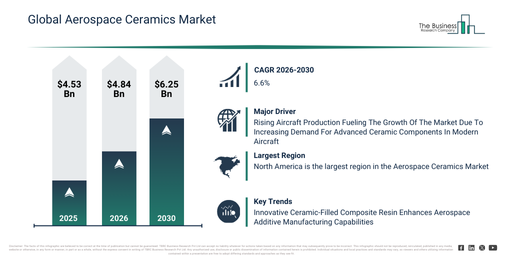
The aerospace ceramics market has demonstrated significant expansion in recent years. This market is anticipated to grow from $4.53 billion in 2025 to $4.84 billion in 2026, exhibiting a compound annual growth rate (CAGR) of 6.8%. Historically, this growth has been fueled by various factors, including the increasing application of ceramic matrix composites in aerospace components, the development of thermal barrier coatings for high-temperature engines, a rising demand for lightweight and wear-resistant materials, the adoption of silicon carbide components in structural and propulsion systems, and government investment in advanced materials research for aerospace applications.
The aerospace ceramics market is projected to experience substantial expansion over the coming years, reaching $6.25 billion by 2030, driven by a compound annual growth rate (CAGR) of 6.6%. This anticipated growth stems from several factors: an increasing need for high-performance ceramics in advanced aircraft and spacecraft, broader applications of ceramics in hypersonic and high-speed defense systems, an emphasis on enhancing thermal shock and corrosion resistance, the adoption of advanced manufacturing methods for intricate ceramic components, and a rise in the acquisition of tailored ceramics for essential aerospace and defense missions. Key trends expected during this period involve a surge in demand for ultra-lightweight ceramic materials, greater incorporation of ceramic matrix composites into aerospace engines, a heightened requirement for thermal barrier coatings on hypersonic platforms, the proliferation of ceramics in future structural and protective systems, and advancements in high-temperature ceramic performance vital for deep-space endeavors.
Make Data-Driven Decisions With A Free Aerospace Ceramics Market Sample Report:
Key Demand Driver Expected To Lift Aerospace Ceramics Market Revenue
The anticipated expansion of the aerospace ceramics market is linked to an increase in aircraft manufacturing going forward. This surge in aircraft output stems from progress in manufacturing technologies, facilitating quicker and more streamlined assembly processes. Aerospace ceramics find application in aircraft production, providing excellent strength-to-weight ratios and thermal endurance, which enables the creation of lighter, more robust parts that streamline manufacturing. For example, as reported by Airbus SE, a Netherlands-based aerospace and defense company, in January 2024, they supplied 735 commercial aircraft in 2023, signifying an 11% rise over the 663 aircraft delivered in 2022. Consequently, increasing rates of aircraft production are fueling the expansion of the aerospace ceramics market.
Exploring The Aerospace Ceramics Market Through Its Key Segments
The aerospace ceramics market covered in this report is segmented –
1) By Type: Oxide Ceramics, Non-Oxide Ceramics, Composite Ceramics
2) By Manufacturing Process: Powder Processing, Slip Casting, Hot Pressing, 3D Printing, Other Advanced Manufacturing Techniques
3) By Temperature Resistance: High-Temperature Resistant Ceramics, Intermediate-Temperature Resistant Ceramics, Low-Temperature Resistant Ceramics
4) By Application: Engine Components, Thermal Protection Systems, Structural Components, Electronics And Sensors, Aerospace Structural Parts
5) By End-User: Commercial Aviation, Military Aviation, Space Exploration, Drone Technology, Other End-Users
Subsegments:
1) By Oxide Ceramics: Alumina, Zirconia, Mullite, Magnesia
2) By Non-Oxide Ceramics: Silicon Carbide, Boron Carbide, Silicon Nitride, Aluminum Nitride
3) By Composite Ceramics: Ceramic Matrix Composites, Fiber-Reinforced Ceramics, Oxide-Oxide Composites, Carbon-Ceramic Composites
New Trends Redefining Competition In The Aerospace Ceramics Market
Major companies operating in the aerospace ceramics market are focusing on developing innovative solutions, such as ceramic-filled composite resin, to enhance component strength, thermal resistance, and performance in extreme environments. Ceramic-filled composite resin is a material composed of a polymer resin matrix reinforced with finely dispersed ceramic particles, designed to combine the toughness and processability of polymers with the high strength, stiffness, and thermal resistance of ceramics. For instance, in April 2025, PolySpectra Inc., a US-based provider of photopolymer materials for 3D printing, partnered with Tethon 3D, a US-based ceramic additive manufacturing specialist, and launched ThOR 10, a rugged ceramic-filled composite resin. This innovative material combines PolySpectra’s durable cyclic olefin resin chemistry with Tethon 3D’s advanced ceramic filler technology, resulting in a resin that offers exceptional thermal stability, improved stiffness, and enhanced dimensional accuracy. ThOR 10 is optimized for use in DLP and other resin-based 3D printing systems, enabling the production of parts that can withstand demanding mechanical loads and elevated temperatures. Its unique formulation also provides superior wear resistance and low shrinkage, making it ideal for functional prototypes and end-use parts in aerospace, automotive, and industrial applications.
Aerospace Ceramics Market Competition: Key Players And Industry Participants
Major companies operating in the aerospace ceramics market are Boeing Company, Lockheed Martin Corporation, Saint-Gobain Ceramics & Plastics Inc., General Electric Company, Honeywell International Inc., BAE Systems plc, 3M Company, Safran SA, Kyocera Corporation, Murata Manufacturing Co. Ltd., NGK Spark Plug Co. Ltd., CoorsTek Inc., Morgan Advanced Materials plc, CeramTec GmbH, Ceradyne Inc., Superior Technical Ceramics Corporation, Blasch Precision Ceramics Inc., Applied Ceramics Inc., Rauschert GmbH, Precision Ceramics USA, McDanel Advanced Ceramic Technologies LLC, International Syalons Limited, Advanced Ceramic Manufacturing LLC
Get The Detailed Aerospace Ceramics Market Research Report Here:
Aerospace Ceramics Market Regional Overview: Largest Market And Global Coverage
North America was the largest region in the aerospace ceramics market in 2025. Asia-Pacific is expected to be the fastest-growing region in the forecast period. The regions covered in the aerospace ceramics market report are Asia-Pacific, South East Asia, Western Europe, Eastern Europe, North America, South America, Middle East, Africa.
Reach Out To Our Team:
The Business Research Company: https://www.thebusinessresearchcompany.com/
Americas: +1 310-496-7795
Asia: +44 7882 955267 & +91 8897263534
Europe: +44 7882 955267
Email us at: marketing@tbrc.info
Follow us on:
LinkedIn: https://in.linkedin.com/company/the-business-research-company
YouTube: https://www.youtube.com/channel/UC24_fI0rV8cR5DxlCpgmyFQ
Global Market Model: https://www.thebusinessresearchcompany.com/global-market-model

Wasay has over a decade of experience in market research, data modelling, and analytics, with prior experience at GlobalData and Decision Tree Consulting Services. At The Business Research Company , he leads research operations across syndicated studies, customized consulting engagements, and the Global Market Model platform. His professional experience includes supporting organizations such as Boston Consulting Group, KPMG, and Ernst & Young. Wasay holds a degree in Electronics and Communications Engineering, postgraduate management qualifications from International Management Institute Belgium and Indian School of Business and Entrepreneurship, and completed the Integrated Program in Business Analytics from Indian Institute of Management Indore.