
Built to provide research that’s more actionable and strategically valuable, The Business Research Company’s 2026 market reports include market attractiveness analysis, total addressable market sizing, company benchmarking matrices, interactive Excel dashboards, broader supply chain intelligence, emerging startup tracking, and in-depth product insights.
Mobile Edge Computing Market Size, Value And Growth Trajectory Through 2030
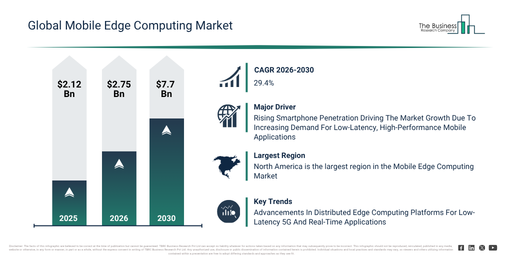
The mobile edge computing market has witnessed substantial expansion in recent years. It is projected to increase from $2.12 billion in 2025 to $2.75 billion in 2026, achieving a compound annual growth rate (CAGR) of 29.8%. This historical market growth can be attributed to a rise in mobile data traffic, the increasing rollout of 5G networks, a growing demand for real-time applications, improved IoT device connectivity, and the broader adoption of cloud computing.
The mobile edge computing market is projected to experience substantial expansion over the upcoming years, reaching a valuation of $7.7 billion by 2030, exhibiting a compound annual growth rate (CAGR) of 29.4%. This anticipated growth is driven by several factors, including the increasing need for ultra-low-latency computing, the expanding embrace of edge AI inference, the rising establishment of distributed edge data centers, the growing demand for connected vehicle applications, and the widening application of edge computing in industrial automation. Key developments expected during this period involve the heightened deployment of edge servers and edge data centers, the escalating need for low-latency data processing, the increasing acceptance of edge infrastructure-as-a-service, the deepening integration of edge computing with 5G networks, and the growing requirement for localized computing and storage resources.
Get A Free Sample Report With In-Depth Market Insights:
Mobile Edge Computing Market Growth Catalysts And Demand Drivers
The anticipated expansion of the mobile edge computing market is being fueled by the increasing adoption of smartphones. Smartphone penetration is defined as the proportion of individuals within a population who possess or actively utilize a smartphone, signifying the extent of smartphone acceptance in a particular region. This penetration is on the rise as the decreasing cost of smartphones renders them more economical and available to a broader segment of the population. Mobile edge computing (MEC) supports greater smartphone adoption by boosting network speeds and minimizing latency, thus improving the user experience for applications demanding significant data, even on more budget-friendly devices, consequently increasing the appeal and usability of smartphones for a diverse range of users. An illustrative example, as reported in June 2024 by Ericsson, a telecommunications firm based in Sweden, forecasts that regional mobile subscriptions will grow from 1.2 billion in 2023 to 1.3 billion by 2029. Consequently, the growing rate of smartphone penetration is a primary driver for the expansion of the mobile edge computing market.
Mobile Edge Computing Market Segment Analysis: What Are The Core Market Categories?
The mobile edge computing market covered in this report is segmented –
1) By Component: Hardware, Software, Services
2) By Deployment Mode: On-Premises, Cloud
3) By Enterprise Size: Large Enterprises, Small And Medium-Sized Enterprises
4) By Application: Content Delivery, Video Analytics, Internet Of Things Connectivity, Augmented Reality And Virtual Reality, Connected Vehicles, Industrial Automation, Smart Cities, Network Optimization, Artificial Intelligence Inference, Real-Time Data Analytics, Other Applications
5) By End User: Telecommunications, Manufacturing, Healthcare, Retail And E-Commerce, Media And Entertainment, Transportation And Logistics, Energy And Utilities, Government And Public Sector, Banking, Financial Services, And Insurance, Information Technology And Information Technology Enabled Services, Other End Users
Subsegments:
1) By Hardware: Edge Servers, Edge Gateways, Edge Data Centers, Networking Equipment
2) By Software: Edge Computing Platforms, Orchestration And Management Software, Virtualization Software, Security Software
3) By Services: Professional Services, Managed Services, Support And Maintenance Services, Edge Infrastructure-As-A-Service
Mobile Edge Computing Market Trends Shaping Long-Term Demand
Leading entities within the mobile edge computing market are concentrating on creating advanced solutions, including multi-access edge computing (MEC) platforms. These initiatives aim to mitigate network delays, improve real-time data processing capabilities, and facilitate robust 5G and cloud-native applications. A multi-access edge computing platform is defined as a distributed computing framework that positions cloud computing assets nearer to end users at the periphery of the telecom network, functioning to decrease latency, maximize bandwidth utilization, and enable immediate data processing. An illustrative example is Verizon Communications, a US-based telecommunications firm, which introduced the globe’s inaugural mobile edge computing platform in July 2026. This platform, developed in collaboration with AWS Wavelength, integrates cloud computing and AWS infrastructure directly into Verizon’s 5G network edge locations. This innovation provides advantages like extremely low latency, elevated application performance, and effortless integration between cloud and 5G services. The objective of this introduction is to assist customers in attaining quicker real-time data processing and superior user experiences, concurrently furthering the wider shift towards 5G-enabled edge computing and decentralized cloud architectures.
Mobile Edge Computing Market Top Companies Driving Competitive Growth
Major companies operating in the mobile edge computing market are Google LLC, Microsoft Corporation, Samsung Electronics Co. Ltd., NVIDIA Corporation, Amazon Web Services Inc., Verizon Communications Inc., Huawei Technologies Co. Ltd., AT&T Inc., Dell Technologies Inc., Accenture plc, International Business Machines Corporation, Oracle Corporation, Cisco Systems Inc., Intel Corporation, Qualcomm Incorporated, Vodafone Group Plc, Fujitsu Limited, Nokia Corporation, SK Telecom Co. Ltd., CommScope Holding Company Inc., Advantech Co. Ltd., EdgeConneX Inc., ADLINK Technology Inc., Zenlayer Inc., Vapor IO Inc.
View The Full Mobile Edge Computing Market Report:
Mobile Edge Computing Market Global Footprint: Which Region Leads The Industry?
North America was the largest region in the mobile edge computing market in 2025. Asia-Pacific is expected to be the fastest-growing region in the forecast period. The regions covered in the mobile edge computing market report are Asia-Pacific, South East Asia, Western Europe, Eastern Europe, North America, South America, Middle East, Africa.
Reach Out To Our Team:
The Business Research Company: https://www.thebusinessresearchcompany.com/
Americas: +1 310-496-7795
Asia: +44 7882 955267 & +91 8897263534
Europe: +44 7882 955267
Email us at: marketing@tbrc.info
Follow us on:
LinkedIn: https://in.linkedin.com/company/the-business-research-company
YouTube: https://www.youtube.com/channel/UC24_fI0rV8cR5DxlCpgmyFQ
Global Market Model: https://www.thebusinessresearchcompany.com/global-market-model

Wasay has over a decade of experience in market research, data modelling, and analytics, with prior experience at GlobalData and Decision Tree Consulting Services. At The Business Research Company , he leads research operations across syndicated studies, customized consulting engagements, and the Global Market Model platform. His professional experience includes supporting organizations such as Boston Consulting Group, KPMG, and Ernst & Young. Wasay holds a degree in Electronics and Communications Engineering, postgraduate management qualifications from International Management Institute Belgium and Indian School of Business and Entrepreneurship, and completed the Integrated Program in Business Analytics from Indian Institute of Management Indore.