
Backed by market attractiveness analysis, total addressable market sizing, company benchmarking matrices, interactive Excel dashboards, wider supply chain intelligence, emerging startup coverage, and detailed product-level insights, The Business Research Company’s 2026 market reports are designed to offer research that is more actionable and strategically valuable than ever.
Mobile Phone Memory Market Forecast: What Value Will The Market Reach By 2030?
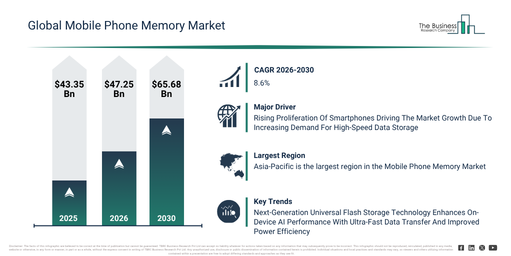
The mobile phone memory market has witnessed substantial growth in recent years. This market is projected to expand from $43.35 billion in 2025 to $47.25 billion in 2026, reflecting a compound annual growth rate (CAGR) of 9.0%. Historically, this expansion has been attributed to factors such as increasing smartphone penetration, expanded mobile application usage, growing demand for multimedia content, rising adoption of mobile gaming, and a heightened need for mobile photography and video storage.
The mobile phone memory market size is anticipated to expand significantly in the coming years. It is projected to reach $65.68 billion in 2030, demonstrating a compound annual growth rate (CAGR) of 8.6%. This growth during the forecast period can be attributed to factors such as the increasing demand for AI-enabled smartphones, the rising adoption of high-resolution video applications, the growing need for greater smartphone storage capacities, the wider acceptance of advanced mobile memory standards, and an increased demand for faster mobile data access. Significant trends expected in this period include a greater uptake of higher-capacity mobile memory, an increasing requirement for faster memory interfaces, the continuous integration of advanced memory technologies into smartphones, a heightened demand for power-efficient mobile memory, and a rising prevalence of high-capacity memory cards.
Get A Free Sample Report With In-Depth Market Insights:
Mobile Phone Memory Market Demand Drivers Opening New Revenue Streams
The expanding adoption of smartphones is anticipated to fuel the expansion of the mobile phone memory market in the future. These sophisticated mobile devices integrate communication, computing, and multimedia capabilities, necessitating robust memory solutions to facilitate operating systems, applications, and data storage. The increasing prevalence of smartphones is attributed to wider internet penetration, prompting more users to acquire them for online access and digital services. This escalating use of smartphones is consequently boosting the need for mobile phone memory with greater capacity and improved speed, essential for supporting sophisticated applications, seamless multitasking, and superior mobile performance. As an illustration, the Global System for Mobile Communications Association (GSMA), a UK-based entity, reported in September 2025 that roughly 1.5 billion individuals worldwide were utilizing 5G smartphones for mobile internet connectivity around 2024. Thus, the expanding adoption of smartphones is indeed a key driver for the growth of the mobile phone memory market.
Mobile Phone Memory Market Segment Landscape: Which Areas Lead Development?
The mobile phone memory market covered in this report is segmented –
1) By Product: Mobile Dynamic Random Access Memory, Mobile Not And Flash Memory, Universal Flash Storage, Embedded MultiMedia Card, Mobile Memory Cards
2) By Memory Type: Volatile Memory, Non Volatile Memory
3) By Storage Capacity: Up To 64 Gigabytes, 64 Gigabytes To 128 Gigabytes, 128 Gigabytes To 256 Gigabytes, 256 Gigabytes To 512 Gigabytes, Above 512 Gigabytes
4) By Distribution Channel: Original Equipment Manufacturers, Aftermarket
Subsegments:
1) By Mobile Dynamic Random Access Memory: Low Power Double Data Rate Third Generation, Low Power Double Data Rate Fourth Generation, Low Power Double Data Rate Fifth Generation, Low Power Double Data Rate Fifth Generation Extended
2) By Mobile Not And Flash Memory: Single Level Cell Not And Flash Memory, Multi Level Cell Not And Flash Memory, Triple Level Cell Not And Flash Memory, Quad Level Cell Not And Flash Memory
3) By Universal Flash Storage: Universal Flash Storage Version 2.1, Universal Flash Storage Version 3.1, Universal Flash Storage Version 4.0
4) By Embedded MultiMedia Card: Embedded MultiMedia Card Version 5.0, Embedded MultiMedia Card Version 5.1, Embedded MultiMedia Card Industrial Grade, Embedded MultiMedia Card Automotive Grade
5) By Mobile Memory Cards: Secure Digital High Capacity Memory Cards, Secure Digital Extended Capacity Memory Cards, Secure Digital Ultra Capacity Memory Cards, Micro Secure Digital Express Memory Cards
Mobile Phone Memory Market Trends Powering Strategic Industry Growth
Major companies operating in the mobile phone memory market are focused on developing innovative solutions, such as next-generation universal flash storage (UFS) architectures. These efforts aim to improve data transfer speeds, enhance power efficiency, and support advanced on-device computing capabilities, including mobile AI processing. Next-generation UFS architectures are sophisticated embedded storage solutions designed for smartphones, enabling significantly faster read and write speeds, reduced latency, and better energy efficiency compared to older storage standards. This advancement helps overcome performance bottlenecks in high-performance mobile applications and AI-driven workloads. For instance, in June 2026, Samsung Electronics Co., Ltd., a South Korea-based consumer electronics corporation, launched its UFS 5.0 storage solution, specifically designed for next-generation on-device AI applications. This technology achieves data transfer speeds of up to 10.8 GB/s, considerably improving mobile storage performance for AI-driven tasks like image processing, voice recognition, and real-time analytics. Additionally, the solution enhances power efficiency and reduces package size, contributing to improved thermal management and longer battery life in mobile devices while supporting increasingly complex AI workloads directly on smartphones without heavy reliance on cloud computing.
Mobile Phone Memory Market Industry Leaders And Competitive Landscape
Major companies operating in the mobile phone memory market are Samsung Electronics Co Ltd, SK Hynix Inc, Micron Technology Inc, Kioxia Holdings Corporation, Western Digital Corporation, Winbond Electronics Corporation, Nanya Technology Corporation, Yangtze Memory Technologies Co Ltd, Powerchip Semiconductor Manufacturing Corporation, GigaDevice Semiconductor Inc, Macronix International Co Ltd, AP Memory Technology Corporation, BIWIN Storage Technology Co Ltd, Elite Semiconductor Microelectronics Technology Inc, Fidelix Co Ltd, Dosilicon Co Ltd, Etron Technology Inc, Zentel Electronics Corporation, Shenzhen Longsys Electronics Co Ltd, Kingston Technology Corporation
View The Full Mobile Phone Memory Market Report:
Mobile Phone Memory Market Regional Analysis And Leading Geography
Asia-Pacific was the largest region in the mobile phone memory market in 2025. Asia-Pacific is expected to be the fastest-growing region in the forecast period. The regions covered in the mobile phone memory market report are Asia-Pacific, South East Asia, Western Europe, Eastern Europe, North America, South America, Middle East, Africa.
Reach Out To Our Team:
The Business Research Company: https://www.thebusinessresearchcompany.com/
Americas: +1 310-496-7795
Asia: +44 7882 955267 & +91 8897263534
Europe: +44 7882 955267
Email us at: marketing@tbrc.info
Follow us on:
LinkedIn: https://in.linkedin.com/company/the-business-research-company
YouTube: https://www.youtube.com/channel/UC24_fI0rV8cR5DxlCpgmyFQ
Global Market Model: https://www.thebusinessresearchcompany.com/global-market-model

Wasay has over a decade of experience in market research, data modelling, and analytics, with prior experience at GlobalData and Decision Tree Consulting Services. At The Business Research Company , he leads research operations across syndicated studies, customized consulting engagements, and the Global Market Model platform. His professional experience includes supporting organizations such as Boston Consulting Group, KPMG, and Ernst & Young. Wasay holds a degree in Electronics and Communications Engineering, postgraduate management qualifications from International Management Institute Belgium and Indian School of Business and Entrepreneurship, and completed the Integrated Program in Business Analytics from Indian Institute of Management Indore.