
Built to provide research that’s more actionable and strategically valuable, The Business Research Company’s 2026 market reports include market attractiveness analysis, total addressable market sizing, company benchmarking matrices, interactive Excel dashboards, broader supply chain intelligence, emerging startup tracking, and in-depth product insights.
Mobile Phone Semiconductor Market Growth Analysis: How Will Revenue Trend Over The Forecast Period?
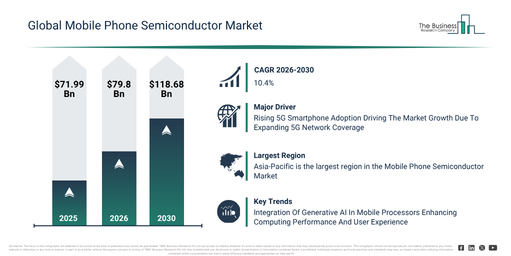
The mobile phone semiconductor market size has seen substantial growth in recent years. Its expansion is projected to be from $71.99 billion in 2025 to $79.8 billion in 2026, exhibiting a compound annual growth rate (CAGR) of 10.9%. The market’s historical growth can be attributed to several factors including an increase in smartphone shipments, wider adoption of mobile connectivity, rising demand for advanced mobile processors, a greater embrace of wireless communication technologies, and a heightened need for improved smartphone battery efficiency.
The mobile phone semiconductor market size is expected to experience substantial expansion in the coming years. It is projected to reach $118.68 billion by 2030, growing at a compound annual growth rate (CAGR) of 10.4%. This projected growth throughout the forecast period can be attributed to factors such as the increasing demand for on-device AI processing, the rising adoption of advanced wireless connectivity, a growing need for energy-efficient semiconductor architectures, the greater integration of multifunctional semiconductor components, and the increased use of advanced semiconductor materials. Key trends anticipated during this period include the expanding integration of advanced mobile systems on chips, an escalating demand for higher semiconductor integration, the growing application of advanced radio frequency components, the increasing development of power-efficient mobile semiconductor designs, and a rising demand for enhanced semiconductor reliability and performance.
Get A Free Sample Report With In-Depth Market Insights:
Mobile Phone Semiconductor Market Growth Factors Behind Sustained Expansion
The expanding adoption of 5G smartphones is set to drive the growth of the mobile phone semiconductor market. A 5G smartphone is defined as a mobile phone equipped with technology enabling connection to fifth-generation (5G) cellular networks. This rise in 5G smartphone usage is driven by the widening 5G network coverage, as increased availability of 5G services encourages consumers to upgrade for faster and more reliable connectivity. The proliferation of 5G smartphones boosts demand for advanced mobile phone semiconductors, necessitating high-performance, energy-efficient, and highly integrated chips that support faster connectivity, lower latency, enhanced AI capabilities, improved power efficiency, and superior overall smartphone performance. As an illustration, in September 2025, the Global System for Mobile Communications Association (GSMA), a UK-based organization, indicated that around 1.5 billion people globally were using 5G smartphones for mobile internet access in approximately 2024. Therefore, the increasing adoption of 5G smartphones is a key factor contributing to the growth of the mobile phone semiconductor market.
Mobile Phone Semiconductor Market Segment Outlook: Which Categories Are Growing Fastest?
The mobile phone semiconductor market covered in this report is segmented –
1) By Component: Processors And Systems On Chips, Baseband And Radio Frequency Chips, Connectivity Integrated Circuits, Memory And Storage, Power And Analog Integrated Circuits, Other Components
2) By Smartphone Tier: Premium Smartphones, Mid Range Smartphones, Entry Level Smartphones
3) By Semiconductor Material: Silicon, Silicon Carbide, Gallium Arsenide, Gallium Nitride, Other Semiconductor Materials
4) By Application: Smartphones, Feature Phones
5) By End User: Original Equipment Manufacturers, Aftermarket
Subsegments:
1) By Processors And Systems On Chips: Application Processors, Graphics Processing Units, Neural Processing Units, Digital Signal Processors, Integrated Mobile Systems On Chips
2) By Baseband And Radio Frequency Chips: Baseband Processors, Radio Frequency Transceivers, Radio Frequency Front End Modules, Power Amplifiers, Low Noise Amplifiers, Radio Frequency Filters
3) By Connectivity Integrated Circuits: Wireless Fidelity Integrated Circuits, Bluetooth Integrated Circuits, Near Field Communication Integrated Circuits, Global Navigation Satellite System Integrated Circuits, Ultra Wideband Integrated Circuits
4) By Memory And Storage: Dynamic Random Access Memory, Low Power Double Data Rate Memory, NAND Flash Memory, Universal Flash Storage, Embedded MultiMediaCard
5) By Power And Analog Integrated Circuits: Power Management Integrated Circuits, Battery Management Integrated Circuits, Audio Codec Integrated Circuits, Display Driver Integrated Circuits, Voltage Regulators
6) By Other Components: Image Signal Processors, Sensor Integrated Circuits, Security Integrated Circuits, Touch Controller Integrated Circuits, Timing And Clock Integrated Circuits
Mobile Phone Semiconductor Market Industry Trends Fueling Future Revenue Growth
Leading companies in the mobile phone semiconductor market are concentrating on developing innovative products, such as generative AI-enabled mobile processors, to significantly enhance on-device artificial intelligence, computing performance, power efficiency, and premium smartphone experiences. Generative AI-enabled mobile processors are sophisticated system-on-chip (SoC) semiconductors that integrate dedicated AI engines, CPUs, GPUs, and neural processing units, enabling them to execute generative AI models directly on smartphones. This approach provides faster, more secure, and lower-latency AI capabilities compared to cloud-dependent processing. For instance, in October 2023, Qualcomm Technologies, Inc., a US-based semiconductor company, unveiled the Snapdragon 8 Gen 3 mobile platform, which is its first premium processor specifically designed for generative AI-powered flagship smartphones. The platform offers industry-leading on-device AI performance, advanced camera capabilities, console-quality gaming, studio-grade audio, and high-speed connectivity within a power-efficient architecture. It allows users to generate content, improve productivity, and access advanced AI-powered applications directly on their devices, while supporting leading Android smartphone manufacturers globally.
Mobile Phone Semiconductor Market Leading Companies And Competitive Benchmarking
Major companies operating in the mobile phone semiconductor market are Apple Inc., Samsung Electronics Co. Ltd., Huawei Technologies Co. Ltd., Sony Semiconductor Solutions Corporation, SK Hynix Inc., Broadcom Inc., Qualcomm Incorporated, Micron Technology Inc., MediaTek Inc., Texas Instruments Incorporated, Infineon Technologies AG, NXP Semiconductors N.V., STMicroelectronics N.V., Murata Manufacturing Co. Ltd., Analog Devices Inc., Renesas Electronics Corporation, ON Semiconductor Corporation, Skyworks Solutions Inc., Arm Holdings plc, Qorvo Inc., UNISOC (Shanghai) Technologies Co. Ltd., Cirrus Logic Inc.
View The Full Mobile Phone Semiconductor Market Report:
Mobile Phone Semiconductor Market Largest Region By Revenue And Market Share
Asia-Pacific was the largest region in the mobile phone semiconductor market in 2025. Asia-Pacific is expected to be the fastest-growing region in the forecast period. The regions covered in the mobile phone semiconductor market report are Asia-Pacific, South East Asia, Western Europe, Eastern Europe, North America, South America, Middle East, Africa.
Reach Out To Our Team:
The Business Research Company: https://www.thebusinessresearchcompany.com/
Americas: +1 310-496-7795
Asia: +44 7882 955267 & +91 8897263534
Europe: +44 7882 955267
Email us at: marketing@tbrc.info
Follow us on:
LinkedIn: https://in.linkedin.com/company/the-business-research-company
YouTube: https://www.youtube.com/channel/UC24_fI0rV8cR5DxlCpgmyFQ
Global Market Model: https://www.thebusinessresearchcompany.com/global-market-model

Wasay has over a decade of experience in market research, data modelling, and analytics, with prior experience at GlobalData and Decision Tree Consulting Services. At The Business Research Company , he leads research operations across syndicated studies, customized consulting engagements, and the Global Market Model platform. His professional experience includes supporting organizations such as Boston Consulting Group, KPMG, and Ernst & Young. Wasay holds a degree in Electronics and Communications Engineering, postgraduate management qualifications from International Management Institute Belgium and Indian School of Business and Entrepreneurship, and completed the Integrated Program in Business Analytics from Indian Institute of Management Indore.