
Featuring market attractiveness scoring, total addressable market sizing, company benchmarking matrices, interactive Excel dashboards, deeper supply chain intelligence, emerging startup tracking, and granular product-level insights, The Business Research Company’s 2026 market reports are built to deliver research that is both more actionable and more strategically valuable.
Satellite And Spacecraft Subsystem Market Forecast: What Value Will The Market Reach By 2030?
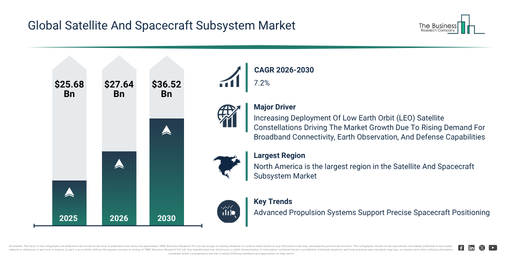
The satellite and spacecraft subsystem market size has experienced robust growth in recent years. It is projected to expand from $25.68 billion in 2025 to $27.64 billion in 2026, exhibiting a compound annual growth rate (CAGR) of 7.6%. This historical expansion can be attributed to factors such as an increase in satellite launches, the broadening of commercial satellite communications, a rise in earth observation missions, escalating government space exploration programs, and a growing demand for satellite-based navigation.
The satellite and spacecraft subsystem market is projected to experience substantial expansion in the coming years, reaching a valuation of $36.52 billion by 2030, demonstrating a compound annual growth rate (CAGR) of 7.2%. This growth over the forecast period is driven by factors such as the increasing deployment of small satellites, a rising need for space-based connectivity, the expansion of satellite constellations, escalating defense and surveillance space initiatives, and greater investment in deep-space exploration missions. Concurrently, significant trends anticipated during this period include the increased integration of autonomous spacecraft operations, a growing preference for modular satellite subsystems, ongoing advancements in high-reliability spacecraft electronics, the continuous miniaturization of spacecraft subsystems, and an expanding requirement for radiation-hardened subsystems.
Get A Free Sample Report With In-Depth Market Insights:
Satellite And Spacecraft Subsystem Market Growth Backed By Core Demand Fundamentals
The expansion of low earth orbit (LEO) satellite constellations is anticipated to drive the growth of the satellite and spacecraft subsystem market in the coming years. Low earth orbit (LEO) satellite constellations consist of interconnected groups of numerous satellites situated at altitudes between 160 km and 2,000 km above Earth, working collaboratively to deliver low-latency communication and continuous global coverage. The increasing number of low earth orbit (LEO) satellite constellations stems from the rising demand for high-speed internet connectivity, as these networks provide quicker data transmission and reduced latency compared to traditional satellite systems, thus enabling reliable connectivity in remote and underserved regions. These low earth orbit (LEO) satellite constellations further support the expansion of satellite and spacecraft subsystems by boosting the demand for advanced components such as communication, power, propulsion, thermal control, and navigation systems, which are necessary for the efficient operation of large satellite networks. For instance, in May 2023, data from the Union of Concerned Scientists (UCS), a US-based nonprofit organization, showed that 7,560 operational satellites were in orbit worldwide, with 6,768 of these operating in low earth orbit (LEO). Consequently, the growing deployment of low earth orbit (LEO) satellite constellations is a primary driver for the satellite and spacecraft subsystem market’s growth.
Satellite And Spacecraft Subsystem Market Segment Breakdown: Which Categories Lead On Revenue?
The satellite and spacecraft subsystem market covered in this report is segmented –
1) By Component: Hardware, Software, Services
2) By Launch Vehicle Subsystem: Structure, Avionics, Propulsion System, Control System, Electrical System, Stage Separation, Thermal System
3) By Orbit: Low Earth Orbit, Medium Earth Orbit, Geostationary Earth Orbit, Beyond Earth Orbit
4) By Application: Communication, Earth Observation, Navigation, Space Exploration, Scientific Research, Surveillance And Reconnaissance
5) By End User: Commercial, Civil Government, Defense, Academic Or Research Organizations
Subsegments:
1) By Hardware: Satellite Bus Systems, Power Systems, Communication Systems, Attitude And Orbit Control Systems, Thermal Control Systems
2) By Software: Flight Software, Ground Control Software, Mission Planning Software, Data Processing Software, Satellite Simulation Software
3) By Services: Satellite Integration Services, Testing And Validation Services, Launch Support Services, Maintenance And Repair Services, Ground Station Services
Satellite And Spacecraft Subsystem Market Growth Trends Reshaping The Competitive Landscape
Major companies operating in the satellite and spacecraft subsystem market are directing their efforts toward creating and providing advanced propulsion systems designed to enable accurate spacecraft positioning, intricate maneuvering, and effective mission operations. These advancements bolster spacecraft performance and reliability, simultaneously allowing for complex scientific and exploration missions to fulfill rigorous operational specifications. For instance, in January 2026, Thales Alenia Space, a France-based aerospace company known for its satellite systems and space technologies, secured a $19.2 million (€16.5 million) contract with OHB System AG, a Germany-based firm specializing in Earth observation satellites, to furnish the propulsion subsystem for the European Space Agency’s Laser Interferometer Space Antenna (LISA) mission. As part of this agreement, Thales Alenia Space will undertake the design, manufacture, assembly, integration, and testing of the propulsion subsystem for LISA, a mission involving three spacecraft operating in formation to detect gravitational waves. This propulsion subsystem will be instrumental in ensuring the precise positioning and control essential for the mission’s three-spacecraft configuration. The contract further solidifies Thales Alenia Space’s role in supplying crucial spacecraft subsystems and demonstrates the continuous evolution of propulsion technologies for future space missions.
Satellite And Spacecraft Subsystem Market Leading Players And Competitive Positioning
Major companies operating in the satellite and spacecraft subsystem market are The Boeing Company, RTX Corporation, Lockheed Martin Corporation, Airbus Defence and Space SAS, Northrop Grumman Corporation, China Aerospace Science and Technology Corporation, Honeywell International Inc., L3Harris Technologies Inc., Thales Alenia Space SAS, Mitsubishi Electric Corporation, NEC Corporation, Leonardo S.p.A., Space Exploration Technologies Corp., MDA Space Ltd., Kawasaki Heavy Industries Ltd., Teledyne Technologies Incorporated, Israel Aerospace Industries Ltd., Moog Inc., Hanwha Systems Co. Ltd., OHB SE, INVAP S.E., Arquimea Group S.L., EnduroSat AD, GomSpace A/S, AAC Clyde Space AB, ISISPACE Group B.V., Cosine Research B.V., Berlin Space Technologies GmbH, NewSpace Systems Pty Ltd
View The Full Satellite And Spacecraft Subsystem Market Report:
Satellite And Spacecraft Subsystem Market Regional Distribution: Which Areas Power Market Growth?
North America was the largest region in the satellite and spacecraft subsystem market in 2025. Asia-Pacific is expected to be the fastest-growing region in the forecast period. The regions covered in the satellite and spacecraft subsystem market report are Asia-Pacific, South East Asia, Western Europe, Eastern Europe, North America, South America, Middle East, Africa.
Reach Out To Our Team:
The Business Research Company: https://www.thebusinessresearchcompany.com/
Americas: +1 310-496-7795
Asia: +44 7882 955267 & +91 8897263534
Europe: +44 7882 955267
Email us at: marketing@tbrc.info
Follow us on:
LinkedIn: https://in.linkedin.com/company/the-business-research-company
YouTube: https://www.youtube.com/channel/UC24_fI0rV8cR5DxlCpgmyFQ
Global Market Model: https://www.thebusinessresearchcompany.com/global-market-model

Wasay has over a decade of experience in market research, data modelling, and analytics, with prior experience at GlobalData and Decision Tree Consulting Services. At The Business Research Company , he leads research operations across syndicated studies, customized consulting engagements, and the Global Market Model platform. His professional experience includes supporting organizations such as Boston Consulting Group, KPMG, and Ernst & Young. Wasay holds a degree in Electronics and Communications Engineering, postgraduate management qualifications from International Management Institute Belgium and Indian School of Business and Entrepreneurship, and completed the Integrated Program in Business Analytics from Indian Institute of Management Indore.