
Market attractiveness scoring, total addressable market sizing, company benchmarking matrices, interactive Excel dashboards, deeper supply chain intelligence, emerging startup tracking, and granular product-level insights are among the key offerings featured in The Business Research Company’s 2026 market reports, designed to deliver more actionable and strategically valuable research.
What Is The Aerospace Parts Manufacturing Market Size In 2026, And Where Is It Heading By 2030?
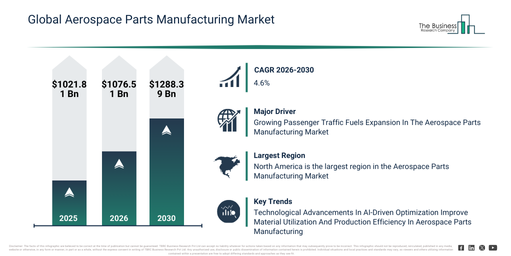
The aerospace parts manufacturing market size has experienced robust growth in recent years. This market is projected to expand from $1021.81 billion in 2025 to $1076.51 billion in 2026, demonstrating a compound annual growth rate (CAGR) of 5.4%. Historically, this expansion can be ascribed to several factors, including an increase in global aircraft production programs, growing demand for aircraft engine upgrades and replacements, the expansion of commercial aviation fleets driving component manufacturing requirements, rising military procurement of advanced propulsion systems, and the adoption of advanced forming processes such as rubber pad forming and hydroforming to boost manufacturing efficiency.
The aerospace parts manufacturing market is projected to experience consistent growth over the coming years. By 2030, this market is anticipated to reach $1288.39 billion, demonstrating a compound annual growth rate (CAGR) of 4.6%. This expansion during the forecast period is driven by several factors, including the increased production of next-generation aircraft, which necessitates intricate engine and propulsion components. Other contributing factors are the growing adoption of lightweight and composite-compatible aerospace parts, the rising need for sustainable and fuel-efficient propulsion systems, the expanding scope of maintenance, repair, and overhaul (MRO) operations that stimulate replacement part manufacturing, and advancements in digital manufacturing technologies like additive manufacturing for aerospace components. Key trends expected during this period involve the greater use of advanced composite materials, an escalating demand for lightweight aircraft components, an uptick in aftermarket manufacturing to support MRO activities, the growth of modular aircraft component production, and the broader integration of additive manufacturing for producing parts.
Request Your Free Aerospace Parts Manufacturing Market Sample With Segment And Regional Data:
Aerospace Parts Manufacturing Market Growth Drivers And Their Impact On Future Demand
The aerospace parts manufacturing market is projected to grow, driven by an anticipated increase in passenger traffic. Passenger traffic refers to the aggregate count of individuals utilizing airport facilities, encompassing both those boarding and disembarking flights. This metric was determined by dividing the number of passenger miles covered by the overall distance traveled within a specific timeframe. Annual increases in passenger movement will necessitate a greater production of aircraft, consequently boosting the manufacturing demand for aerospace components. Such an increase in passenger volumes will further stimulate market expansion. As an illustration, the International Air Transport Association (IATA), a Canadian trade organization representing global airlines, reported in January 2024 that international air traffic expanded by 41.6% in 2023 compared to 2022. Concurrently, total air traffic, quantified in revenue passenger kilometers, saw a 36.9% increase during the identical period. Consequently, the upward trend in passenger traffic is a key factor propelling the aerospace parts manufacturing market.
What Categories Define The Aerospace Parts Manufacturing Market?
The aerospace parts manufacturing market covered in this report is segmented –
1) By Product: Engines, Aerostructure, Cabin Interiors, Equipment, System and Support, Avionics, Insulation Components
2) By Application: Interior, Propulsion Systems
3) By End Use: Commercial Aircraft, Business Aircraft, Military Aircraft, Other Uses
Subsegments:
1) By Engines: Turbine Engines, Turbojet Engines, Turboprop Engines
2) By Aerostructure: Fuselage Sections, Wings And Wing Components, Tail Structures
3) By Cabin Interiors: Seating Systems, Galleys And Lavatories, Cabin Lighting
4) By Equipment, System, And Support: Landing Gear Systems, Fuel Systems, Electrical Systems
5) By Avionics: Flight Control Systems, Navigation Systems, Communication Systems
6) By Insulation Components: Thermal Insulation, Acoustic Insulation, Fireproof Insulation
What New Developments Are Emerging In The Aerospace Parts Manufacturing Market?
Major companies within the aerospace parts manufacturing market are prioritizing the development of innovative technologies, such as AI-powered solutions, to improve production accuracy, streamline operations, and reduce inefficiencies. AI-enabled solutions refer to software, systems, or devices that incorporate artificial intelligence technologies like machine learning, natural language processing, or computer vision to analyze data, automate tasks, and make intelligent decisions. For instance, in January 2023, Plataine Ltd., an Israel-based provider of AI-driven manufacturing optimization technologies, introduced FabricOptimizer. This AI-powered nesting and defect-management solution is specifically designed for aerospace production environments, automatically evaluating multiple cutting configurations and material quantities to generate the most efficient cut plan for individual kits. By maximizing material utilization and reducing manual errors, rework, and scrap levels, FabricOptimizer supports full process automation and helps manufacturers overcome workforce and supply chain challenges while improving sustainability and productivity outcomes.
Major Players Driving Competition In The Aerospace Parts Manufacturing Market
Major companies operating in the aerospace parts manufacturing market are RTX Corporation, General Electric Company, Airbus SAS, Honeywell International Inc., Mitsubishi Heavy Industries Ltd., BAE Systems plc, Safran S.A., Eaton Corporation plc, Freudenberg & Co. KG, Rolls Royce plc, Bombardier Inc., MTU Aero Engines AG, Spirit AeroSystems Holdings Inc., Embraer S.A., GKN Aerospace Ltd., Woodward Inc., Hexcel Corporation, Triumph Group, Panasonic Avionics Corporation, Jamco Corporation, Kellstrom Defense Aerospace Inc., Intrex Aerospace, Aequs Private Limited, CAMAR Aircraft Parts Company, Lycoming Engines, Aero Engineering & Manufacturing Co., Engineered Propulsion System Inc., Superior Air Parts Inc., Aviant Aerospace Inc.
View The Comprehensive Aerospace Parts Manufacturing Market Analysis:
Aerospace Parts Manufacturing Market Regional Leaders: Insights From The 2026 Report
North America was the largest region in the aerospace parts manufacturing market in 2025. Asia-Pacific is expected to be the fastest-growing region in the global aerospace parts manufacturing market report during the forecast period. The regions covered in the aerospace parts manufacturing market report are Asia-Pacific, South East Asia, Western Europe, Eastern Europe, North America, South America, Middle East, Africa.
Reach Out To Our Team:
The Business Research Company: https://www.thebusinessresearchcompany.com/
Americas: +1 310-496-7795
Asia: +44 7882 955267 & +91 8897263534
Europe: +44 7882 955267
Email us at: marketing@tbrc.info
Follow us on:
LinkedIn: https://in.linkedin.com/company/the-business-research-company
YouTube: https://www.youtube.com/channel/UC24_fI0rV8cR5DxlCpgmyFQ
Global Market Model: https://www.thebusinessresearchcompany.com/global-market-model

Wasay has over a decade of experience in market research, data modelling, and analytics, with prior experience at GlobalData and Decision Tree Consulting Services. At The Business Research Company , he leads research operations across syndicated studies, customized consulting engagements, and the Global Market Model platform. His professional experience includes supporting organizations such as Boston Consulting Group, KPMG, and Ernst & Young. Wasay holds a degree in Electronics and Communications Engineering, postgraduate management qualifications from International Management Institute Belgium and Indian School of Business and Entrepreneurship, and completed the Integrated Program in Business Analytics from Indian Institute of Management Indore.

