With a focus on actionable insights and strategic value, The Business Research Company’s 2026 market reports include market attractiveness scoring, total addressable market sizing, company benchmarking matrices, interactive Excel dashboards, deeper supply chain intelligence, emerging startup tracking, and granular product-level insights.
Aerospace Propellant Market Size Forecast Points To $8.79 Billion In Revenue By 2030
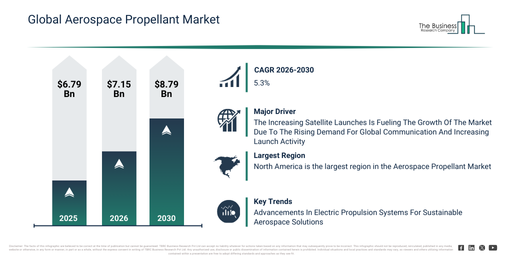
The aerospace propellant market has recently demonstrated substantial expansion. It is anticipated to increase from $6.79 billion in 2025 to $7.15 billion in 2026, registering a compound annual growth rate (CAGR) of 5.4%. This historic growth is primarily due to factors such as the development and deployment of solid and liquid propellants in early aerospace operations, improvements in cold gas propulsion technologies, the manufacturing of sodium-potassium (nak) propellants for specific purposes, government funding allocated to space and defense propulsion research, and the rise of commercial and military aerospace programs requiring high-performance propellants.
The aerospace propellant market is anticipated to experience significant expansion over the coming years. It is projected to reach $8.79 billion by 2030, exhibiting a compound annual growth rate (CAGR) of 5.3%. This expansion during the forecast period is driven by several factors, including a growing demand for advanced cold gas and hybrid propellants for future aerospace vehicles, an increase in satellite and spacecraft launches boosting propellant consumption, ongoing developments in environmentally sound and safer propellant compositions, increased financial commitments towards enhancing propulsion efficiency and optimizing performance, and the incorporation of AI and simulation tools for predicting propellant capabilities. Key trends expected during this period involve a move towards high-performance solid and hybrid propellants, a greater adoption of environmentally safer propellant mixes, progress in hypersonic and high-thrust applications, the expansion of satellite thrusters and deep-space propulsion initiatives, and improved propellant efficiency to allow for larger mission payload capacities.
Get A Free Aerospace Propellant Market Sample Covering Drivers, Trends And Key Players:
Aerospace Propellant Market Driver Analysis: Key Factor Supporting Revenue Growth
The increasing number of satellite launches is expected to drive the growth of the aerospace propellant market in the coming years. Satellite launches involve deploying satellites into space aboard rockets or launch vehicles to place them in orbit for purposes such as communication, observation, or research. This rise in satellite launches is driven by the escalating demand for global communication, as businesses and governments increasingly rely on satellite networks for broadband and connectivity. Aerospace propellant is crucial for launching satellites, providing the thrust required to propel rockets into orbit. It powers the engines, enabling precise control over the rocket’s speed and trajectory to position the satellite in its optimal orbit. For instance, in January 2024, according to the Space Foundation, a US-based nonprofit organization, global launch activity reached record levels for the third consecutive year, with 223 attempts and 212 successful launches, reflecting a significant increase. Additionally, commercial launches surged by 50% compared to 2022, while the United States experienced a 33% increase in launch attempts. Therefore, the growing frequency of satellite launches is fueling the expansion of the aerospace propellants market.
Aerospace Propellant Market Segmentation Framework: Major Segments At A Glance
The aerospace propellant market covered in this report is segmented –
1) By Type: Solid Propellants, Liquid Propellants, Hybrid Propellants
2) By Technology: Conventional Rocket Engines, Ion Thrusters, Nuclear Thermal Engines, Electric Propulsion Systems, Hybrid Propulsion Systems
3) By Application: Launch Vehicles, Satellite Propulsion, Space Exploration, Missile Systems, Spacecraft Maneuvering
4) By End-User: Government Organizations, Commercial Enterprises, Aerospace Contractors, Research Institutions, Military
Subsegments:
1) By Solid Propellants: Composite Propellants, Double Base Propellants, Nitramine-Based Propellants, Modified Double Base (MDB) Propellants
2) By Liquid Propellants: Monopropellants, Bipropellants
3) By Hybrid Propellants: Hydroxyl-Terminated Polybutadiene (HTPB)-Based, Paraffin-Based, Polyethylene-Based
Latest Aerospace Propellant Market Developments And Emerging Trends
Leading companies in the aerospace propellant market are concentrating on developing advanced solutions, such as electric propulsion systems, to support the transition to more sustainable and cost-effective propulsion technologies. An electric propulsion system utilizes electrical energy to accelerate a propellant, generating thrust for spacecraft or aircraft. It offers enhanced efficiency, lower fuel consumption, and extended operational lifespans, making it highly suitable for space exploration and satellites. For instance, in October 2024, Phase Four, a US-based provider of electric propulsion (EP) solutions, announced its monopropellant multi-mode propulsion system for satellites. This system integrates the high thrust of chemical propulsion with the efficiency of electric propulsion, employing a single propellant (hydrazine or non-toxic ASCENT) through a proprietary radiofrequency (RF) thruster. This approach eliminates separate propellant tanks, reducing satellite size, weight, and cost while simultaneously enhancing maneuverability and mission flexibility.
Which Companies Are Shaping The Aerospace Propellant Market?
Major companies operating in the aerospace propellant market are Lockheed Martin Corporation, Raytheon Technologies Corporation, Northrop Grumman Corporation, Honeywell International Inc., Safran S.A., Thales Group, L3Harris Technologies Inc., IHI Corporation, SpaceX, Rheinmetall AG, MBDA, Blue Origin LLC, Rocket Lab USA Inc., Ursa Major Technologies, Avio S.p.A., Bellatrix Aerospace, Firehawk Aerospace, Virgin Galactic, Khrunichev State Research and Production Space Center, Nammo AS, NPO Energomash.
Dive Deeper Into The Aerospace Propellant Market With The Full Report:
Aerospace Propellant Market Regional Distribution: Where Is Revenue Concentrated?
North America was the largest region in the aerospace propellant market in 2025. The regions covered in the aerospace propellant market report are Asia-Pacific, South East Asia, Western Europe, Eastern Europe, North America, South America, Middle East, Africa.
Reach Out To Our Team:
The Business Research Company: https://www.thebusinessresearchcompany.com/
Americas: +1 310-496-7795
Asia: +44 7882 955267 & +91 8897263534
Europe: +44 7882 955267
Email us at: marketing@tbrc.info
Follow us on:
LinkedIn: https://in.linkedin.com/company/the-business-research-company
YouTube: https://www.youtube.com/channel/UC24_fI0rV8cR5DxlCpgmyFQ
Global Market Model: https://www.thebusinessresearchcompany.com/global-market-model

Wasay has over a decade of experience in market research, data modelling, and analytics, with prior experience at GlobalData and Decision Tree Consulting Services. At The Business Research Company , he leads research operations across syndicated studies, customized consulting engagements, and the Global Market Model platform. His professional experience includes supporting organizations such as Boston Consulting Group, KPMG, and Ernst & Young. Wasay holds a degree in Electronics and Communications Engineering, postgraduate management qualifications from International Management Institute Belgium and Indian School of Business and Entrepreneurship, and completed the Integrated Program in Business Analytics from Indian Institute of Management Indore.