
Built to provide research that’s more actionable and strategically valuable, The Business Research Company’s 2026 market reports include market attractiveness analysis, total addressable market sizing, company benchmarking matrices, interactive Excel dashboards, broader supply chain intelligence, emerging startup tracking, and in-depth product insights.
Satellite Communication In Defense Sector Market Revenue Outlook: What CAGR Lies Ahead Through 2030?
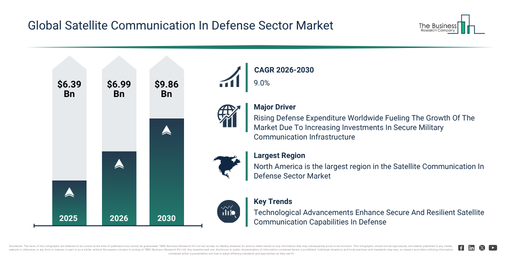
The market size for satellite communication in the defense sector has shown robust expansion in recent years. It is anticipated to increase from $6.39 billion in 2025 to $6.99 billion in 2026, registering a compound annual growth rate (CAGR) of 9.4%. The growth observed in prior periods can be attributed to escalating defense communication needs in remote territories, a growing demand for secure long-distance connectivity, the military’s increasing dependence on satellite-based communication, the heightened necessity for resilient communication during operations, and the expanded deployment of satellite terminals for defense forces.
The market size for satellite communication in the defense sector is projected to experience substantial growth in the upcoming years. It is forecasted to expand to $9.86 billion in 2030, achieving a compound annual growth rate (CAGR) of 9.0%. This expansion over the forecast period is attributed to several factors, including the increasing demand for robust military communication networks, rising defense investment in satellite communication infrastructure, the growing need for high-capacity data transmission, the expanding deployment of multi-orbit defense communication systems, and the heightened demand for continuous connectivity during challenging operations. Significant trends during this period are expected to encompass the increasing implementation of multi-orbit satellite communication architectures, the growing adoption of high-throughput satellite communication, the rising utilization of protected and anti-jamming communication links, the enhanced integration of interoperable satellite communication networks, and the wider deployment of portable satellite communication terminals.
Get A Free Sample Report With In-Depth Market Insights:
Satellite Communication In Defense Sector Market Growth Factors Behind Sustained Expansion
Global increases in defense spending are anticipated to fuel expansion within the satellite communication in defense sector market. This spending encompasses government funds directed towards military forces, infrastructure, equipment acquisition, research and development, and national security activities. The rise in defense budgets stems from escalating geopolitical tensions and regional security risks, prompting governments to enhance military capabilities and dedicate greater resources to national security and defense readiness. Such expenditure facilitates progress in satellite communication within the defense sector by financing the creation, deployment, and updating of secure satellite networks, thereby enhancing military communication, surveillance, intelligence gathering, and operational synergy to tackle evolving security demands. For example, the International Institute for Strategic Studies, a UK defense and security research body, reported in February 2026 that worldwide defense spending hit USD 2.63 trillion in 2025, an increase from USD 2.48 trillion in 2024, with a real-term year-over-year growth of 2.5%. Consequently, the global increase in defense expenditure is a key factor driving the expansion of the satellite communication in defense sector market.
Satellite Communication In Defense Sector Market Segments: Where Is Growth Concentrated?
The satellite communication in defense sector market covered in this report is segmented –
1) By Component: Services, Hardware, Software
2) By Platform: Land Based, Airborne, Naval, Space Based
3) By Orbit Type: Low Earth Orbit, Medium Earth Orbit, Geostationary Earth Orbit
4) By Communication Type: Voice Communication, Data Communication, Video Communication, Integrated Communication Systems
5) By Application: Command And Control, Intelligence Surveillance And Reconnaissance, Communication And Data Transfer, Navigation And Positioning, Electronic Warfare
Subsegments:
1) By Services: Communication Services, Managed Services, Consulting Services, Integration Services, Maintenance And Support Services, Training Services
2) By Hardware: Satellite Transponders, Antennas, Ground Station Equipment, Satellite Terminals, Modems And Routers, Power Systems
3) By Software: Satellite Network Management Software, Mission Planning Software, Data Processing Software, Communication Management Software, Cybersecurity Software, Analytics Software
Satellite Communication In Defense Sector Market Industry Trends Fueling Future Revenue Growth
Leading entities within the satellite communication in defense sector market are prioritizing the creation of advanced solutions, specifically low earth orbit (LEO) satellite communication constellations, to improve secure military communications, facilitate real-time data transmission, strengthen battlefield connectivity, and sharpen operational awareness. These LEO satellite constellations consist of satellite networks situated nearer to Earth compared to conventional geostationary satellites, providing advantages such as reduced latency, quicker data transfer, expanded coverage, and robust communication connections for defense activities. As an example, in September 2025, the Space Development Agency (SDA), a US defense space entity, commenced the deployment of its initial operational Tranche 1 Transport Layer satellites, integrating them into its advanced military communication network. This initial phase involved 21 satellites manufactured by York Space Systems, which were launched via a SpaceX Falcon 9 rocket. This deployment is a component of a larger planned constellation totaling 154 satellites, intended to deliver secure, high-speed data transport to military personnel. These satellites are engineered to support sophisticated communication features, such as inter-satellite laser communication links and seamless integration with military user terminals, thereby facilitating quicker information exchange throughout defense networks.
Satellite Communication In Defense Sector Market Key Participants And Competitive Landscape
Major companies operating in the satellite communication in defense sector market are L3Harris Technologies Inc, Viasat Inc, SES SA, Kratos Defense & Security Solutions Inc, Iridium Communications Inc, Rocket Lab USA Inc, Gilat Satellite Networks Ltd, Telesat Corporation, KVH Industries Inc, Impulse Space Inc, AST SpaceMobile Inc, Kepler Communications Inc, AvL Technologies Inc, Skylo Technologies Inc, WORK Microwave GmbH, Ovzon AB, Leaf Space S.r.l., Satcube AB, PolarSat Inc, Quadsat ApS
View The Full Satellite Communication In Defense Sector Market Report:
Satellite Communication In Defense Sector Market Geographic Analysis: Where Is Demand Accelerating Fastest?
North America was the largest region in the satellite communication in defence sector market in 2025. Asia-Pacific is expected to be the fastest-growing region in the forecast period. The regions covered in the satellite communication in defense sector market report are Asia-Pacific, South East Asia, Western Europe, Eastern Europe, North America, South America, Middle East, Africa.
Reach Out To Our Team:
The Business Research Company: https://www.thebusinessresearchcompany.com/
Americas: +1 310-496-7795
Asia: +44 7882 955267 & +91 8897263534
Europe: +44 7882 955267
Email us at: marketing@tbrc.info
Follow us on:
LinkedIn: https://in.linkedin.com/company/the-business-research-company
YouTube: https://www.youtube.com/channel/UC24_fI0rV8cR5DxlCpgmyFQ
Global Market Model: https://www.thebusinessresearchcompany.com/global-market-model

Wasay has over a decade of experience in market research, data modelling, and analytics, with prior experience at GlobalData and Decision Tree Consulting Services. At The Business Research Company , he leads research operations across syndicated studies, customized consulting engagements, and the Global Market Model platform. His professional experience includes supporting organizations such as Boston Consulting Group, KPMG, and Ernst & Young. Wasay holds a degree in Electronics and Communications Engineering, postgraduate management qualifications from International Management Institute Belgium and Indian School of Business and Entrepreneurship, and completed the Integrated Program in Business Analytics from Indian Institute of Management Indore.