
Featuring market attractiveness scoring, total addressable market sizing, company benchmarking matrices, interactive Excel dashboards, deeper supply chain intelligence, emerging startup tracking, and granular product-level insights, The Business Research Company’s 2026 market reports are built to deliver research that is both more actionable and more strategically valuable.
Satellite Laser Communication Market Growth Potential: How Will Market Size Shift Through 2030?
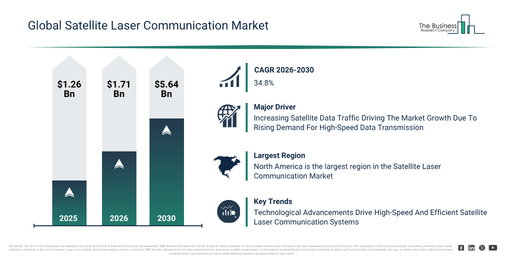
The satellite laser communication market size has seen significant expansion over recent years. It is anticipated to rise from $1.26 billion in 2025 to $1.71 billion in 2026, showing a compound annual growth rate (CAGR) of 35.2%. This historical development can be ascribed to a heightened demand for high-speed space communication, an escalation in satellite data transmission needs, the evolving requirement for low-latency communication links, the growing restrictions of conventional RF communication bandwidth, and the broader implementation of satellite communication infrastructure.
The satellite laser communication market is projected to experience substantial expansion in the coming years, reaching $5.64 billion by 2030, exhibiting a compound annual growth rate (CAGR) of 34.8%. This anticipated growth during the forecast period is driven by factors such as the increasing need for high-capacity data transfer between satellites, the rising establishment of extensive satellite constellations, the heightened requirement for secure communication pathways in space, the expanding demand for transmitting high-bandwidth Earth observation data, and the increasing investment in space communication infrastructure. Key trends expected over the forecast horizon encompass the ongoing advancement of higher-power laser communication terminals, the increasing adoption of adaptive optical beam pointing systems, the proliferation of compact optical ground stations, the continued innovation in high-efficiency optical transceivers, and the broader implementation of standardized optical communication interfaces.
Get A Free Sample Report With In-Depth Market Insights:
Satellite Laser Communication Market Growth Factors: What’s Supporting Expansion?
The expanding volume of satellite data traffic is anticipated to drive the advancement of the satellite laser communication market in the coming years. This satellite data traffic represents the rising amount of information exchanged among satellites, ground stations, and other space-based communication networks, driven by the greater uptake of satellite-based services. The surge in satellite data traffic stems from the swift expansion of satellite constellations, where the deployment of numerous satellites in low Earth orbit (LEO) generates significantly more data from various applications. With this continuous growth in satellite data traffic, satellite laser communication becomes a crucial technology for enabling quicker, more secure, and higher-capacity data transfer between satellites and ground stations. An illustrative example shows that in October 2023, Kratos Space, a US-based technology company, estimated that Earth observation (EO) data is projected to hit around 2 exabytes (EB) by 2032, experiencing an annual growth rate of 11%, with EO applications accounting for nearly 86% of all data produced within the space applications segment during the forecast period. Consequently, the increasing satellite data traffic is fostering the growth of the satellite laser communication market.
Satellite Laser Communication Market Segmentation And Category Overview
The satellite laser communication market covered in this report is segmented –
1) By Component: Hardware, Software, Services
2) By Technology: Optical Inter Satellite Links, Free Space Optical Communication, Quantum Laser Communication, Hybrid Radio Frequency And Optical Communication
3) By Platform: Satellite To Satellite, Satellite To Ground, Ground To Satellite, Air To Satellite
4) By End User: Commercial, Government, Defense And Military, Space Agencies, Research Institutions
Subsegments:
1) By Hardware: Laser Communication Terminals, Optical Transceivers, Beam Steering Assemblies, Optical Antennas, Modems And Signal Processors, Optical Ground Station Equipment
2) By Software: Network Management Software, Link Control Software, Beam Tracking Software, Communication Protocol Software, Mission Planning Software, Network Optimization Software
3) By Services: System Integration Services, Installation And Deployment Services, Network Design Services, Managed Communication Services, Maintenance And Support Services, Consulting Services
Satellite Laser Communication Market Industry Trends: What’s Reshaping Demand?
Leading companies in the satellite laser communication market are prioritizing the development of innovative solutions, such as laser communication terminals, to boost high-speed data transmission, communication reliability, and bandwidth efficiency across space networks. Laser communication terminals function as optical communication systems, utilizing infrared laser beams instead of conventional radio frequency (RF) signals to transfer data among satellites, spacecraft, and ground stations. This approach facilitates substantially higher data rates, reduced size and power demands, and improved communication capacity compared to traditional RF-based systems. For instance, in November 2023, the Massachusetts Institute of Technology Lincoln Laboratory, a US-based research and development laboratory, created ILLUMA-T, a laser communication terminal sent to the International Space Station (ISS) as part of NASA’s optical communication demonstration program. This system was engineered to transmit high-rate data from the ISS to NASA’s Laser Communications Relay Demonstration satellite using laser signals and to enable two-way optical communication between low Earth orbit and ground stations. ILLUMA-T integrates advanced optical components, including a two-axis gimbal and precision pointing mechanisms, to sustain laser links while the spacecraft travels through orbit.
Satellite Laser Communication Market Competitive Analysis Of Leading Industry Participants
Major companies operating in the satellite laser communication market are Airbus SE, Northrop Grumman Corporation, Mitsubishi Electric Corporation, CACI International Inc, General Atomics Aeronautical Systems Inc, HENSOLDT AG, Spire Global Inc, Honeywell Aerospace Technologies, Cailabs SA, Kepler Communications Inc, Aalyria Technologies Inc, Leaf Space S.r.l., Astrolight UAB, Transcelestial Technologies Pte Ltd, Archangel Lightworks Ltd, SpaceOptix GmbH, ODYSSEUS Space SA, Warpspace Inc, Stellar Project Ltd, Olee Space Inc
View The Full Satellite Laser Communication Market Report:
Satellite Laser Communication Market Geographic Distribution And Regional Opportunities
North America was the largest region in the satellite laser communication market in 2025. Asia-Pacific is expected to be the fastest-growing region in the forecast period. The regions covered in the satellite laser communication market report are Asia-Pacific, South East Asia, Western Europe, Eastern Europe, North America, South America, Middle East, Africa.
Reach Out To Our Team:
The Business Research Company: https://www.thebusinessresearchcompany.com/
Americas: +1 310-496-7795
Asia: +44 7882 955267 & +91 8897263534
Europe: +44 7882 955267
Email us at: marketing@tbrc.info
Follow us on:
LinkedIn: https://in.linkedin.com/company/the-business-research-company
YouTube: https://www.youtube.com/channel/UC24_fI0rV8cR5DxlCpgmyFQ
Global Market Model: https://www.thebusinessresearchcompany.com/global-market-model

Wasay has over a decade of experience in market research, data modelling, and analytics, with prior experience at GlobalData and Decision Tree Consulting Services. At The Business Research Company , he leads research operations across syndicated studies, customized consulting engagements, and the Global Market Model platform. His professional experience includes supporting organizations such as Boston Consulting Group, KPMG, and Ernst & Young. Wasay holds a degree in Electronics and Communications Engineering, postgraduate management qualifications from International Management Institute Belgium and Indian School of Business and Entrepreneurship, and completed the Integrated Program in Business Analytics from Indian Institute of Management Indore.