
Designed to make market research more actionable and strategically valuable, The Business Research Company’s 2026 market reports feature market attractiveness scoring, total addressable market sizing, company benchmarking matrices, interactive Excel dashboards, deeper supply chain intelligence, emerging startup tracking, and granular product-level insights.
What Is The Projected CAGR Of The Airborne Fire Control Radar Market Through 2030?
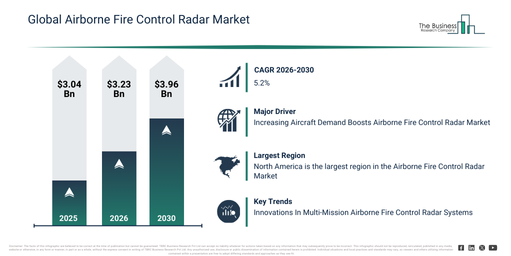
The airborne fire control radar market has experienced substantial expansion recently. This market is projected to expand from $3.04 billion in 2025 to $3.23 billion in 2026, demonstrating a compound annual growth rate (CAGR) of 6.2%. Historically, this growth has been driven by several factors, including the greater uptake of pulse-doppler radar systems for enhanced target tracking, an increase in the acquisition of fast-strike aircraft outfitted with integrated fire control radars, ongoing modernization initiatives for legacy airborne radar systems, a heightened demand for precise engagement capabilities in military operations, and continuous improvements in radar signal processing that boost detection accuracy.
The airborne fire control radar market is projected to experience substantial expansion in the coming years. Its valuation is anticipated to reach $3.96 billion by 2030, exhibiting a compound annual growth rate (CAGR) of 5.2%. This growth during the forecast period is driven by factors such as the broader deployment of advanced electronically scanned array radars, increased capital directed towards multi-mode airborne radar systems capable of handling intricate mission scenarios, a heightened need for precise high-resolution tracking to improve weapon accuracy, the creation of lighter and more energy-efficient radar units for modern aircraft, and a stronger focus on interoperable radar designs for network-centric warfare environments. Key trends shaping this period encompass the incorporation of artificial intelligence for detecting and tracking targets, the rollout of autonomous radar systems to facilitate swift threat evaluations, the application of big data and cloud analytics to refine radar precision, the miniaturization of radar components for lighter platforms, and the adoption of multi-mode radar capabilities for concurrent air-to-air, air-to-ground, and air-to-sea operations.
Claim Your Free Airborne Fire Control Radar Market Sample Report With Key Data And Trends:
Airborne Fire Control Radar Market Demand Analysis: The Driving Force Behind Expansion
The increasing need for aircraft is anticipated to boost the growth of the airborne fire control radar market in the future. An aircraft is defined as a machine that remains airborne, supported for flight either by buoyancy or by the dynamic interaction of air with its surfaces, often propelled by jet engines or through the design of its wings. The airborne fire control radar is essential in aircraft, offering precise guidance to pilots when aiming at and engaging hostile aircraft or ground targets. For instance, in January 2024, Airbus SE, a Netherlands-based manufacturer and developer of aerospace services, solutions, and products, stated that in 2023, the company delivered 735 commercial aircraft to 87 customers globally, marking an 11% rise compared to 2022. Thus, the escalating demand for aircraft is propelling the expansion of the airborne fire control radar market.
Breaking Down The Airborne Fire Control Radar Market By Segment
The airborne fire control radar market covered in this report is segmented –
1) By Frequency Band: L And S-Band, X-Band, Ku Or K Or Ka-Band
2) By Platform: Fighter Jets, Combat Helicopters, Other Platforms
3) By Application: Air To Ground, Air To Sea, Air To Air
Subsegments:
1) By L And S-Band: L-Band Radar Systems, S-Band Radar Systems
2) By X-Band: X-Band Radar Systems
3) By Ku Or K Or Ka-Band: Ku-Band Radar Systems, K-Band Radar Systems, Ka-Band Radar Systems
Top Trend Influencing The Airborne Fire Control Radar Market Outlook
Leading companies in the airborne fire control radar market are concentrating on creating advanced solutions, including multi-mission radar systems, to satisfy the growing demand for superior targeting capabilities in modern military operations. A multi-mission radar system represents an adaptable radar that simultaneously conducts surveillance, target tracking, and threat detection, thereby elevating situational awareness and operational flexibility across military and civilian applications. As an illustration, in May 2025, SRC Inc., a US-based defense technology company, introduced Gryphon R1430/R1440 systems to broaden its Gryphon Multi-Mission Radar product line. These latest radar systems are engineered to offer improved situational understanding and precise targeting for both manned and unmanned aerial platforms. The Gryphon R1430/R1440 systems incorporate sophisticated signal processing techniques and modular designs, allowing for rapid adjustments to changing mission requirements. Their capabilities feature high-resolution imaging, real-time data fusion, and robust performance in contested environments. These characteristics position the Gryphon R1430/R1440 as a significant progression beyond conventional radar systems, delivering enhanced operational effectiveness and improved mission success rates.
Airborne Fire Control Radar Market Competitive Landscape And Major Players
Major companies operating in the airborne fire control radar market are Bharat Electronics Limited, Hensoldt AG, Israel Aerospace Industries Ltd., Leonardo S.p.A., Lockheed Martin Corporation, BAE Systems PLC, Northrop Grumman Corporation, Raytheon Technologies Corporation, Saab AB, Thales Group, General Dynamics Corporation, Airbus SE, ASELSAN A.S., Honeywell International Inc., NEC Corporation, L3Harris Technologies Inc., ELTA Systems Ltd., Curtiss-Wright Corporation, Elbit Systems Ltd., Kongsberg Gruppen
Read The Full Airborne Fire Control Radar Market Report By The Business Research Company:
Where Is The Airborne Fire Control Radar Market Largest? Key Regional Insights
North America was the largest region in the airborne fire control radar market in 2025. Asia-Pacific is expected to be the fastest-growing region in the forecast period. The regions covered in the airborne fire control radar market report are Asia-Pacific, South East Asia, Western Europe, Eastern Europe, North America, South America, Middle East, Africa.
Reach Out To Our Team:
The Business Research Company: https://www.thebusinessresearchcompany.com/
Americas: +1 310-496-7795
Asia: +44 7882 955267 & +91 8897263534
Europe: +44 7882 955267
Email us at: marketing@tbrc.info
Follow us on:
LinkedIn: https://in.linkedin.com/company/the-business-research-company
YouTube: https://www.youtube.com/channel/UC24_fI0rV8cR5DxlCpgmyFQ
Global Market Model: https://www.thebusinessresearchcompany.com/global-market-model

Wasay has over a decade of experience in market research, data modelling, and analytics, with prior experience at GlobalData and Decision Tree Consulting Services. At The Business Research Company , he leads research operations across syndicated studies, customized consulting engagements, and the Global Market Model platform. His professional experience includes supporting organizations such as Boston Consulting Group, KPMG, and Ernst & Young. Wasay holds a degree in Electronics and Communications Engineering, postgraduate management qualifications from International Management Institute Belgium and Indian School of Business and Entrepreneurship, and completed the Integrated Program in Business Analytics from Indian Institute of Management Indore.

