With a focus on actionable insights and strategic value, The Business Research Company’s 2026 market reports include market attractiveness scoring, total addressable market sizing, company benchmarking matrices, interactive Excel dashboards, deeper supply chain intelligence, emerging startup tracking, and granular product-level insights.
Aircraft Actuator Market Size Forecast Points To $30.09 Billion In Revenue By 2030
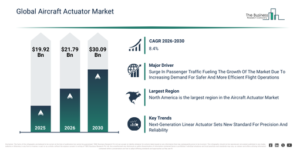
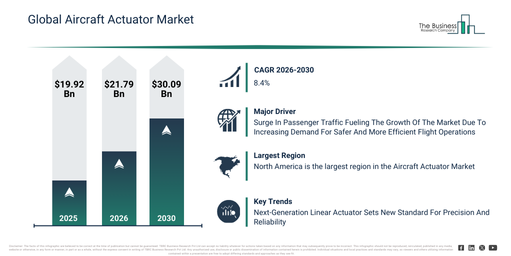
The aircraft actuator market size has experienced robust growth in recent years. It is projected to expand from $19.92 billion in 2025 to $21.79 billion in 2026, at a compound annual growth rate (CAGR) of 9.4%. Historically, this market expansion is attributed to several factors, including an increase in commercial aircraft production driving demand for flight control surface actuators, the growing adoption of advanced actuation systems for landing gear and cargo door operations, the expansion of engine development programs requiring precise actuator-controlled components, a heightened emphasis on aircraft safety and reliability promoting the use of high-performance actuators, and the widespread integration of hydraulic and electrohydraulic actuators across major aircraft platforms.
The aircraft actuator market size is expected to experience strong growth in the coming years, projected to reach $30.09 billion by 2030, with a compound annual growth rate (CAGR) of 8.4%. This expansion during the forecast period can be attributed to a growing transition towards electro-mechanical actuators to reduce weight and enhance efficiency, an anticipated rise in next-generation aircraft platforms demanding more sophisticated actuation systems, the increasing integration of smart and health-monitoring actuators for predictive maintenance, expanding fleet modernization efforts driving replacement demand for legacy actuators, and technological advancements boosting actuator precision, durability, and energy efficiency. Key trends anticipated during this period include the increasing adoption of electromechanical actuators over traditional hydraulic units, a rising demand for lightweight actuator materials to improve fuel efficiency, the expansion of fly-by-wire systems in next-generation aircraft, growth in maintenance, repair, and overhaul requirements for aircraft actuation systems, and a higher integration of actuators in aircraft engine control mechanisms.
Get A Free Aircraft Actuator Market Sample Covering Drivers, Trends And Key Players:
Aircraft Actuator Market Driver Analysis: Key Factor Supporting Revenue Growth
The global increase in passenger traffic is projected to fuel the expansion of the aircraft actuators market moving forward. Passenger traffic denotes the total count of individuals traveling via a transportation system, such as airlines, trains, or buses, during a specific period. This rise in passenger numbers is driven by increasing demand for transportation services, prompting operators to expand their capacity and introduce new routes. Aircraft actuators facilitate improved passenger movement by enhancing aircraft control, reliability, and operational efficiency, leading to safer and more effective flight operations. For instance, in December 2024, according to Eurostat, a Luxembourg-based government agency, 976 million air passengers were carried in the EU in 2023, representing a 19 % increase compared to 2022. Thus, the escalating passenger traffic worldwide is a key factor driving the growth of the aircraft actuators market.
Aircraft Actuator Market Segmentation Framework: Major Segments At A Glance
The aircraft actuator market covered in this report is segmented –
1) By Actuators Type: Hydraulic, Pneumatic, Electric, Electromechanical, Electrohydrostatic
2) By Motion: Linear, Rotary
3) By Platform: Fixed Wing, Rotary Wing
4) By End User: Commercial Aircraft, Military Aircraft, Other End Users
Subsegments:
1) By Hydraulic Actuators: Linear Hydraulic Actuators, Rotary Hydraulic Actuators, Hydraulic Servo Actuators
2) By Pneumatic Actuators: Linear Pneumatic Actuators, Rotary Pneumatic Actuators, Pneumatic Cylinder Actuators
3) By Electric Actuators: Brushless DC Electric Actuators, Stepper Electric Actuators, AC Electric Actuators
4) By Electromechanical Actuators: DC Gear Motor Actuators, Linear Actuators with Gear Mechanism, Electric Actuators with Feedback Control
5) By Electrohydrostatic Actuators: Direct Drive Electrohydrostatic Actuators, Integrated Electrohydrostatic Actuators
Latest Aircraft Actuator Market Developments And Emerging Trends
Leading companies within the aircraft actuator market are concentrating on developing innovative products like linear servo actuators to enhance the precision, reliability, and efficiency of flight control systems. These linear servo actuators are electromechanical devices that convert electrical signals into precise linear motion, aiding in improved flight control accuracy, reduced system weight, minimized maintenance needs, and enabling smoother, more dependable aircraft operations compared to traditional hydraulic or mechanical actuators. For instance, in October 2024, UAVOS Inc., a U.S.-based aerospace technology company, launched the SDLM-04B Linear Servo Actuator, a cutting-edge device specifically engineered for applications demanding high force, precision, and long-term reliability. This actuator features a brushless DC motor with a high-performance FOC servo drive, a contactless multiturn absolute position encoder, and integrated feedback on position, velocity, torque, and current. Its compact yet robust design, incorporating hardened steel gears and an aluminum housing rated IP66, allows it to operate reliably even in harsh environments, including conditions with intense shock and vibration. The SDLM-04B is particularly well-suited for unmanned aircraft systems, having been successfully integrated into the Albatross MALE aircraft and UVH 500 helicopters, thereby enhancing flight control reliability and operational flexibility. Beyond aerospace, this actuator is also applicable in robotics and industrial automation, offering zero-backlash precision, high-speed actuation, and simplified installation thanks to its integrated controller.
Which Companies Are Shaping The Aircraft Actuator Market?
Major companies operating in the aircraft actuator market are Honeywell International Inc., Eaton Corporation, Moog Inc., Parker Hannifin Corporation, Safran S.A., Meggitt plc, Woodward Inc., Sitec Aerospace GmbH, Progressive Automations Inc., Tamagawa Seiki Co. Ltd., Aero Space Controls Corporation, Beaver Aerospace & Defense Inc., Rockwell Collins Inc., Curtiss-Wright Corporation, Raytheon Technologies Corporation, Liebherr Group, Nabtesco Corporation, SKF Group, Arkwin Industries Inc., ITT Inc., AAR Corporation, GE Aviation Systems LLC, TransDigm Group Incorporated, BAE Systems plc, Héroux-Devtek Inc., Raytheon Technologies Corp., Lufthansa Technik AG, Electromech Technologies LLC, Hemisphere Engineering Inc.
Dive Deeper Into The Aircraft Actuator Market With The Full Report:
Aircraft Actuator Market Regional Distribution: Where Is Revenue Concentrated?
North America was the largest region in the aircraft actuators market in 2025. Asia-Pacific is expected to be the fastest-growing region in the forecast period. The regions covered in the aircraft actuator market report are Asia-Pacific, South East Asia, Western Europe, Eastern Europe, North America, South America, Middle East, Africa.
Reach Out To Our Team:
The Business Research Company: https://www.thebusinessresearchcompany.com/
Americas: +1 310-496-7795
Asia: +44 7882 955267 & +91 8897263534
Europe: +44 7882 955267
Email us at: marketing@tbrc.info
Follow us on:
LinkedIn: https://in.linkedin.com/company/the-business-research-company
YouTube: https://www.youtube.com/channel/UC24_fI0rV8cR5DxlCpgmyFQ
Global Market Model: https://www.thebusinessresearchcompany.com/global-market-model

Wasay has over a decade of experience in market research, data modelling, and analytics, with prior experience at GlobalData and Decision Tree Consulting Services. At The Business Research Company , he leads research operations across syndicated studies, customized consulting engagements, and the Global Market Model platform. His professional experience includes supporting organizations such as Boston Consulting Group, KPMG, and Ernst & Young. Wasay holds a degree in Electronics and Communications Engineering, postgraduate management qualifications from International Management Institute Belgium and Indian School of Business and Entrepreneurship, and completed the Integrated Program in Business Analytics from Indian Institute of Management Indore.