Designed to make market research more actionable and strategically valuable, The Business Research Company’s 2026 market reports feature market attractiveness scoring, total addressable market sizing, company benchmarking matrices, interactive Excel dashboards, deeper supply chain intelligence, emerging startup tracking, and granular product-level insights.
How Fast Is The Aircraft Autopilot System Market Growing? Market Size, CAGR And Forecast Insights
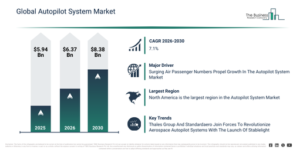
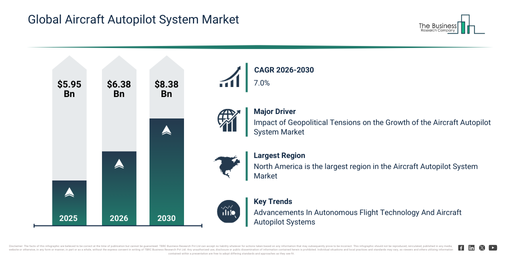
The aircraft autopilot system market has experienced significant expansion in recent years. Its value is forecasted to increase from $5.95 billion in 2025 to $6.38 billion in 2026, exhibiting a compound annual growth rate (CAGR) of 7.3%. Historically, this growth was spurred by factors such as the initial adoption of autopilot systems to facilitate basic flight stabilization and alleviate pilot workload, the rising deployment of sensing units and servos for enabling controlled directional guidance, the development of autopilot computers capable of handling predefined flight plans, the escalating demand for navigation management services across commercial and military aviation, and the integration of command units to enhance the accuracy and reliability of automated flight operations.
The aircraft autopilot system market is anticipated to show significant expansion over the next few years. It is projected to reach $8.38 billion by 2030, growing at a compound annual growth rate (CAGR) of 7.0%. This growth during the forecast period is primarily driven by the increasing adoption of advanced autopilot technologies to facilitate higher levels of flight automation, a rising demand for improved track guidance and precise navigation in next-generation aircraft, the expansion of autonomous and remotely piloted aircraft systems requiring sophisticated autopilot capabilities, the growing integration of AI-based decision-support tools within autopilot architectures, and technological advancements that enhance system redundancy, safety, and real-time data processing. Major trends expected in this period include advanced flight navigation automation, predictive maintenance and diagnostics, enhanced flight safety monitoring, the integration of hybrid propulsion systems, and real-time aircraft performance optimization.
Unlock Aircraft Autopilot System Market Insights With A Free Sample Report:
Aircraft Autopilot System Market Momentum: Key Driver Expected To Boost Growth Through 2030
The escalating geopolitical tensions are projected to drive the expansion of the aircraft autopilot system market in the foreseeable future. Geopolitical tensions encompass political conflicts, competition, or disagreements among nations or regions, often linked to aspects such as territory, resources, power, or ideology. Autopilot systems are essential for unmanned aerial vehicles (UAVs), which are crucial for reconnaissance and surveillance during periods of geopolitical unrest. For example, in January 2024, a report by The White & Case LLP, a US-based international law firm, indicated that 45% of respondents considered geopolitics the dominant trend shaping activity in 2024. Within this, 20% specifically mentioned geopolitical issues, 11% cited resource nationalism, 7% referred to supply chain reconfiguration, and another 7% highlighted industrial and critical minerals policies as key contributors. Thus, the increasing geopolitical tensions are propelling the growth of the aircraft autopilot system market.
Aircraft Autopilot System Market Segments: A Category-By-Category Overview
The aircraft autopilot system market covered in this report is segmented –
1) By Components: Computer System, Gyros, Global Positioning System (GPS), Actuators
2) By Type: Fixed Wing, Rotary Wing
3) By System: Attitude and Heading Reference System, Flight Director System, Flight Control System, Avionics System, Other Systems
4) By Application: Commercial, Military, Civil
Subsegments:
1) By Computer System: Flight Management System (FMS), Autopilot Control Unit, Navigation Computer
2) By Gyros: Rate Gyros, Fiber Optic Gyros, Micro-Electro-Mechanical Systems (MEMS) Gyros
3) By Global Positioning System (GPS): Standard GPS, Differential GPS (DGPS), Real-Time Kinematic (RTK) GPS
4) By Actuators: Electric Actuators, Hydraulic Actuators, Pneumatic Actuators
Which Emerging Trends Are Gaining Traction In The Aircraft Autopilot System Market?
Leading firms within the aircraft autopilot system market are focusing on technological innovations, including autonomous flight capabilities, with the goal of improving operational efficiency, minimizing human error, bolstering safety, and facilitating intricate flight operations independent of pilot input. This autonomous flight technology allows aircraft to function without human intervention, employing sensors and artificial intelligence for navigation and making real-time adjustments. As an illustration, in April 2024, Purdue University, a public research institution in the US, established the inaugural global center dedicated to advancing autonomous aviation transportation via AI. Named the Center on AI for Digital, Autonomous, and Augmented Aviation (AIDA3), it seeks to meet the projected need for approximately 1 million uncrewed aircraft in the U.S. by 2027. AIDA3 will leverage AI and machine learning to improve the safety and effectiveness of unmanned aerial vehicles (UAVs) in vital areas like emergency services and humanitarian support, collaborating with Windracers to formulate practical solutions for current autonomous aviation issues.
Aircraft Autopilot System Market Key Participants: Prominent Companies At A Glance
Major companies operating in the aircraft autopilot system market are Honeywell International Inc., MicroPilot, Lockheed Martin Corporation, BAE Systems plc, Collins Aerospace- RXT corporation, Furuno Electric Co. Ltd., Garmin Ltd., Airware, Dynon Avionics, Trimble Inc., Esterline Technologies Corporation, General Electric Company, Avidyne Corporation, Trio Avionics, Safran Electronics & Defense, Genesys Aerosystems, Cloud Cap Technology, Century Flight Systems, L-3 Communications Holdings Inc., Meggitt plc, Moog Inc., NavtechGPS, Northrop Grumman Corporation, Precision Flight Controls Inc., Sagem Avionics Inc., Sandel Avionics Inc., S-TEC Corporation, Thales Group, Aspen Avionics Inc., Universal Avionics Systems Corporation, Chelton Limited
Get Detailed Aircraft Autopilot System Market Forecasts In The Complete Report:
Top Region In The Aircraft Autopilot System Market: A Global Perspective
North America was the largest region in the aircraft autopilot system market in 2025. Asia-Pacific is expected to be the fastest-growing region in the global aircraft autopilot system market during the forecast period. The regions covered in the aircraft autopilot system market report are Asia-Pacific, South East Asia, Western Europe, Eastern Europe, North America, South America, Middle East, Africa.
Reach Out To Our Team:
The Business Research Company: https://www.thebusinessresearchcompany.com/
Americas: +1 310-496-7795
Asia: +44 7882 955267 & +91 8897263534
Europe: +44 7882 955267
Email us at: marketing@tbrc.info
Follow us on:
LinkedIn: https://in.linkedin.com/company/the-business-research-company
YouTube: https://www.youtube.com/channel/UC24_fI0rV8cR5DxlCpgmyFQ
Global Market Model: https://www.thebusinessresearchcompany.com/global-market-model

Wasay has over a decade of experience in market research, data modelling, and analytics, with prior experience at GlobalData and Decision Tree Consulting Services. At The Business Research Company , he leads research operations across syndicated studies, customized consulting engagements, and the Global Market Model platform. His professional experience includes supporting organizations such as Boston Consulting Group, KPMG, and Ernst & Young. Wasay holds a degree in Electronics and Communications Engineering, postgraduate management qualifications from International Management Institute Belgium and Indian School of Business and Entrepreneurship, and completed the Integrated Program in Business Analytics from Indian Institute of Management Indore.