
With a focus on actionable insights and strategic value, The Business Research Company’s 2026 market reports include market attractiveness scoring, total addressable market sizing, company benchmarking matrices, interactive Excel dashboards, deeper supply chain intelligence, emerging startup tracking, and granular product-level insights.
Aircraft Cabin Interior Market Size Snapshot: 2026 Valuation, 2030 Projection And Key Growth Factors
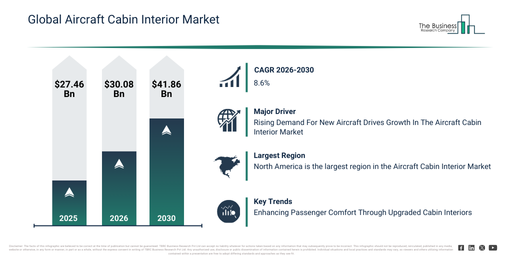
The aircraft cabin interior market has demonstrated significant expansion in recent years. It is projected to increase from $27.46 billion in 2025 to $30.08 billion in 2026, registering a compound annual growth rate (CAGR) of 9.5%. The market’s historical growth can be attributed to several factors, such as the rise in commercial air travel, which has boosted the need for improved passenger cabin components; the heightened adoption of advanced smoke detectors and air purifiers to enhance onboard safety; the broadening of aircraft refurbishment programs that replace older interior systems; the increased deployment of efficient water and waste systems crucial for long-haul operations; and the initial incorporation of ergonomic and space-optimized cabin designs aimed at improving the overall passenger experience.
The aircraft cabin interior market is projected to experience robust expansion in the coming years. It is anticipated to reach $41.86 billion in 2030, exhibiting a compound annual growth rate (CAGR) of 8.6%. This growth during the forecast period stems from several factors, including an increasing need for lightweight and energy-efficient cabin solutions, greater investment in smart cabin technologies for real-time monitoring and automation, a rise in the use of modular interior systems to minimize airline maintenance time, the expansion of premium cabin enhancements spurred by competitive passenger experience approaches, and the creation of advanced air quality and sanitation systems to satisfy more stringent safety and comfort requirements. Key trends anticipated for this period encompass optimizing passenger comfort, innovations in cabin noise reduction, intelligent air filtration and sanitation systems, designs that are both lightweight and space-efficient for interiors, and adaptable, modular cabin configurations.
Get A No-Cost Sample Of The Aircraft Cabin Interior Market Study:
Major Factor Fueling The Aircraft Cabin Interior Market Through 2030
The increasing demand for new aircraft is fueling the expansion of the aircraft cabin interior market. This heightened need for aircraft arises from a surge in air passenger traffic and cargo volumes. To accommodate this rising demand, commercial airline operators globally are enlarging their aircraft fleets. Aircraft cabin interiors are essential for providing a comfortable and valuable flight experience. For instance, the International Civil Aviation Organization, a Canada-based specialized agency of the United Nations, forecasts that demand for air transport will grow by an average of 4.3% per annum by 2040. Additionally, Airbus, a Netherlands-based aerospace company, predicts that passenger traffic demand will increase annually by 3.6% over the next 20 years. Therefore, the growing requirement for new aircraft will significantly propel the aircraft cabin interior market.
Aircraft Cabin Interior Market Segment Landscape: Main Categories And Subcategories Covered
The aircraft cabin interior market covered in this report is segmented –
1) By Type: Aircraft Seating, In-Flight Entertainment And Connectivity, Aircraft Cabin Lighting, Aircraft Galley, Aircraft Lavatory, Aircraft Windows And Windshields, Aircraft Stowage Bins, Aircraft Interior Panels
2) By Class: First Class, Business Class, Economy And Premium Economy Class
3) By Aircraft Type: Narrow Body Aircraft, Wide Body Aircraft, Business Jets, Regional Transport Aircraft
4) By Material: Alloys, Composites, Other Materials
5) By End User: OEM, Aftermarket
Subsegments:
1) By Aircraft Seating: Economy Class Seating, Business Class Seating, First Class Seating, Premium Economy Seating
2) By In-Flight Entertainment And Connectivity: IFE Systems, Connectivity Solutions
3) By Aircraft Cabin Lighting: Ambient Lighting, Reading Lights, Emergency Lighting Systems
4) By Aircraft Galley: Galley Equipment, Food Preparation Areas
5) By Aircraft Lavatory: Lavatory Fixtures, Sanitation Systems
6) By Aircraft Windows And Windshields: Cabin Windows, Cockpit Windshields
7) By Aircraft Stowage Bins: Overhead Bins, Crew Storage Compartments
8) By Aircraft Interior Panels: Sidewall Panels, Ceiling Panels, Floor Panels
How Are Emerging Trends Influencing The Aircraft Cabin Interior Market’s Growth Path?
Leading firms in the aircraft cabin interior market are concentrating on elevating the cabin experience through improved interiors. This aims to boost passenger comfort and general in-flight contentment across both commercial and business aviation sectors. These upgraded cabin interiors provide enhanced aircraft aesthetics and functionality, boosting passenger comfort, convenience, and visual appeal. They incorporate elements like ergonomic seating, sophisticated lighting, and contemporary entertainment systems, delivering a premium journey experience. As an illustration, in October 2025, Southwest Airlines, a US-based passenger airline offering scheduled air transportation, revealed its redesigned Boeing 737 MAX 8 cabins. These new cabins feature increased legroom, expansive new Recaro R2 seats equipped with multi-adjustable headrests, built-in device holders, and dual USB power ports available at each seat. The revamp also encompasses larger overhead compartments, updated blue color palettes, contemporary lighting, and distinct premium seating areas that come with priority boarding and complimentary snacks. This substantial cabin transformation signifies a pivotal step in Southwest’s transition towards assigned seating and a more upscale travel offering, alongside a complete rollout and modifications to boarding procedures.
Aircraft Cabin Interior Market Leading Players And Key Industry Participants In 2026
Major companies operating in the aircraft cabin interior market are Safran S.A., Honeywell International Inc., Recaro Holding, Collins Aerospace, JAMCO Corporation, Astronics Corporation, Turkish Cabin Interior, Cobham Limited, Die Diehl Stiftung & Co. KG, Panasonic Avionics Corporation, HAECO Americas LLC, SCI Cabin Interiors, Geven S.p.A., Aviointeriors S.p.A., Bucher Leichtbau AG, Thales Group, Thompson Aero Seating, The Boeing Company, Gogo Inc., Global Aerospace Logistics (GAL), Hong Kong Aircraft Engineering Company Limited, Singapore Technologies Engineering Ltd., Acro Aircraft Seating, Boeing Encore Interiors LLC, AIM Altitude Limited, B/E Aerospace Inc., GKN Aerospace Limited, Greenpoint Technologies, United Technologies Corporation, Lacobucci
Check Out The Full Aircraft Cabin Interior Market Report 2026:
Aircraft Cabin Interior Market By Geography: Revenue Leaders Among Global Regions
North America was the largest region in the aircraft cabin Interior market in 2025. Asia-Pacific is expected to be the fastest-growing region in the forecast period. The regions covered in the aircraft cabin interior market report are Asia-Pacific, South East Asia, Western Europe, Eastern Europe, North America, South America, Middle East, Africa.
Reach Out To Our Team:
The Business Research Company: https://www.thebusinessresearchcompany.com/
Americas: +1 310-496-7795
Asia: +44 7882 955267 & +91 8897263534
Europe: +44 7882 955267
Email us at: marketing@tbrc.info
Follow us on:
LinkedIn: https://in.linkedin.com/company/the-business-research-company
YouTube: https://www.youtube.com/channel/UC24_fI0rV8cR5DxlCpgmyFQ
Global Market Model: https://www.thebusinessresearchcompany.com/global-market-model

Wasay has over a decade of experience in market research, data modelling, and analytics, with prior experience at GlobalData and Decision Tree Consulting Services. At The Business Research Company , he leads research operations across syndicated studies, customized consulting engagements, and the Global Market Model platform. His professional experience includes supporting organizations such as Boston Consulting Group, KPMG, and Ernst & Young. Wasay holds a degree in Electronics and Communications Engineering, postgraduate management qualifications from International Management Institute Belgium and Indian School of Business and Entrepreneurship, and completed the Integrated Program in Business Analytics from Indian Institute of Management Indore.

