
Built to provide research that’s more actionable and strategically valuable, The Business Research Company’s 2026 market reports include market attractiveness analysis, total addressable market sizing, company benchmarking matrices, interactive Excel dashboards, broader supply chain intelligence, emerging startup tracking, and in-depth product insights.
Static Random Access Memory (SRAM) And Read-Only Memory (ROM) Design Intellectual Property (IP) Market Growth Potential: How Will Market Size Shift Through 2030?
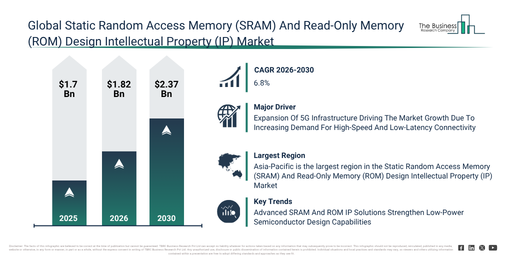
The static random access memory (sram) and read-only memory (rom) design intellectual property (ip) market size has experienced robust expansion in recent years. This market is projected to expand from $1.7 billion in 2025 to $1.82 billion in 2026, demonstrating a compound annual growth rate (CAGR) of 7.2%. Historically, this growth has been driven by factors such as the increasing complexity of SoC designs, a rise in semiconductor design outsourcing, a greater demand for pre-verified memory blocks, the growing necessity to shorten chip development timelines, and the increasing embrace of licensed semiconductor IP.
The market for static random access memory (sram) and read-only memory (rom) design intellectual property (ip) is expected to demonstrate robust expansion in the coming years. It is projected to achieve a valuation of $2.37 billion in 2030, growing at a compound annual growth rate (CAGR) of 6.8%. This forecasted growth can be attributed to several factors, including the increasing demand for sophisticated memory architectures, the growing necessity for process-portable memory IP, the rising adoption of multi-voltage memory designs, the heightened demand for faster memory access performance, and a stronger focus on memory IP interoperability. Significant trends anticipated during this period encompass the increasing uptake of high-density SRAM and ROM IP cores, a surging demand for silicon-verified memory IP blocks, a growing preference for reusable memory circuit designs, enhanced integration of configurable memory IP into SoCs and ICs, and an increased emphasis on ensuring memory IP portability across diverse semiconductor process technologies.
Get A Free Sample Report With In-Depth Market Insights:
Static Random Access Memory (SRAM) And Read-Only Memory (ROM) Design Intellectual Property (IP) Market Industry Drivers: What’s Behind The Revenue Growth?
The ongoing development of 5G infrastructure is projected to fuel the expansion of the static random access memory (SRAM) and read-only memory (ROM) design intellectual property (IP) market. This 5G infrastructure encompasses a network of physical and digital components such as small cells, base stations, antennas, fiber optic systems, and core network equipment, all of which are essential for delivering fifth-generation wireless communication services. The increasing deployment of 5G infrastructure stems from a growing need for faster data speeds, given that bandwidth-intensive applications like video streaming, cloud computing, and real-time communication necessitate high bandwidth and minimal latency. This expansion of 5G infrastructure, in turn, boosts the demand for advanced semiconductor devices, thereby increasing the requirement for high-performance, low-latency, and energy-efficient static random access memory (SRAM) and read-only memory (ROM) design intellectual property (IP) to support next-generation network equipment, edge computing, and connected devices. For instance, in December 2023, a report from the Office of Communications (Ofcom), a UK-based government office, indicated that the UK recorded over 18,500 5G deployments across approximately 81,000 sites, which is an increase from around 12,000 deployments in 2022, signifying a considerable year-on-year growth. Consequently, the expansion of 5G infrastructure is a primary driver for the growth of the static random access memory (SRAM) and read-only memory (ROM) design intellectual property (IP) market.
Static Random Access Memory (SRAM) And Read-Only Memory (ROM) Design Intellectual Property (IP) Market Segmentation: How Does The Market Break Down By Category?
The static random access memory (sram) and read-only memory (rom) design intellectual property (ip) market covered in this report is segmented –
1) By Product: Standard Static Random Access Memory, Embedded Static Random Access Memory, Asynchronous Static Random Access Memory, Synchronous Static Random Access Memory, Read Only Memory
2) By Technology: Complementary Metal Oxide Semiconductor, Bipolar Complementary Metal Oxide Semiconductor, Silicon On Insulator, Fin Field Effect Transistor
3) By Application: Consumer Electronics, Automotive, Industrial, Telecommunications, Other Applications
4) By End User: Original Equipment Manufacturers, Semiconductor Companies, Other End Users
Subsegments:
1) By Standard Static Random Access Memory: Single Port, Dual Port, Low Power, High Speed, High Density
2) By Embedded Static Random Access Memory: Single Port Embedded Memory, Dual Port Embedded Memory, Multi Port Embedded Memory, Low Leakage Embedded Memory, High Performance Embedded Memory
3) By Asynchronous Static Random Access Memory: Low Power Asynchronous Memory, High Speed Asynchronous Memory, Industrial Grade Asynchronous Memory, Automotive Grade Asynchronous Memory, Radiation Hardened Asynchronous Memory
4) By Synchronous Static Random Access Memory: Burst Synchronous Memory, Pipeline Synchronous Memory, Quad Data Rate Synchronous Memory, Low Power Synchronous Memory, High Performance Synchronous Memory
5) By Read Only Memory: Mask Programmable Read Only Memory, Programmable Read Only Memory, Erasable Programmable Read Only Memory, Electrically Erasable Programmable Read Only Memory, One Time Programmable Read Only Memory
#Static Random Access Memory (SRAM) And Read-Only Memory (ROM) Design Intellectual Property (IP) Market Growth Trends: What’s Shaping The Future Outlook?
Leading companies in the static random access memory (SRAM) and read-only memory (ROM) design intellectual property (IP) market are increasingly engaging in strategic partnerships. This approach aims to accelerate memory IP innovation, strengthen semiconductor design capabilities, and broaden their presence in the market. A strategic partnership involves a long-term alliance between businesses, combining their expertise and resources to foster innovation, extend market reach, and achieve shared goals. For instance, in August 2024, M31 Technology Corporation, a Taiwan-based silicon intellectual property provider, formed a partnership with Tower Semiconductor, an Israel-based semiconductor foundry company. This collaboration focused on developing advanced SRAM and ROM IP solutions for Tower Semiconductor’s 65nm power management platform. Through this joint effort, silicon-validated Single Port SRAM, One Port SRAM, and ROM IP memory compilers were introduced, featuring low-power analog FET integration and various Deep N-Well voltage options. These solutions are specifically optimized for applications in the Internet of Things (IoT), smart wearables, vehicle-to-everything (V2X), and artificial intelligence (AI).
Static Random Access Memory (SRAM) And Read-Only Memory (ROM) Design Intellectual Property (IP) Market Key Participants And Competitive Landscape
Major companies operating in the static random access memory (sram) and read-only memory (rom) design intellectual property (ip) market are Taiwan Semiconductor Manufacturing Company Limited, Samsung Electronics Co. Ltd., Intel Corporation, Synopsys Inc., Cadence Design Systems Inc., Renesas Electronics Corporation, GlobalFoundries Inc., United Microelectronics Corporation, Socionext Inc., Silvaco Group Inc., Tower Semiconductor Ltd., VeriSilicon Microelectronics (Shanghai) Co. Ltd., SiFive Inc., Faraday Technology Corporation, M31 Technology Corporation, Dolphin Semiconductor, Mobile Semiconductor Inc., DXCorr Hardware Inc., sureCore Limited, NSCore Inc., Arm Limited, Rambus Inc., eMemory Technology Inc.
View The Full Static Random Access Memory (SRAM) And Read-Only Memory (ROM) Design Intellectual Property (IP) Market Report:
Static Random Access Memory (SRAM) And Read-Only Memory (ROM) Design Intellectual Property (IP) Market Geographic Analysis: Where Is Demand Accelerating Fastest?
Asia-Pacific was the largest region in the static random access memory (SRAM) and read-only memory (ROM) design intellectual property (IP) market in 2025. Asia-Pacific is expected to be the fastest-growing region in the forecast period. The regions covered in the static random access memory (sram) and read-only memory (rom) design intellectual property (ip) market report are Asia-Pacific, South East Asia, Western Europe, Eastern Europe, North America, South America, Middle East, Africa.
Reach Out To Our Team:
The Business Research Company: https://www.thebusinessresearchcompany.com/
Americas: +1 310-496-7795
Asia: +44 7882 955267 & +91 8897263534
Europe: +44 7882 955267
Email us at: marketing@tbrc.info
Follow us on:
LinkedIn: https://in.linkedin.com/company/the-business-research-company
YouTube: https://www.youtube.com/channel/UC24_fI0rV8cR5DxlCpgmyFQ
Global Market Model: https://www.thebusinessresearchcompany.com/global-market-model

Wasay has over a decade of experience in market research, data modelling, and analytics, with prior experience at GlobalData and Decision Tree Consulting Services. At The Business Research Company , he leads research operations across syndicated studies, customized consulting engagements, and the Global Market Model platform. His professional experience includes supporting organizations such as Boston Consulting Group, KPMG, and Ernst & Young. Wasay holds a degree in Electronics and Communications Engineering, postgraduate management qualifications from International Management Institute Belgium and Indian School of Business and Entrepreneurship, and completed the Integrated Program in Business Analytics from Indian Institute of Management Indore.