
Built to provide research that’s more actionable and strategically valuable, The Business Research Company’s 2026 market reports include market attractiveness analysis, total addressable market sizing, company benchmarking matrices, interactive Excel dashboards, broader supply chain intelligence, emerging startup tracking, and in-depth product insights.
Semi Synthetic Lubricant Market Set To Climb From $5.95 Billion In 2026 To $7.55 Billion By 2030
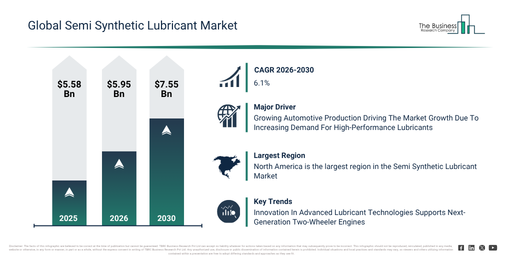
The market for semi synthetic lubricants has experienced significant growth recently. It is projected to increase from $5.58 billion in 2025 to $5.95 billion in 2026, exhibiting a compound annual growth rate (CAGR) of 6.6%. This historical growth is linked to several factors, including the rising adoption of semi-synthetic lubricants in vehicle applications, a heightened demand for better engine and machinery protection, a developing inclination towards lubricants that balance performance and cost, their increasing application in high-temperature environments, and an expanding need for lubrication solutions resistant to wear.
The semi synthetic lubricant market is projected to experience substantial expansion over the coming years, reaching $7.55 billion by 2030, driven by a compound annual growth rate (CAGR) of 6.1%. This anticipated growth during the forecast period is primarily due to several factors, including the increasing need for fuel-efficient lubrication solutions, a greater requirement for extended equipment operating life, the escalating demand for high-performance lubricants within industrial machinery, a growing inclination towards low-maintenance lubrication options, and a rising call for environmentally friendlier lubricant formulations. Key trends anticipated during this period encompass a heightened demand for economical yet high-performance lubrication, a growing preference for lubricants offering superior wear protection, an increasing call for better thermal stability, a stronger inclination towards lubricants exhibiting higher oxidation resistance, and a rising need for longer lubricant service intervals.
Get A Free Sample Report With In-Depth Market Insights:
Semi Synthetic Lubricant Market Demand Drivers Opening New Revenue Streams
The increasing manufacturing of automobiles is projected to drive the expansion of the semi-synthetic lubricant market moving forward. Automotive production encompasses the creation of passenger cars, commercial vehicles, and other motor vehicles through integrated assembly and component manufacturing processes. This rise in automotive manufacturing is attributed to increasing consumer demand for vehicles, government support for domestic automotive industries, and consumers’ growing tendency to replace older vehicles with newer models. Automotive production fuels the demand for semi-synthetic lubricants by increasing the need for high-performance engine oils and other lubricants that provide enhanced engine protection, improved fuel efficiency, better thermal stability, and extended service intervals in modern vehicles. As an illustration, in April 2026, the International Organization of Motor Vehicle Manufacturers, a France-based trade association, reported that global vehicle production rose from 92.7 million units in 2024 to 96.4 million units in 2025, marking a 3.9% increase. Simultaneously, global sales grew from 95.3 million to 99.8 million units, reflecting a 4.7% increase. Thus, the growing automotive production is propelling the growth of the semi-synthetic lubricant market.
Semi Synthetic Lubricant Market Segment Breakdown: Which Categories Lead On Revenue?
The semi synthetic lubricant market covered in this report is segmented –
1) By Product Type: Engine Oils, Transmission Fluids, Hydraulic Fluids, Gear Oils, Greases
2) By Base Oil Type: Group I Base Oils, Group II Base Oils, Group III Base Oils, Synthetic Base Oils
3) By Packaging Type: Bulk Packaging, Drums, Pails, Bottles, Sachets
4) By Application: Automotive, Industrial, Marine, Aviation, Agricultural
5) By End User: Original Equipment Manufacturers, Aftermarket, Maintenance Repair And Operations, Industrial Sectors
Subsegments:
1) By Engine Oils: Passenger Vehicle Engine Oils, Commercial Vehicle Engine Oils, Motorcycle Engine Oils, Marine Engine Oils, Industrial Engine Oils
2) By Transmission Fluids: Automatic Transmission Fluids, Manual Transmission Fluids, Continuously Variable Transmission Fluids, Dual Clutch Transmission Fluids, Tractor Transmission Fluids
3) By Hydraulic Fluids: Anti Wear Hydraulic Fluids, High Performance Hydraulic Fluids, Fire Resistant Hydraulic Fluids, Biodegradable Hydraulic Fluids, Multi Purpose Hydraulic Fluids
4) By Gear Oils: Automotive Gear Oils, Industrial Gear Oils, Extreme Pressure Gear Oils, Worm Gear Oils, Synthetic Blend Gear Oils
5) By Greases: Lithium Based Greases, Calcium Based Greases, Aluminum Complex Greases, Polyurea Based Greases, Molybdenum Disulfide Greases
Semi Synthetic Lubricant Market Trends Powering Strategic Industry Growth
Leading companies within the semi-synthetic lubricant market are concentrating on creating novel products, such as BS6-compliant semi-synthetic engine oils, to boost engine efficiency, enhance fuel economy, provide superior wear protection, and ensure adherence to evolving emission regulations. These BS6-compliant semi-synthetic engine oils are lubricants formulated by combining mineral base oils with synthetic base oils and specialized additive packages, delivering enhanced thermal stability, resistance to oxidation, and engine safeguarding compared to traditional mineral oils, while simultaneously serving as a more economical option than fully synthetic lubricants. As an illustration, in March 2023, Uno Minda Limited, an India-based automotive components manufacturer, introduced Purosynth, a BS6-compliant semi-synthetic engine oil specifically designed for 125cc–150cc motorcycles. This lubricant boasts high viscosity to offer excellent engine wear protection, smoother driving experience, quick engine startup, improved acceleration, and better fuel efficiency, all while lowering upkeep expenses. Proven to perform effectively for up to 10,000 kilometres, this engine oil also prolongs engine longevity with consistent usage and comes in 100% eco-friendly, lead-free containers, thereby supporting both vehicle performance and environmental sustainability.
Semi Synthetic Lubricant Market Key Participants And Competitive Landscape
Major companies operating in the semi synthetic lubricant market are Exxon Mobil Corporation, Shell plc, TotalEnergies SE, BP plc, Chevron Corporation, Phillips 66 Company, ENEOS Corporation, Indian Oil Corporation Limited, Repsol S.A., Idemitsu Kosan Co. Ltd., LUKOIL Lubricants Company, Bharat Petroleum Corporation Limited, FUCHS SE, Gulf Oil International Ltd., PT Pertamina Lubricants, AMSOIL Inc., Morris Lubricants Ltd., Rymax Lubricants B.V., Mitasu Oil Corporation, SK Enmove Co., Ltd
View The Full Semi Synthetic Lubricant Market Report:
Semi Synthetic Lubricant Market Geographic Analysis: Where Is Demand Rising Fastest?
North America was the largest region in the semi synthetic lubricant market in 2025. Asia-Pacific is expected to be the fastest-growing region in the forecast period. The regions covered in the semi synthetic lubricant market report are Asia-Pacific, South East Asia, Western Europe, Eastern Europe, North America, South America, Middle East, Africa.
Reach Out To Our Team:
The Business Research Company: https://www.thebusinessresearchcompany.com/
Americas: +1 310-496-7795
Asia: +44 7882 955267 & +91 8897263534
Europe: +44 7882 955267
Email us at: marketing@tbrc.info
Follow us on:
LinkedIn: https://in.linkedin.com/company/the-business-research-company
YouTube: https://www.youtube.com/channel/UC24_fI0rV8cR5DxlCpgmyFQ
Global Market Model: https://www.thebusinessresearchcompany.com/global-market-model

Wasay has over a decade of experience in market research, data modelling, and analytics, with prior experience at GlobalData and Decision Tree Consulting Services. At The Business Research Company , he leads research operations across syndicated studies, customized consulting engagements, and the Global Market Model platform. His professional experience includes supporting organizations such as Boston Consulting Group, KPMG, and Ernst & Young. Wasay holds a degree in Electronics and Communications Engineering, postgraduate management qualifications from International Management Institute Belgium and Indian School of Business and Entrepreneurship, and completed the Integrated Program in Business Analytics from Indian Institute of Management Indore.