
Featuring market attractiveness scoring, total addressable market sizing, company benchmarking matrices, interactive Excel dashboards, deeper supply chain intelligence, emerging startup tracking, and granular product-level insights, The Business Research Company’s 2026 market reports are built to deliver research that is both more actionable and more strategically valuable.
Textile Weaving Residencies Market Poised To Hit $1.06 Billion By 2030 With A 7.7% CAGR
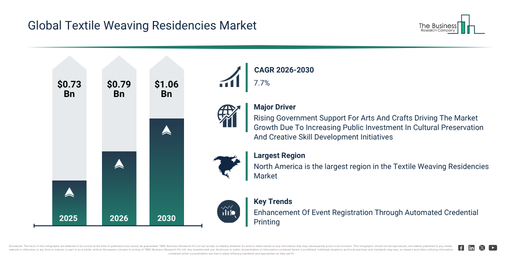
The textile weaving residencies market has experienced robust expansion in recent years. This market is expected to increase from $0.73 billion in 2025 to $0.79 billion in 2026, exhibiting a compound annual growth rate (CAGR) of 8.1%. Historically, this growth has been driven by a surging interest in safeguarding traditional textile weaving techniques, enhanced support for textile artists through cultural and creative initiatives, an escalating demand for specialized environments conducive to textile experimentation, the broadening appreciation of weaving as an artistic and cultural pursuit, and greater involvement from artisans and designers in collaborative textile ventures.
The market size for textile weaving residencies is anticipated to experience robust expansion over the coming years. It is projected to reach $1.06 billion in 2030, demonstrating a compound annual growth rate (CAGR) of 7.7%. This growth during the forecast period can be attributed to factors such as the increasing demand for sustainable textile innovation and eco-conscious weaving practices, the rising adoption of interdisciplinary textile research programs, enhanced collaboration among artists, educational institutions, and textile organizations, a widening global interest in cultural exchange facilitated through textile residencies, and greater investment in creative communities that support advanced weaving practices. Key trends expected in this period include a heightened focus on the preservation of traditional weaving knowledge and cultural heritage practices, the increased embrace of collaborative textile residency models by artists and designers, a surging demand for sustainable material experimentation in textile creation, broadened involvement of emerging textile artists in specialized residency programs, and the intensified development of cross-cultural textile exchange initiatives.
Get A Free Sample Report With In-Depth Market Insights:
Textile Weaving Residencies Market Growth Drivers: What’s Behind The Acceleration?
The expanding government backing for arts and crafts is anticipated to fuel the growth of the textile weaving residencies market. This governmental assistance involves providing grants, funding, training, infrastructure, and policy initiatives to stimulate artistic creation, preserve traditional crafts, and encourage the development of creative industries. Support for arts and crafts is increasing with the goal of preserving cultural heritage by financing projects that safeguard traditional craftsmanship, sustain indigenous artistic practices, and transmit cultural knowledge to future generations. Such support benefits textile weaving residencies by offering funding, infrastructure, training programs, and market access, enabling weavers to uphold traditional techniques, innovate with new designs, and maintain their livelihoods. For instance, in February 2024, the GIA Reader, a national US publication, reported that federal, state, and local funding for the arts in the United States amounted to $1.8 billion in fiscal year 2024, representing a per capita investment of $5.44, which underscores persistent public investment in creative industries. Thus, the rising government support for arts and crafts is propelling the advancement of the textile weaving residencies market.
Textile Weaving Residencies Market Breakdown By Product Type And Application
The textile weaving residencies market covered in this report is segmented –
1) By Residency Type: Handloom Weaving Residencies, Contemporary Textile Art Residencies, Sustainable Textile Residencies, Artisan Collaboration Residencies, Academic Textile Residencies
2) By Duration: Short Term, Long Term
3) By Funding Type: Government Funded Residencies, Privately Funded Residencies, Institution Sponsored Residencies, Non Profit Supported Residencies, Self Funded Residencies
4) By Application: Fashion And Apparel, Home Furnishing Textiles, Artistic Textile Installations, Cultural And Heritage Projects, Educational And Training Programs
5) By End User: Individuals, Educational Institutions, Textile Manufacturers, Art Organizations, Other End Users
Subsegments:
1) By Handloom Weaving Residencies: Traditional Loom Based Residencies, Heritage Weaving Skill Development Residencies, Community Based Handloom Training Residencies, Master Weaver Mentorship Residencies, Rural Handloom Craft Revival Residencies
2) By Contemporary Textile Art Residencies: Experimental Textile Art Residencies, Mixed Media Textile Practice Residencies, Conceptual Textile Design Residencies, Digital Fabrication Textile Art Residencies, Installation Based Textile Art Residencies
3) By Sustainable Textile Residencies: Eco Friendly Dyeing And Weaving Residencies, Circular Textile Design Residencies, Zero Waste Textile Production Residencies, Organic Fibre Textile Development Residencies, Recycled Material Textile Innovation Residencies
4) By Artisan Collaboration Residencies: Cross Cultural Weaving Collaboration Residencies, Designer Artisan Co Creation Residencies, Indigenous Craft Integration Residencies, Intergenerational Craft Knowledge Exchange Residencies, Community Artisan Cooperative Residencies
5) By Academic Textile Residencies: University Based Textile Research Residencies, Textile Material Science Research Residencies, Curriculum Integrated Weaving Training Residencies, Student Led Textile Innovation Residencies, Interdisciplinary Textile Studies Residencies
Textile Weaving Residencies Market Trends: What’s Defining The Industry’s Next Phase?
Companies operating in the textile weaving residencies market are increasingly prioritizing multidisciplinary weaving residency programs. These initiatives blend traditional textile practices with scientific, cultural, technological, and environmental perspectives to promote knowledge exchange and collaborative creative development. Multidisciplinary weaving residency programs are structured collaborative efforts bringing together artists, scientists, knowledge holders, technologists, and creatives from diverse fields to develop projects centered on weaving or other interdisciplinary themes. For example, in January 2026, Treecreate Studio, an Australia-based creative and cultural organization, announced three Weaving Water residencies for 2026, including programs in Vanuatu, Looming, and Yarun (Bribie Island), Queensland. These residencies unite scientists, knowledge holders, technologists, and creatives to investigate subjects such as climate change, ecological restoration, water, and more-than-human perspectives. By integrating weaving practices with scientific, cultural, and environmental insights, the Weaving Water residencies foster collaborative textile creation, interdisciplinary learning, and a creative examination of ecological and cultural issues.
Textile Weaving Residencies Market Top Companies Driving Competitive Growth
Major companies operating in the textile weaving residencies market are Fondation d’Entreprise Hermès, Banff Centre for Arts and Creativity, Haystack Mountain School of Crafts, Penland School of Craft, Stichting TextielMuseum, Fondazione Arte della Seta Lisio, Cité Internationale de la Tapisserie, Australian Tapestry Workshop, Textile Museum of Canada, Dovecot Studios Limited, Arquetopia A.C., Textile Arts Center Inc., The Weaving Mill, Praxis Fiber Workshop, Córtex Frontal Associação, Thread Caravan LLC, Tabby Studio, Maria Sigma Studio, Freeweaver Studio, Textile Center, Stofnun Textílína á Íslandi, Salem Art Works Inc., Qhatuy Lab, La Napoule Art Foundation
View The Full Textile Weaving Residencies Market Report:
Textile Weaving Residencies Market Global Footprint: Which Region Leads The Industry?
North America was the largest region in the textile weaving residencies market in 2025. Asia-Pacific is expected to be the fastest-growing region in the forecast period. The regions covered in the textile weaving residencies market report are Asia-Pacific, South East Asia, Western Europe, Eastern Europe, North America, South America, Middle East, Africa.
Reach Out To Our Team:
The Business Research Company: https://www.thebusinessresearchcompany.com/
Americas: +1 310-496-7795
Asia: +44 7882 955267 & +91 8897263534
Europe: +44 7882 955267
Email us at: marketing@tbrc.info
Follow us on:
LinkedIn: https://in.linkedin.com/company/the-business-research-company
YouTube: https://www.youtube.com/channel/UC24_fI0rV8cR5DxlCpgmyFQ
Global Market Model: https://www.thebusinessresearchcompany.com/global-market-model

Wasay has over a decade of experience in market research, data modelling, and analytics, with prior experience at GlobalData and Decision Tree Consulting Services. At The Business Research Company , he leads research operations across syndicated studies, customized consulting engagements, and the Global Market Model platform. His professional experience includes supporting organizations such as Boston Consulting Group, KPMG, and Ernst & Young. Wasay holds a degree in Electronics and Communications Engineering, postgraduate management qualifications from International Management Institute Belgium and Indian School of Business and Entrepreneurship, and completed the Integrated Program in Business Analytics from Indian Institute of Management Indore.