
Backed by market attractiveness analysis, total addressable market sizing, company benchmarking matrices, interactive Excel dashboards, wider supply chain intelligence, emerging startup coverage, and detailed product-level insights, The Business Research Company’s 2026 market reports are designed to offer research that is more actionable and strategically valuable than ever.
TextileGenesis Traceability Market Value Growth And Long-Term Outlook
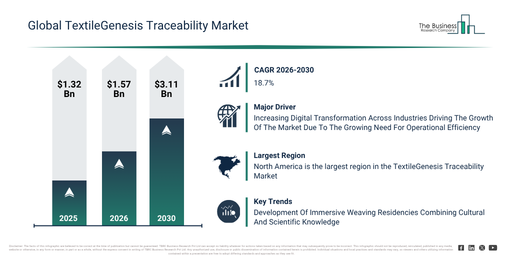
The textilegenesis traceability market size has seen rapid growth in recent years. It is projected to expand from $1.32 billion in 2025 to $1.57 billion in 2026, at a compound annual growth rate (CAGR) of 19.1%. This historical growth can be attributed to factors such as an increasing demand for supply chain transparency within the textile industry, a growing regulatory focus on sustainable textile production, rising concerns regarding counterfeit textile materials and product authenticity, the expanding adoption of digital supply chain management solutions, and an increasing need for improved supplier verification and compliance monitoring.
The textilegenesis traceability market is anticipated to experience substantial growth over the coming years. It is projected to expand to $3.11 billion by 2030, achieving a compound annual growth rate (CAGR) of 18.7%. This expansion during the forecast period is propelled by factors such as the increasing demand for comprehensive textile traceability solutions, the growing acceptance of digital product passport requirements, a heightened emphasis on circular economy practices within textile value chains, the broadening implementation of cloud-based supply chain platforms, and the rising consumer and brand demand for verified sustainability claims. Key trends for this period encompass the increased adoption of digital traceability solutions across textile supply chains, a surging demand for authenticated sustainable sourcing and material authenticity, the expanding implementation of digital product passports for textile compliance, an intensified focus on supplier transparency and responsible sourcing practices, and the greater integration of traceability platforms with textile certification processes.
Get A Free Sample Report With In-Depth Market Insights:
TextileGenesis Traceability Market Demand Drivers: What’s Powering Industry Growth?
The future expansion of the TextileGenesis traceability market is anticipated to be fueled by the rising digital transformation across various sectors. This transformation involves the extensive integration of digital technologies to boost operational effectiveness, enrich customer interactions, and foster innovation throughout diverse industries. Its growth is attributed to the escalating demand for operational efficiency, as businesses leverage digital tools to automate processes, cut expenses, and enhance productivity. TextileGenesis traceability facilitates this industry-wide digital shift by digitizing supply chain information, allowing for real-time tracking, automating paperwork, and boosting transparency, adherence to regulations, and operational performance throughout the textile value chain. An illustrative example is the UK’s Government Digital and Data profession, which, as reported by the Central Digital and Data Office in November 2023, experienced a 19% increase in its overall size between April 2022 and April 2023. Consequently, the growing digital transformation observed across industries is serving as a key impetus for the expansion of the TextileGenesis traceability market.
TextileGenesis Traceability Market Segment Landscape And Growth Outlook
The textilegenesis traceability market covered in this report is segmented –
1) By Component: Software, Services
2) By Material Type: Cotton, Recycled Polyester, Wool, Cellulosic Fibers, Synthetic Fibers, Blended Fabrics
3) By Deployment Mode: Cloud, On-Premises
4) By Application: Supply Chain Transparency, Material Traceability, Digital Product Passport, Sustainability Compliance, Supplier Verification
5) By End User: Textile Manufacturers, Apparel Brands, Retailers, Fiber Producers, Fashion Companies, Certification Bodies
Subsegments:
1) By Software: Platform Software, Integration Software, Data Management Software, Analytics Software, Blockchain Traceability Software
2) By Services: Implementation Services, Consulting Services, Support And Maintenance Services, Training And Onboarding Services, System Integration Services
TextileGenesis Traceability Market Innovation Trends: What Developments Are Reshaping The Industry?
Key companies operating within the TextileGenesis traceability market are concentrating on developing innovative solutions, such as traceability consortium platforms, to bolster end-to-end supply chain transparency, enhance material traceability, and support sustainability compliance across various industries. Traceability consortium platforms function as collaborative digital networks connecting brands, suppliers, manufacturers, and certification bodies to securely track and verify the origin and movement of materials throughout the supply chain. For example, in January 2024, TextileGenesis, a Hong Kong-based supply chain traceability technology company, launched its footwear and leather traceability consortia, designed to enable comprehensive traceability of footwear and leather supply chains. This initiative offers benefits including authenticated material traceability, improved collaboration among ecosystem participants, and streamlined sustainability and compliance verification. The launch aims to assist customers in enhancing supply chain transparency and verifying product authenticity while simultaneously supporting sustainability initiatives, responsible sourcing, and digital supply chain transformation.
TextileGenesis Traceability Market Key Participants And Competitive Landscape
Major companies operating in the textilegenesis traceability market are Alliance for European Flax-Linen & Hemp, Arvind Limited, Bombyx PLM Ltd., Circulor Ltd., EON Group Limited, Eastman Chemical Company, Grasim Industries Limited, Haelixa AG, Lenzing AG, Provenance Technologies Ltd., Retraced GmbH, Sourcemap Inc., Supima Association of America, Tailorlux GmbH, Textile Exchange, The Schneider Group, TrusTrace AB, National Cotton Council of America
View The Full TextileGenesis Traceability Market Report:
TextileGenesis Traceability Market Geographic Analysis: Where Is Demand Accelerating Fastest?
North America was the largest region in the textilegenesis traceability market in 2025. Asia-Pacific is expected to be the fastest-growing region in the forecast period. The regions covered in the textilegenesis traceability market report are Asia-Pacific, South East Asia, Western Europe, Eastern Europe, North America, South America, Middle East, Africa.
Reach Out To Our Team:
The Business Research Company: https://www.thebusinessresearchcompany.com/
Americas: +1 310-496-7795
Asia: +44 7882 955267 & +91 8897263534
Europe: +44 7882 955267
Email us at: marketing@tbrc.info
Follow us on:
LinkedIn: https://in.linkedin.com/company/the-business-research-company
YouTube: https://www.youtube.com/channel/UC24_fI0rV8cR5DxlCpgmyFQ
Global Market Model: https://www.thebusinessresearchcompany.com/global-market-model

Wasay has over a decade of experience in market research, data modelling, and analytics, with prior experience at GlobalData and Decision Tree Consulting Services. At The Business Research Company , he leads research operations across syndicated studies, customized consulting engagements, and the Global Market Model platform. His professional experience includes supporting organizations such as Boston Consulting Group, KPMG, and Ernst & Young. Wasay holds a degree in Electronics and Communications Engineering, postgraduate management qualifications from International Management Institute Belgium and Indian School of Business and Entrepreneurship, and completed the Integrated Program in Business Analytics from Indian Institute of Management Indore.