Delivering more actionable and strategically valuable research, The Business Research Company’s 2026 market reports feature market attractiveness analysis, total addressable market evaluation, company benchmarking matrices, interactive Excel dashboards, expanded supply chain intelligence, emerging startup coverage, and detailed product insights.
#Institutional Buildings Market Size And Revenue Forecast Through 2030
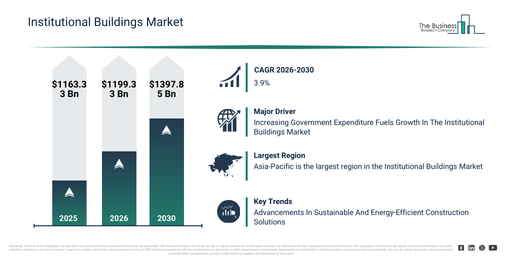
The institutional buildings market size has experienced consistent growth in recent years. It is projected to expand from $1163.33 billion in 2025 to $1199.33 billion in 2026, demonstrating a compound annual growth rate (CAGR) of 3.1%. The growth observed in the historic period was primarily driven by factors such as an increase in public infrastructure funding, rising demand for educational and healthcare capacity, continued reliance on traditional construction approaches, the expansion of community service institutions, and a growing need for large functional buildings.
The institutional buildings market is projected to experience consistent expansion in the coming years, with its size reaching $1397.85 billion by 2030, exhibiting a compound annual growth rate (CAGR) of 3.9%. This projected growth throughout the forecast period stems from factors such as the increasing integration of smart institutional facilities, a heightened emphasis on sustainability within public buildings, growing investments aimed at modernizing older structures, an expanding demand for healthcare and senior-care infrastructure, and a stronger focus on developing resilient community facilities. Key trends anticipated during this period include an uptick in the construction of educational and healthcare facilities, an increasing need for extensive community service buildings, a growing focus on renovating outdated institutional structures, the enlargement of specialized dormitories and convents, and an elevated demand for building designs that prioritize functionality and compliance.
Download A Free Sample Report For Comprehensive Market Insights:
#Institutional Buildings Market Demand Drivers Creating New Revenue Opportunities
The future expansion of the institutional buildings market is anticipated to be fueled by rising government spending. This expenditure denotes funds allocated by the government for diverse goods and services. Enhanced government spending directly benefits public structures like government hospitals and government schools, thereby supporting the advancement of infrastructure needs, including institutional buildings. For instance, in August 2024, data from the UK’s Office for National Statistics indicates that the central government’s overall spending for July 2024 reached $136.4 billion (£107.4 billion). This figure represents an increase of $4.45 billion (£3.5 billion) compared to July 2023. This specific increase of $4.45 billion (£3.5 billion) contributed to the total expenditure growth. Consequently, the expansion of the institutional buildings market is propelled by increased government expenditure.
Institutional Buildings Market Segmentation Trends And Revenue Drivers
The institutional buildings market covered in this report is segmented –
1) By Type: Residential, Non-Residential
2) By Construction Type: New Construction, Renovation
3) By Building Type: Smart Buildings, Traditional Buildings
4) By Application: Owned, Rental
5) By End User: Private, Public
Subsegments:
1) By Residential: Senior Living Facilities
2) By Non-Residential: Educational Buildings, Healthcare Facilities, Government Buildings, Recreational Facilities
Institutional Buildings Market Trends Driving Strategic Industry Expansion
Major companies operating in the institutional building market are prioritizing the creation of advanced innovations, such as energy-saving ceiling panels that use phase change material (PCM) technology. This focus aims to improve operational efficiency, lessen energy use, enhance indoor environmental quality (IEQ), and deliver adaptable acoustic solutions for educational and healthcare facilities. Energy-saving phase change material ceiling panels are building components that combine phase change technology with mineral fiber or similar substrates to passively regulate indoor temperature, thereby reducing heating and cooling requirements while maintaining thermal comfort and sound performance. For example, in November 2024, Armstrong World Industries, a US-based manufacturer of ceiling and wall solutions, launched its school zone fine fissured templok energy-saving ceiling panels as part of its expanded Templok portfolio. These panels merge phase change material technology with total acoustics performance, leading to up to 15% energy savings, improved speech privacy, mold- and mildew-resistant surfaces, and flexible floor plan integration, representing a contemporary approach to developing sustainable, comfortable, and efficient institutional building environments.
#Institutional Buildings Market Industry Leaders: Which Organizations Are Driving Competition?
Major companies operating in the institutional buildings market are China State Construction Engineering Co. Ltd., Shanghai Construction Group Co. Ltd., Clark Construction Group LLC, The Whiting-Turner Contracting Company, Turner Construction Company, Balfour Beatty plc, Greenland Holdings Corp. Ltd., Obayashi Corporation, Daiwa Real Estate Co. Ltd., HOCHTIEF Aktiengesellschaft, Vinci S.A., Bouygues SA, Kajima U.S.A. Inc., Bechtel Corporation, Skanska AB, The Metallurgical Corp of China, Actividades de Construccion y Servicios SA, Tutor Perini Corp., Parsons Corp., AECOM Inc., Jacobs Solutions Inc., WSP Global Inc., HNTB Corp., STV Group Inc., Fluor Corporation, Kiewit Corporation, PCL Construction Enterprises Inc., McCarthy Holdings Inc., The Boldt Company, The Weitz Company, Mortenson Construction, Gilbane Building Company, JE Dunn Construction Group Inc., Hensel Phelps Construction Co., Barton Malow Company, Ryan Companies US Inc., Skender Construction, The Beck Group, Sundt Construction Inc., Brasfield & Gorrie LLC, DPR Construction, Gray Construction, Hoffman Construction Company, Holder Construction Company, Messer Construction Co., Pepper Construction Group LLC, Robins & Morton LLC
Access The Complete Institutional Buildings Market Report:
#Institutional Buildings Market Largest Region: Which Geography Holds The Highest Market Share?
Asia-Pacific was the largest region in the institutional buildings market in 2025. The regions covered in the institutional buildings market report are Asia-Pacific, South East Asia, Western Europe, Eastern Europe, North America, South America, Middle East, Africa.
Get in touch with us:
The Business Research Company: https://www.thebusinessresearchcompany.com/
Americas: +1 310-496-7795
Asia: +44 7882 955267 & +91 8897263534
Europe: +44 7882 955267
Email us at: marketing@tbrc.info
Follow us on:
LinkedIn: https://in.linkedin.com/company/the-business-research-company
YouTube: https://www.youtube.com/channel/UC24_fI0rV8cR5DxlCpgmyFQ
Global Market Model: https://www.thebusinessresearchcompany.com/global-market-model

Wasay has over a decade of experience in market research, data modelling, and analytics, with prior experience at GlobalData and Decision Tree Consulting Services. At The Business Research Company , he leads research operations across syndicated studies, customized consulting engagements, and the Global Market Model platform. His professional experience includes supporting organizations such as Boston Consulting Group, KPMG, and Ernst & Young. Wasay holds a degree in Electronics and Communications Engineering, postgraduate management qualifications from International Management Institute Belgium and Indian School of Business and Entrepreneurship, and completed the Integrated Program in Business Analytics from Indian Institute of Management Indore.