The Business Research Company’s 2026 market reports combine market attractiveness scoring, total addressable market sizing, company benchmarking matrices, interactive Excel dashboards, deeper supply chain intelligence, emerging startup tracking, and granular product-level insights to deliver research that is more actionable and strategically valuable.
Counter-Unmanned Aircraft Systems (UAS) Market Revenue Forecast: $3.69 Billion In 2026 Rising To $6.36 Billion In 2030
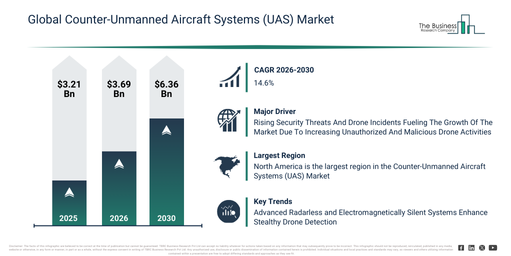
The market for counter-unmanned aircraft systems (uas) has seen rapid expansion in recent years. This market is set to increase from $3.21 billion in 2025 to $3.69 billion in 2026, achieving a compound annual growth rate (CAGR) of 14.9%. The historical growth of this market can be attributed to several factors, including the rising frequency of drone-related security breaches that spurred early adoption of counter-uas technologies, the expansion of radar and RF-based detection systems for monitoring restricted airspace, the increased use of kinetic interceptors to neutralize high-risk unmanned aircraft threats, the deployment of counter-uas solutions at airports and vital infrastructure sites, and the growth in system integration and maintenance services supporting multi-sensor counter-uas platforms.
The counter-unmanned aircraft systems (UAS) market is projected to expand significantly in the coming years, reaching $6.36 billion by 2030, exhibiting a compound annual growth rate (CAGR) of 14.6%. This anticipated growth is driven by several factors, including the increasing adoption of AI-driven threat analysis and automated drone classification tools, a heightened demand for hybrid counter-UAS systems that integrate both electronic and kinetic mitigation approaches, the broadened deployment in the commercial sector across venues like stadiums, energy facilities, and urban security networks, innovations in software-based detection and tracking solutions for intricate drone swarms, and greater government investment in scalable, portable, and quickly deployable counter-UAS units. Key trends expected during this period involve the expanding implementation of counter-UAS systems at airports and vital infrastructure, a growing preference for layered defense strategies that combine detection with interdiction, a surge in the need for portable, rapid-response counter-UAS units, the broadening of counter-UAS applications in commercial and civilian settings, and enhanced integration of kinetic and electronic neutralization techniques.
Free Sample Report: Counter-Unmanned Aircraft Systems (UAS) Market Size, Trends And Forecast To 2030:
Counter-Unmanned Aircraft Systems (UAS) Market Growth Catalyst: What Is Creating New Demand?
The increasing number of security threats and incidents involving drones is projected to stimulate the growth of the counter-unmanned aircraft systems (UAS) market moving forward. These security threats and incidents relate to unauthorized or malicious drone activities that present dangers to public safety, privacy, and essential infrastructure. The surge in such threats and incidents is attributed to drones’ growing accessibility and misuse, which leads to activities like unauthorized surveillance, smuggling, and potential attacks. Counter-UAS systems are instrumental in addressing these escalating security threats and drone incidents by detecting, tracking, and neutralizing unauthorized drones before they can cause damage or disruption. For example, in August 2024, The National Counter Terrorism Security Office, a UK-based government office, reported that in 2023, police recorded over 6,000 drone-related incidents, with only about 11% of these cases categorized as offenses. Hence, the rising security threats and incidents involving drones are propelling the expansion of the counter-unmanned aircraft systems (UAS) market.
Counter-Unmanned Aircraft Systems (UAS) Market Segment Overview: Categories Covered In The 2026 Report
The counter-unmanned aircraft systems (uas) market covered in this report is segmented –
1) By Technology: Laser Technology, Kinetic Systems, Electronic System
2) By Platform: Land-Based, Airborne, Naval-Based, Other Platforms
3) By Application: Detection, Interdiction
4) By End Use: Military And Defense, Commercial, Homeland Security
Subsegments:
1) By Laser Technology: High-Energy Laser (HEL) Systems, Laser Directed Energy Weapons (LDEW), Solid-State Lasers, Fiber Lasers, Chemical Lasers
2) By Kinetic Systems: Projectile-based Systems, Missile-based Systems, Drone-on-Drone Interceptors, Electromagnetic Railguns, Grenade Launchers or Explosive Devices
3) By Electronic System: Radio Frequency (RF) Jammers, GPS Spoofing Systems, Radar-based Detection And Jamming, Cyber or Software-based UAS Mitigation, Signal Intelligence (SIGINT) Systems
How Are Leading Companies Shaping Counter-Unmanned Aircraft Systems (UAS) Market Trends?
Major companies operating in the counter-unmanned aircraft systems (UAS) market are focusing on developing technologically advanced products, such as radarless and electromagnetically silent systems, to enhance drone detection and neutralization. These radarless and electromagnetically silent systems are detection technologies that operate without emitting radar signals, ensuring stealthy surveillance by avoiding electromagnetic emissions. For instance, in April 2025, ELT Group, an Italy-based electronics company, launched the Kinetic Anti-drone Mobile Asset (KARMA). This is a fast-deploy AI-based counter-unmanned aircraft system (UAS), available in mobile and fixed setups, that detects and identifies small drones (class 1 and 2) using AI to boost sensor accuracy and overall protection of military and critical infrastructure. This innovation features radarless and electromagnetically silent systems that enable the system to operate without emitting detectable signals, enhancing stealth detection, tracking, and minimizing signals to avoid enemy detection.
Counter-Unmanned Aircraft Systems (UAS) Market Players: Key Companies Shaping Competition
Major companies operating in the counter-unmanned aircraft systems (uas) market are Raytheon Technologies Corporation, The Boeing Company, Lockheed Martin Corporation, Airbus SE, Northrop Grumman Corporation, BAE Systems plc, Thales Group, L3Harris Technologies Inc. (formerly Harris Corporation), Rheinmetall AG, Elbit Systems Ltd., Diehl Stiftung & Co. KG, Saab AB, General Atomics, Moog Inc., Robin Radar Systems B.V., Dedrone Holdings Inc., Aaronia AG, Enterprise Control Systems Ltd., DroneShield Limited, Blighter Surveillance Systems Ltd., TRD Systems Pte Ltd.
Access Complete Counter-Unmanned Aircraft Systems (UAS) Market Data, Forecasts And Competitive Insights:
Counter-Unmanned Aircraft Systems (UAS) Market Regional Performance And Geographic Coverage
North America was the largest region in the counter-unmanned aircraft systems (UAS) market in 2025. Asia-Pacific is expected to be the fastest-growing region in the forecast period. The regions covered in the counter-unmanned aircraft systems (uas) market report are Asia-Pacific, South East Asia, Western Europe, Eastern Europe, North America, South America, Middle East, Africa.
Reach Out To Our Team:
The Business Research Company: https://www.thebusinessresearchcompany.com/
Americas: +1 310-496-7795
Asia: +44 7882 955267 & +91 8897263534
Europe: +44 7882 955267
Email us at: marketing@tbrc.info
Follow us on:
LinkedIn: https://in.linkedin.com/company/the-business-research-company
YouTube: https://www.youtube.com/channel/UC24_fI0rV8cR5DxlCpgmyFQ
Global Market Model: https://www.thebusinessresearchcompany.com/global-market-model

Wasay has over a decade of experience in market research, data modelling, and analytics, with prior experience at GlobalData and Decision Tree Consulting Services. At The Business Research Company , he leads research operations across syndicated studies, customized consulting engagements, and the Global Market Model platform. His professional experience includes supporting organizations such as Boston Consulting Group, KPMG, and Ernst & Young. Wasay holds a degree in Electronics and Communications Engineering, postgraduate management qualifications from International Management Institute Belgium and Indian School of Business and Entrepreneurship, and completed the Integrated Program in Business Analytics from Indian Institute of Management Indore.